
Why Procrastinators are More Likely to be Overachievers
Moderated Task Management


I had an interesting conversation with one of my classmates recently. We were having a Zoom study session and she revealed to me that she is a self-proclaimed procrastinator. I let her speak for a few moments, and describe her situation and why she waits to get everything done until the last minute. At this point I interjected with my own comments.
“Maybe you aren’t a procrastinator,” I informed her.
I have this theory that most of us struggle with time. It never feels like there is enough of it to go around. We all have hectic schedules that include the mundane tasks like tidying up our homes, errands, the time it takes to travel between different activities, and making sure we are properly nourished. We all have tasks that require levels of responsibility, such as school and homework; our jobs and careers; entrepreneurial interests and endeavors; friendships, relationships, and marriage; children; pets. To add to an already high volume of activity, we are increasingly being told that we need to squeeze in time for mental and physical health-related activities, self-care, exercise.
What this volume leads to is a lack of time. When we lack time, we have to prioritize what we do with our day. This means children, work, spouses, and pets will get the bulk of our attention, while we push off the other things that we have to do until the last possible moment. It’s not that you’re a procrastinator, because, in my opinion, that verbiage would imply that you are lazy.
I also think that there’s more to procrastination than meets the eye. For many of us, we are two-hundred-percenters. To me, that means that no matter what I am doing, I will put 200% of myself into that task. So, let’s break this down.
If a task requires an average person who is not particularly detail-oriented one hour to complete, us two-hundred-percenters are going to need double that time: two hours. Add that to an eight- to ten-hour-per-day work schedule, and you now have only twelve to fourteen hours left in your day. We’ll add in a wake-up schedule of one hour, along with a commuting time of thirty minutes to work, and thirty minutes from work, and now you’re down another two hours. But wait, there’s a chance you’ll need to stop on the way home to pick up groceries, dinner, medication prescriptions, etc. We can assume that will take another thirty minutes, on top of the thirty minutes that you need to eat once you step through the door, and that’s assuming you don’t have to prep dinner! Another hour gone! Now it’s looking like you have only nine to eleven hours left in your day, but you know you need to get some sleep. You might be preparing your children for school tomorrow, making sure their assignments are complete, getting them ready for bed. You might be tidying up your living space. You might be taking a moment to watch some Netflix and let your brain decompress a little. You might find some time in there to sneak in a workout.
Regardless, you are strapped for time, and a task that takes an average person only one hour to complete has now sucked one extra hour away from your life.
If you like to give everything you do your absolute best, it can be incredibly frustrating and feel incredibly unrewarding to give so much of your time and effort. You might be spending your whole life playing catch-up because there’s never enough time.
One of the easiest ways to opt-out of putting an extra hour into a task is putting it off until right before the deadline. If you have a homework assignment due at 11:59pm on a Tuesday, you might force yourself to wait to start working on it until 10:59 on that same Tuesday. This is a defense mechanism, and it's your brain protecting you from a complete burn-out. There is only so much of you to go around on any given day, and your subconscious knows that you are willing to extract more time out of your day than you can handle, and therefore prioritizes other things so that you don’t have to over-extend yourself. Or you might put in your 200% effort on eight tasks in one week, and leave another five tasks to accomplish in the last moments that you can possibly push them off to.
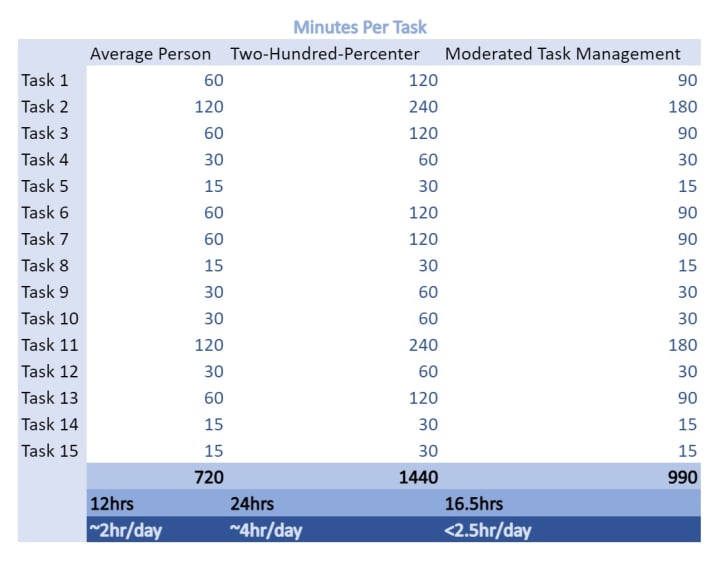
There are things we can do to absolve ourselves from this pressure and scrutiny we put ourselves under. One of the ways we can prevent a total burn-out or pushing off our tasks until the last possible moment is working towards a method I would like to call Moderated Task Management. Let’s say we have 15 tasks that we absolutely have to get done in a seven-day period. On a particular week let’s say we have 5 tasks that should take 60 minutes each, 2 tasks that should take 120 minutes each, 4 tasks that should take 30 minutes each, and another 4 tasks that should take 15 minutes each, for a total of 15 tasks that must be completed. If we total that up, all tasks can be completed in the seven-day period, using just under two hours per day on average to complete each task.
But wait, we’re two-hundred-percenters. So now we can assume that we are doubling our efforts, and, instead, using just under four hours per day to complete our tasks. This is completely unsustainable, especially for those with full-time jobs and children. One way we can break these tasks down is to keep our 15- and 30-minute tasks at those exact levels. We don’t need to rush, but we also shouldn’t be taking our time with these tasks. These are the tasks that we need to push through and not fight ourselves on, because if they are done, that’s all that matters. We’re not going to get extra credit points for taking so long to finish these smaller tasks, that we push off our most important tasks, which usually take the longest. This is an effective way to moderate our task management.
The next thing we can do is to set a limit for ourselves on the bigger tasks. Instead of turning a one-hour project into a two-hour project, we can increase the amount of time we give ourselves by simply using the 1.5 rule. If a task will take over 60 minutes to complete, multiply that by 1.5, and set a timer in which we have to finish and wrap up that project by the time the timer buzzes. With that logic, we’re still putting 150% of ourselves into a project, which is much more than bare minimum, and can still leave us feeling accomplished, and still have the ability to leave an impression on the right people with the quality of our work and efforts.
When setting timers, it is incredibly important to reduce distractions. Setting our electronics into Do Not Disturb mode can keep us focused on the task at hand, so we’re not wasting valuable time by switching back and forth and multi-tasking. This keeps our brains engaged on what we’re doing, keeps us motivated to finish it so that we can move onto the next thing, and allows us extra time in our day to do the things that keep us well and sane.
Try this with your tasks from now on, and you’ll notice how much less likely you are to procrastinate by moderating the time you spend on your tasks.
About the Creator
Millennial Musings
Diary of a Millennial
Keep reading
More stories from writers in Motivation and other communities.
Riding the Energy Transition: New Growth Frontiers in a Rapidly Evolving Market
The global energy market is moving through a decisive period of transformation. Traditional models no longer dominate the landscape, and new forces now shape how energy gets produced, distributed, and consumed. As a result, operators and investors face both disruption and promise. However, this shift does not signal decline. Instead, it opens fresh growth frontiers that reward adaptability and forward thinking. While uncertainty remains, momentum clearly favors those who respond quickly and strategically.
By Matthew J Smith4 days ago in Motivation
🅼🅸🅳🅽🅸🅶🅷🆃 🆂🅽🅰🅲🅺🆂
"It's 10 in Tuscon! We all know what that means... It's Time for Midnight Snacks with your man, Gerald Gee! Ready to spend the night together? Me too! I'm full of snacks and can't wait to regurgitate them all back into your hungry ears. Crack a brew! Pop some corn! Anything to get ready for one hell of a show where the talk maybe cheap but the words cut deep...
By Lamar Wiggins4 days ago in Fiction




Comments
There are no comments for this story
Be the first to respond and start the conversation.