
Why is the U.S. Stars and Stripes "no longer a symbol of unity" despite its ubiquity? The Paradoxical Meaning of the Flag
US Stars and Stripes contradictory flag meaning

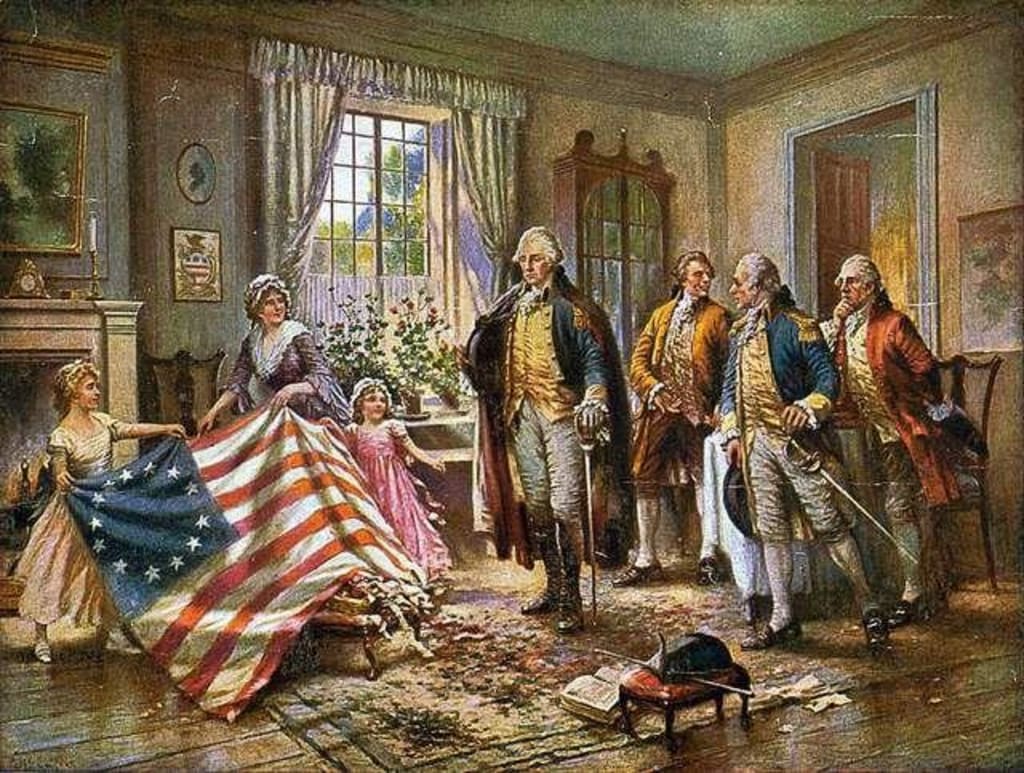
The American flag has undergone 26 transformations since the first American flag appeared on the colonial warship Alfred in 1775. The current 50-star American flag, which was adopted by President Eisenhower in 1960, has been in use longer than any other previous version. At first, it was a symbol of American independence from Great Britain, but now it has become a universal symbol of American influence around the world.
Within the United States, the flag is almost everywhere: on cars, on t-shirts, on top of flagpoles outside stores. And then from classrooms to stadiums to the political arena, the Stars and Stripes remain at the heart of the American public. How on earth did Americans become so obsessed with their flag, so obsessed with their flag? The actual answer is much more than the unconditional loyalty and love expressed in the American national anthem, "The Star-Spangled Banner Never Falls.
Without a long history, Americans have relied on modern symbols and objects to create a strong national identity
National identity is a social construct used to support myths and beliefs about groups of people who live within arbitrarily drawn borders. While humans have historically come together with a common language, religious beliefs, or family, the modern concept of nationhood has completely changed the way people interact with each other today. This is true for the United States as well as for other established nations around the world.
Because the United States is a relatively new nation, bringing everyone together under the red, white, and blue flag is the key to perpetuating America's legacy as the land of freedom and exceptionalism. From the beginning, America's nation builders have focused on creating elaborate mythology that places "the people" above government or church. But this process of creation ignored the plight of the original inhabitants of the land: the displacement and subjugation of indigenous peoples.
So many Americans express their national pride by displaying the flag. And when people do not stand during the national anthem or damage the flag, they are often harshly criticized by others, even though it is a free choice that is already protected by the U.S. Constitution. Because America's identity is so closely tied to the flag itself, leaders know that America's success is built on a symbol of resilience.
During the Civil War, the importance of this flag reached a new level
All the emotions and rituals associated with the Glory of Yesteryear make it seem like a timeless, ubiquitous aspect of the American landscape. However, this does not apply to all of the histories of the American flag. It was not until 1861, during the Civil War, that the American flag became so important.
Before 1861, the flag's basic purpose was to mark government and military buildings, and on April 12, 1861, after Confederate forces captured Fort Sumter near the Charleston coast, retreating Confederate troops, brought the American flag with them to the outpost. Almost overnight, the flag flew in every part of the North as a symbol of unity and support for President Lincoln's national unification efforts. By the time the Confederacy also developed its flag, the American flag was towering over the battlefield, challenging the trend toward secession.
After the war ended, the flag remained a key component of the war-weary nation's reconciliation efforts.
It is said to represent the values of national unity
Beginning in the late 19th century, the American flag was promoted as an enduring beacon of hope that united the people. Since it was impossible to place such a diverse nation under the umbrella of language or race, leaders needed to rely on a core set of values that would demonstrate what it means to be American. These values include courage, honor, justice, and freedom. Even as the population continues to change and the melting pot expands, America remains a shining nation on a hill where anyone can achieve their dreams.
And it takes a great deal of what Stanford professor Francis Fukuyama calls "historical amnesia" to maintain such a myth. The United States does not recognize a history of slavery, racism, or sexism; after all, these histories can be a disincentive to civic unity, and America's national identity depends on the preservation of principles such as dignity and democracy.
"Flags have no inherent meaning," flag expert Ted Kaye told The Deseret News. "They're just a piece of cloth. It only has the meaning that we give them." While some citizens see the American flag as a testament to their country's past success, others see it as a symbol of what the future might hold if or when America truly becomes the land of the free and the home of the brave.
Americans' fervor for the flag has been very successful in business
"It would be hard to find a place in America without a flag." Adam Smith, a British history professor, explains in "What You Don't Know. The Flag Manufacturers Association of America (FMA) estimates that Americans buy 150 million flags of all shapes and sizes each year, a sizable number made possible by the development of printing technology and textile manufacturing.
The commercialization of the American flag in the late 19th century cemented its status as a universally popular icon among Americans around the world, among decorative items. Groups opposed to the mass production of merchandise bearing the flag's design, on the other hand, attempted to curb this trend by adopting the American Flag Code, although most of the rules outlined in the code were later deemed unconstitutional because the First Amendment granted the right to free expression. In addition to the flag itself, Americans purchase a variety of patriotic items. Clothing bearing the American flag, for example, is worn and displayed all year long, not just on holidays such as Independence Day, Memorial Day, or Flag Day. From bathing suits to sunglasses, from shoes to shorts, American flag fashion has become a multi-million dollar industry.
In the post-war 1950s, wearing the American flag became popular. It was eventually adopted by fashion designers such as Ralph Lauren and clothing stores such as Old Navy. after the devastating terrorist attacks on the United States on 9-11, the flag was given a new meaning. In recent years, however, the flag's commercial appeal has also begun to suffer from the political divide in the United States.
It is well known that those on the political right embrace the flag with nationalistic fervor, while those on the political left argue that the flag should not symbolize the mentality of a nation plagued by institutional racism and inequality. Even Old Navy, a popular brand known for its patriotic style, has opted for a more inclusive hue with the launch of a purple shirt on July 4, 2019. The company said on its social media platforms, "Purple is the product of red, white, and blue combined."
The American flag became a means for politicians, to prove that they work for the good of the country
Political campaigning is an expensive and complex adventure that is vital to the American democratic process. Candidates and elected officials, alike, wave the American flag to align themselves with the values associated with the population. Since the 19th century, these red, white, and blue flags have demonstrated to potential voters their love for the country.
Long before presidents, senators, and representatives wore American flag pins, a presidential candidate, draped himself in the flag to show his patriotism. in 1896, Civil War veteran William McKinley draped himself in the Stars and Stripes to defeat his opponent, Democrat William Jennings Bryan. Mark Hanna, McKinley's campaign manager, handed out hundreds of thousands of flags at the rally. Hanna even put two 9-meter-high collapsible flag poles on the train McKinley was riding on to add to the atmosphere.
The show of patriotism worked, and McKinley defeated Bryan. Soon, since that election, every presidential candidate has used the American flag in their campaigns. With the election of Donald Trump as president in 2016, these tactics reached critical mass as his supporters took their love of the flag, to a whole new level. The flag quickly became a partisan symbol that writer Bruce Watson rejected because "the flag belongs to all Americans. In an interview with The New Yorker, he added, "The story of the flag should be the story of a nation finding itself."
In the United States, the worship of the flag begins at an early age, as school children salute the flag every morning when the Pledge of Allegiance is called. "I don't know of any other country where students salute the flag every day." Adam Smith shared in the journal Principles of Work.
The practice of the pledge of allegiance was first introduced in 1892 when large numbers of European immigrants were arriving on American shores from all over Europe. To integrate the children of these immigrants into American society, several organizations began distributing the flag in schools. This led to a practice that continues to this day, which some historians and legal experts, interpret as a dangerous form of worship. in 1940, after Jehovah's Witnesses, were expelled from school for refusing to stand for the Pledge of Allegiance, the rule of the Pledge of Allegiance soon made its way to the Supreme Court. In an 8-1 decision, the court decided that schools had the power to "promote national unity.
Three years later, however, the Court reversed course in a similar case, giving students the right to refuse to take the pledge. Justice Robert Jackson, the creator of this groundbreaking decision, wrote
If patriotism will not flourish, if patriotic rituals are voluntary and spontaneous rather than mandatory routines, then this would be an unpromising estimate of the appeal of our system and free thought.
Even though the school day begins with the Pledge of Allegiance and the flag is hung in every classroom, students are still free to choose to either sit in their seats or simply lie down on the floor.
The flag and the national anthem, are still closely associated with sports
When professional soccer player Colin Kaepernick refused to stand during the national anthem at a game in 2016, his act of civil disobedience sparked both outrages and earned him support. "I'm not going to stand up and be proud of the flag of a country that oppresses black people and people of color," Kaepernick said at the time. Ultimately, Kaepernick's choice sparked major changes in professional and local sports, a sport that continues to reach new heights after the death of Minneapolis resident George Floyd at the hands of a white police officer in 2020.
The deep connection between American sports and the American flag dates back to World War I when the Chicago White Sox decided to put the American flag, on their jerseys. This trend began to spread and grow in the 20th century, and after 9/11, the American flag was on full display at almost every major sporting event. Even every team in Major League Baseball has the flag embroidered on their hats. America's favorite entertainment event has also become a stage for players to support the troops overseas and, of course, pay homage to the flag as a symbol of unity and strength.
This flag-covered spectacle eventually extended far beyond the baseball world to soccer and basketball. Even many football teams, both college and professional, had the American flag emblazoned on their helmets. And college basketball teams like Duke University have the flag on their jerseys. The most notable use of the flag at these games, however, comes during pregame festivities, when giant flags are spread out on the stadium floor. in 2017, 50 Star Productions, a Salt Lake City-based company, booked giant flags for about 120 events, each of which ended up bringing in $4,000 to $7,500 in revenue.
Throughout the 20th and 21st centuries, it was intertwined with a growing militaristic identity that
America's Founding Fathers, weary after years of fending off British soldiers, began to oppose the creation of a large standing army. Instead, they believed that the army should be formed only in emergencies and disbanded when the mission was complete. Thus until 1939, the U.S. military was dwarfed by the armies of other world powers. But that all changed with the start of World War II and the Cold War. Almost overnight, the United States developed the most powerful military in the world, ready to intervene in diplomacy and fight off imminent external threats. Ultimately, Americans' love of the flag coincided with a change in their view of the military.
To justify costly and protracted wars, the administration advanced an argument that has stuck to this day: American intervention was only about protecting freedom and preserving democracy abroad. in 1898, President Teddy Roosevelt laid the groundwork for this argument by convincing Congress to go to war against Spain. While Roosevelt eloquently articulated American ideals, historians have since interpreted his choice, as an empire-building strategy, to give the United States Puerto Rico, Guam, Cuba, and the Philippines.
Fast-forward to 2003, when U.S. forces under President George W. Bush invaded Iraq to destroy the country's so-called weapons of mass destruction and overthrow dictator Saddam Hussein. Although information later emerged that contradicted the Bush administration's WMD claims, there was little opposition to the war due to the upsurge in nationalist sentiment sparked by the September 11 attacks.
Political leaders like Presidents Roosevelt and Bush have transformed the United States into a nation with a strong cult of the military. And intertwined with this militarism is the American flag, which has become a recognizable symbol held high by these leaders to shake up a public that is still very sensitive to the symbolism of the American flag.
Because it is a standard, its meaning can be molded so that it can mean whatever anyone wants it to mean.
In essence, the American flag is a symbol that lacks intrinsic meaning. Its importance ebbs and flows depending on national sentiment and who holds the highest office. While some people wave the flag out of genuine appreciation for their country and its citizens, others use it for their agendas. In an interview with The New Yorker, one white nationalist said, "If an American flag can bring more people close enough to hear our message, it is our responsibility to use that tool."
The myriad meanings Americans give to the flag reflect the country's growing cultural and ethnic diversity. While white Americans tend to see the flag more as a symbol of unity, people of color tend to see the flag as, well, a symbol of subtle but potentially wishful thinking about possible changes in America's future. Whether next to the "Make America Great Again" sign or the "Black Lives Matter" flag, the American flag remains a very contradictory symbol of both division and unity. Ultimately, it is up to each individual to decide what the American flag means to them.
About the Creator
Keep reading
More stories from Mark Rovich and writers in Motivation and other communities.
Environmental degradation! Sudden climate change! Human hunting and killing! How many more animals will become extinct in 2020?
According to a new report by the International Union for Conservation of Nature (IUCN), more than a quarter of the species now on the Red List of Threatened Species are "threatened with extinction" (about 35,765 out of 128,918 species), according to the December 31, 2020 issue of The Metro newspaper.
By Mark Rovich3 years ago in Earth
From Invisible to Influential: The Quiet Habits That Turn Ordinary People into Powerful Leaders
Most people think leaders are born in the spotlight. They imagine powerful speeches, large crowds, and confident voices that command attention. But real leadership almost always begins somewhere far quieter — in moments where no one is watching and no applause is waiting. The journey from invisible to influential rarely starts with a promotion, a viral post, or a title. It starts with self-leadership. Before a person can guide others, they must first learn how to guide themselves. This means showing up on time when no one is tracking their attendance. It means finishing work to a high standard even when no one will check it. It means choosing long-term respect over short-term popularity. These choices don’t look impressive in the moment, but over time, they shape a reputation that speaks louder than words. One of the most powerful habits of emerging leaders is listening. While many people are focused on being heard, strong leaders focus on understanding. They ask thoughtful questions. They notice what isn’t being said. They pay attention to how people feel, not just what they say. This ability to truly listen builds trust, and trust is the foundation of influence. Another quiet habit is consistency. Motivation comes and goes, but consistency builds momentum. Influential people are often not the most talented in the room — they are the most reliable. When others know they can count on you, your presence starts to carry weight. Over time, people begin to look to you for guidance, even without you asking for that role. Leaders also develop a unique relationship with failure. Instead of seeing mistakes as proof of weakness, they treat them as feedback. Every setback becomes a lesson, every loss becomes a strategy session. This mindset doesn’t just improve performance — it builds emotional strength. And emotional strength is what allows a person to stay calm when others panic. In the workplace, this shows up in subtle ways. The person who takes responsibility when a project fails. The one who gives credit when a team succeeds. The one who remains respectful during conflict instead of turning defensive. These moments don’t go unnoticed. Over time, they shape how others perceive character — and character is what makes people willing to follow. Outside of work, the same principles apply. In families, friendships, and communities, influence grows through reliability and empathy. The person who checks in when things get hard. The one who offers support without expecting anything in return. The one who stands firm in their values, even when it’s uncomfortable. Social media has changed how leadership looks on the surface. Today, influence is often measured in followers, likes, and views. But digital attention doesn’t always equal real-world respect. True influence isn’t about how many people watch you — it’s about how many people trust you. This is why some of the most powerful leaders in history were not the loudest. They were the most consistent. They didn’t rush to the front of the room. They earned their place there over time. The transformation from invisible to influential doesn’t happen overnight. It happens through thousands of small decisions that shape how you treat yourself and others. It happens when you choose integrity over convenience. When you choose growth over comfort. When you choose responsibility over excuses. And one day, often without realizing when it started, people begin to listen when you speak. They seek your opinion. They follow your example. Not because you demanded attention — but because you earned respect.
By Hazrat Usman Usmanabout 24 hours ago in Motivation



Comments
There are no comments for this story
Be the first to respond and start the conversation.