
Whispers Beneath the Floorboards
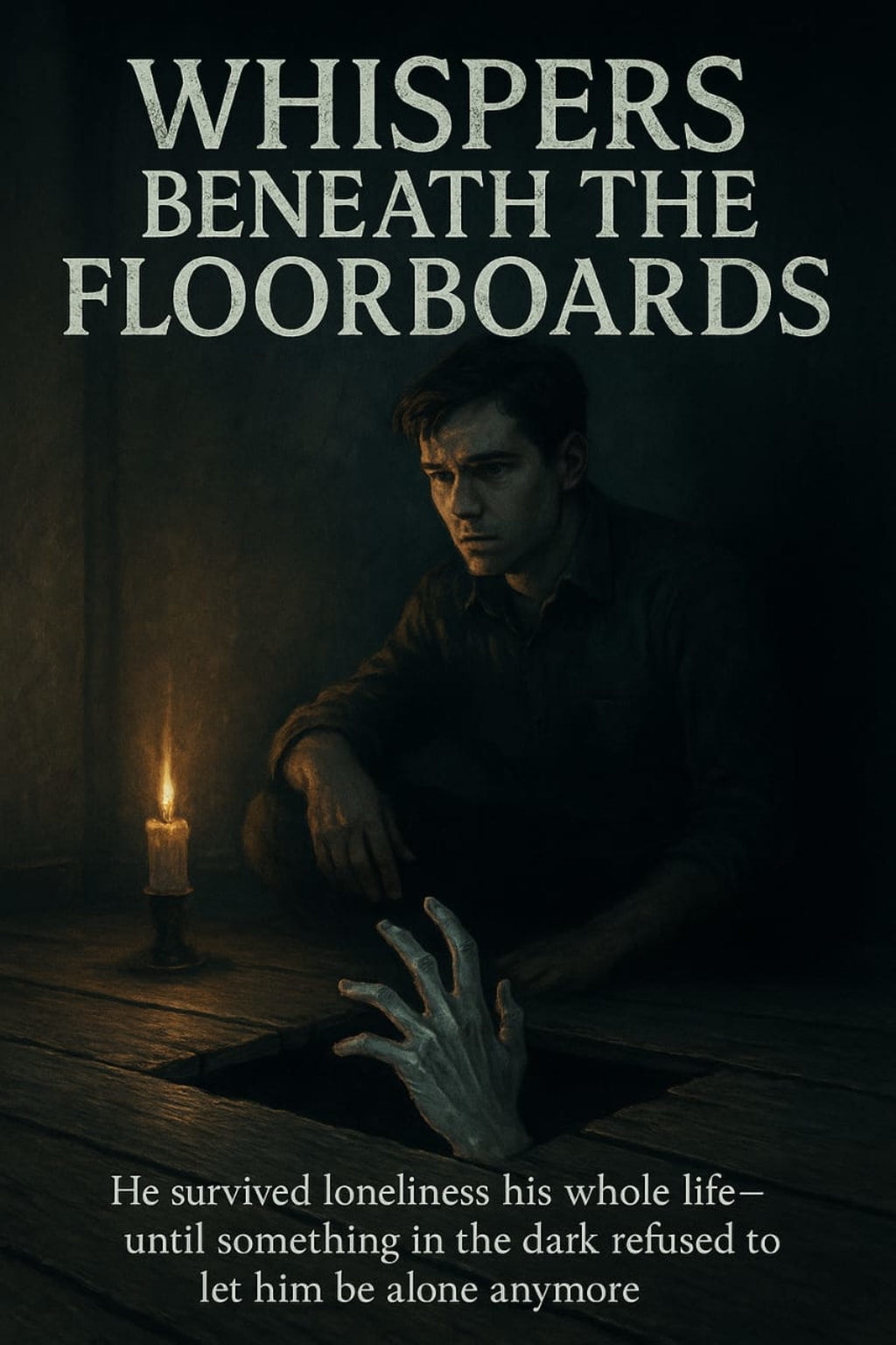
He survived loneliness his whole life—until something in the dark refused to let him be alone anymore.
From the moment he could remember, Ethan Carter knew what silence felt like—not the peaceful kind, but the heavy, suffocating kind that fills a house with absence. He was only six when his parents died in a fire that gutted their home in the middle of the night. There had been no time for goodbyes, no time to hold on. Just smoke, screams, and the sudden silence that followed. After that, life didn’t pause for him. It simply pushed him forward, cold and unfeeling.
Foster homes came and went like changing seasons. Each one was temporary, each one more distant than the last. He learned early not to rely on anyone, not to expect warmth or permanence. People left. Homes vanished. Promises broke. So Ethan became self-sufficient, guarded. Quiet.
By the time he turned twenty-five, Ethan had managed to build a life from the ashes. He had a steady job as a night security guard in a warehouse on the edge of a quiet New England town. He rented a modest third-floor apartment in a century-old building, and he kept to himself. People at work called him “the ghost”—not because he was strange, but because he moved silently, spoke rarely, and never joined in the small talk. That was just how he liked it. Solitude was safer than attachment.
Or so he thought.
It began one night in October.
A sudden power outage took out the streetlights and darkened the entire block. The air outside was crisp with the kind of early autumn chill that hinted at the harsh winter ahead. Inside, Ethan lit a few candles, wrapped himself in a blanket, and settled down with an old mystery novel. The silence wrapped around him like a second skin.
Then he heard it.
Tap. Tap. Tap.
Faint. Deliberate. Coming from underneath the floorboards.
He froze. His eyes scanned the room. He waited. Nothing more. Probably the pipes, he told himself. Old buildings make noise, especially when the temperature drops. He shook it off and went back to reading.
But the tapping returned the next night. And the one after that. Always after midnight. Always three taps.
Ethan tried to ignore it. He turned up the television, kept a fan running to create white noise, even left a podcast playing. Nothing helped. The taps found their way through the sound. Soft. Patient. Persistent.
And then came the whispers.
Faint, barely audible. Not in any language he could understand, yet somehow heavy with meaning. They brushed the edge of his consciousness, like wind brushing across a windowpane. He began waking up drenched in sweat, heart racing. Sleep became a stranger. His world narrowed to a constant state of alertness, dread curling in his chest.
On the fifth night, he snapped.
Driven by a mixture of fear and desperation, Ethan tore up the floorboards in the center of his living room. Beneath them, he found nothing but dust and a slab of cracked concrete. He stood there, chest heaving, staring into the emptiness.
And then it came.
A whisper, clearer than before, cutting through the silence like a blade:
“You left me here.”
He staggered back, the words echoing in his bones. The air in the room turned frigid. The candlelight flickered, casting dancing shadows on the walls.
From that moment on, things worsened.
At work, he began seeing strange shapes on the security monitors—quick flashes of a figure in the corners, too fast to catch, always just beyond the reach of the cameras. At home, objects shifted positions. Doors creaked open by themselves. The bathroom mirror would fog up, even when the shower hadn’t run, and messages would appear in unfamiliar handwriting.
And one name kept appearing.
Elijah.
Written in the condensation on the mirror. Whispered in the dark corners of his room. Sometimes, Ethan would wake to find it scrawled on scraps of paper that hadn’t been there before.
He needed answers.
Digging into town records and property archives, Ethan discovered that his building had once been a Catholic orphanage, closed in the 1920s. One name surfaced again and again—Elijah Turner, a ten-year-old boy who had been confined to the basement after a violent outburst toward another child. He died there. Forgotten. Sealed behind a wall, his body never recovered.
The more Ethan learned, the clearer the connection became. Elijah wasn’t just haunting the building—he was reaching out to him. Ethan didn’t know why. Maybe the boy saw a kindred spirit in him. Maybe his own loneliness had drawn the ghost out. Or maybe, in some inexplicable way, they had always been connected.
On the tenth night, Ethan made a decision.
He returned to the spot where he’d first heard the tapping. The room was dim, candlelit, the air unnaturally cold. He knelt, placed his palm on the wooden floor, and whispered:
“I’m here. I won’t leave you again.”
There was a long pause. Then, with a sharp crack, the floor splintered beneath him.
A small, pale hand reached up through the boards.
And for the first time in almost twenty years, Ethan didn’t feel alone.
About the Creator
Keep reading
More stories from M Ali and writers in Motivation and other communities.




Comments
There are no comments for this story
Be the first to respond and start the conversation.