
We Can Still Benefit from the Stoic Philosophy in the 21st Century
A practical take on the Stoic philosophy to live a more happy life every day


British philosopher and writer Alan Watts once wrote the story of the Chinese farmer.
Once upon a time, there was a Chinese farmer whose horse ran away. That evening, all of his neighbors came around to commiserate. They said, "We are so sorry to hear your horse has run away. This is most unfortunate." The farmer said, "Maybe." The next day the horse came back bringing seven wild horses with it, and in the evening everybody came back and said, "Oh, isn't that lucky. What a great turn of events. You now have eight horses!" The farmer again said, "Maybe."
The story continues with more unfortunate and fortunate events happening. However, the reaction of the farmer remains the same. Maybe. It's only possible to tell whether an event has an unfortunate or fortunate outcome in hindsight. But you can never be sure when the right moment is to decide.
Core values cemented in the Stoic
A Stoic is a firm believer in controlling thoughts and emotions. This resembles the way dictionaries describe the word Stoic: "a person who can endure pain or hardship without showing their feelings or complaining." However, there's a slightly negative vibe that comes with this description which is completely wrong in my opinion.
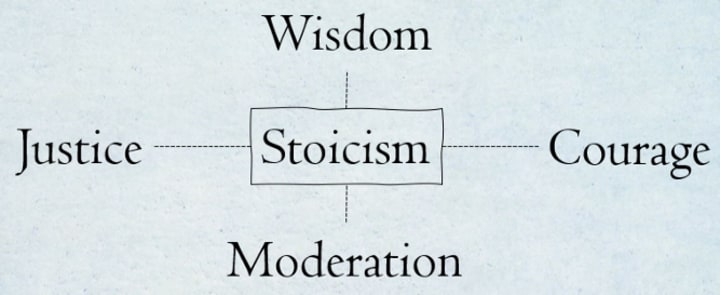
In the heart of Stoicism lies the idea 'control what you can control'. If something is outside your (direct) sphere of influence, don't bother. Some things aren't up to you to change. There's no need to spend time and effort on situations if you can't control the situation. Stoics focus on four main virtues:
Wisdom. Knowing ethical right from wrong. Knowing what to control and what not to control. Knowing what makes you happy. Knowing how to value possession, friend, and family.
Courage. This virtue's pretty similar to the well-known word. It's the act to stand firm in any kind of situation. To act according to your own principles and face problems rather than hide from them.
Moderation. The skill to be self-disciplined. This will enable you to be the moderator of your own life.
Justice. The skill of having a good soul and carry this out to others and nature. Semantically this is slightly different than the word is used in modern language. For Stoics, being just means to master kindness and fairness.
Remember the Chinese farmer from earlier? He isn't caught up in emotions. The external event (which he couldn't control) did not affect the way he lived his life in any way.
Meet the Stoics
Over two centuries ago the philosophical movement of Stoicism was born. The philosophy highly pertains to knowing and improving yourself. It's focused on personal ethics and the way one can live his life. A life guided by logic and nature. Unlike other ideologies, there is no desire to spread Stoicism around the globe. It's something you practice for you and you alone, similar to Buddhism.
We know a lot about the way the Stoics lived their life and what they saw as their purpose. However, there isn't a lot of literature available about this philosophical movement. Mostly due to the fact that Stoicism is something you do rather than read.
However, a few very important writings are still available. These books form the basis of (modern) Stoicism. The writers are seen as the most influential contributors to the Stoic ideology:
The Enchiridion (the handbook) and Discourses by Epictetus
Epictetus was born as a slave in ancient Greece. He believed every individual is responsible and accountable for his/her own actions. Moreover, he strongly believed that every man or woman was responsible for his/her own happiness. That's quite interesting, coming from the mouth of a slave in ancient Greece.
Meditations by Marcus Aurelius
A journal that's written by the Roman Emperor. He wrote the journal without the intent to share it with others. This makes the writing rather personal and also very easy to apply to everyday life. He reflects on everyday life but also on reigning one of the greatest empires that ever existed.
Letters (from a stoic) by Seneca
Seneca wrote letters to his brother shortly before passing away.
Recipient: his brother Lucilius.
Subject: his Stoic take on slavery, coping with failure, preparing for death, and everything else life had to offer.
Forrest Gump would've been a great Stoic. Life is indeed like a box of chocolate and you'll never know what you're gonna get. It's not even important what you're getting, but the way you perceive what you're getting.
4 Practical uses of Stoicism to apply today
Many Stoic ideas can be applied to modern-day life. There's no clear recipe on how to live a Stoic life. How to implement Stoic beliefs is all up to this one person called 'me'. The following practices can kickstart your Stoic lifestyle.
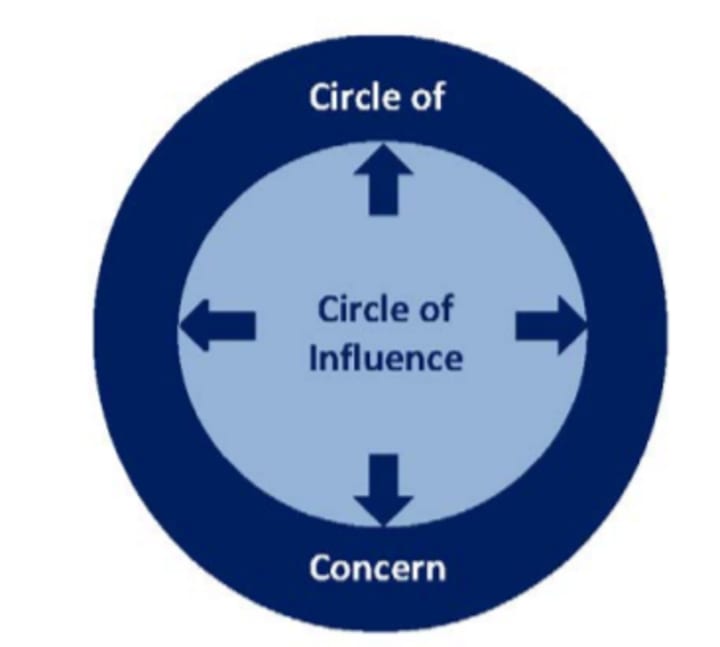
As said before, in the heart of Stoic belief is the idea to focus on the things you can control. Don't bother spending time and energy on things outside of your direct control.
Similar to this idea is the popular Circle of Influence by Stephen Covey. Take a big piece of paper, draw a circle and start writing down everything that lies within your personal circle of influence.
A very practical way to do reflect on your own behavior and thoughts is journaling. Just like Marcus Aurelius did to capture his thoughts and actions.
Think about a specific situation. Had an argument at home? Had a bad day at work because your boss was being bossy again? Any situation will do.
Write down what happened, what you thought, and what your actions were as a reaction to the situation.
Journaling doesn't have to take up much time of your day. It can be as quick and easy as writing down something you're grateful for, every day.
As discussed before, Stoic beliefs revolve around our virtues. These words are generally known in the 21st century. However, if we would both give a description of a courageous man, our definitions will differ quite a lot.
Think about what these virtues actually mean to you. How would you like to carry them out in your day-to-day life? Are you living up to your own virtues?
Life happens. Both bad and good stuff can happen every day in your life. There's no way you can foresee something bad happening (nor something good). Therefore, it's not important what happens or when it happens, but the way you perceive the event. You are responsible for your own actions and reactions.
In times of fortune but also in times of misfortune; think about all the other possible outcomes of the same situation. None of the other possible outcomes should have changed who you are and how you feel.
Marcus Aurelius had quite an interesting metaphor to explain this matter. He believed any person (regular man, soldier, emperor, etc.) was like a rock. "Throw the rock up in the air. it loses nothing by coming down and gained nothing by going up."
The rock stays the same.
All together now!
As soon as you start to read and practice Stoicism, you'll notice that many Stoic aspects are connected. One virtue could not exist without the others. An example:
Your boss is being bossy again but this time you believe he's also treating you unfairly (virtue: justice). The same evening, you sit down to write down what happened (journaling) and how you handled the situation (perceiving the event). Eventually, you write down what lies within your power to do the next time such an event occurs (circle of influence).
Key takeaway
Practicing Stoicism can help to live a more happy and mindful life. By reflecting on your behavior, take action because you decided to, know what to control, and take life as it comes.
The Philosophy is focused on getting to know yourself and improving based on the learnings. Simple daily activities will help you master Stoicism:
- Know what lies within your sphere of influence
- Reflect on behavior and thoughts
- Live up to your own virtues
- Don't be emotionally affected by external events
The Stoic philosophy is over 2000 years old. However, it might be even more applicable to modern-day life than it was back then.
You have power over your mind - not outside events. Realize this, and you will find strength.―Marcus Aurelius
About the Creator
NelisT
Slave to the rhytm by day, Stoic by night!
Keep reading
More stories from NelisT and writers in Motivation and other communities.
How I earn $100 in a day
There was a time when earning $100 in a single day felt like a fantasy to me. Not a goal — a fantasy. I remember staring at my phone late at night, doing small mental calculations: If I earn $5 today and $10 tomorrow, maybe by the end of the month… Even those numbers weren’t guaranteed. Some days, nothing came in at all. And that silence — the absence of notifications, emails, or messages — was louder than failure. People online love to talk about success like it’s loud and shiny. For me, it was quiet. Heavy. Full of doubt. The day I earned $100 didn’t begin with excitement. It began like every other day: tired eyes, a slow morning, and a question I kept asking myself — Is this even worth it? What kept me going wasn’t motivation. It was necessity. I didn’t suddenly become smarter or more talented. I didn’t discover a secret website or a hidden trick. I simply stopped waiting for the “perfect” moment and started using what I already had. I offered small digital work. Simple things. Work that wouldn’t impress anyone on social media — but work that people genuinely needed. And I did it sincerely. That day, the first payment came in early. It wasn’t big. Just enough to remind me that someone trusted me with their money. That feeling mattered more than the amount. Later, while I was offline, something unexpected happened. A digital product I had created earlier — something I almost didn’t upload because I thought it wasn’t good enough — sold. Then it sold again. I stared at the screen for a few seconds, unsure whether to smile or stay calm. By evening, another small task came my way. Then one more. None of these moments felt dramatic. No fireworks. No victory music. Just quiet confirmations that effort, even imperfect effort, still counts. When I finally added everything together late at night, my heart paused. It crossed $100. I didn’t jump. I didn’t celebrate. I just sat there — still — because for the first time, the number felt real. What hit me hardest wasn’t the money. It was the realization that I had been underestimating myself for a long time. I believed earning like this was reserved for “others” — more confident people, more skilled people, luckier people. That belief was wrong. Earning $100 in a day didn’t change my life instantly. But it changed something inside me. It replaced doubt with proof. And proof is powerful. Now I understand something important: money doesn’t always come from doing big things. Sometimes it comes from doing small things consistently and with sincerity. Some days I still don’t reach $100. Some days are quiet again. But the fear is gone. Because once you know something is possible, it stops being a dream and starts being a process. I no longer wait for motivation. I work, even when I feel unsure. I trust that effort never disappears — it just takes time to show itself. If you’re reading this while feeling stuck, tired, or invisible, I want you to know something honestly: You’re not behind. You’re just early in your story. And one ordinary day — without warning — things can start to add up.
By Shah Fayaz 6 days ago in Motivation


Comments
There are no comments for this story
Be the first to respond and start the conversation.