

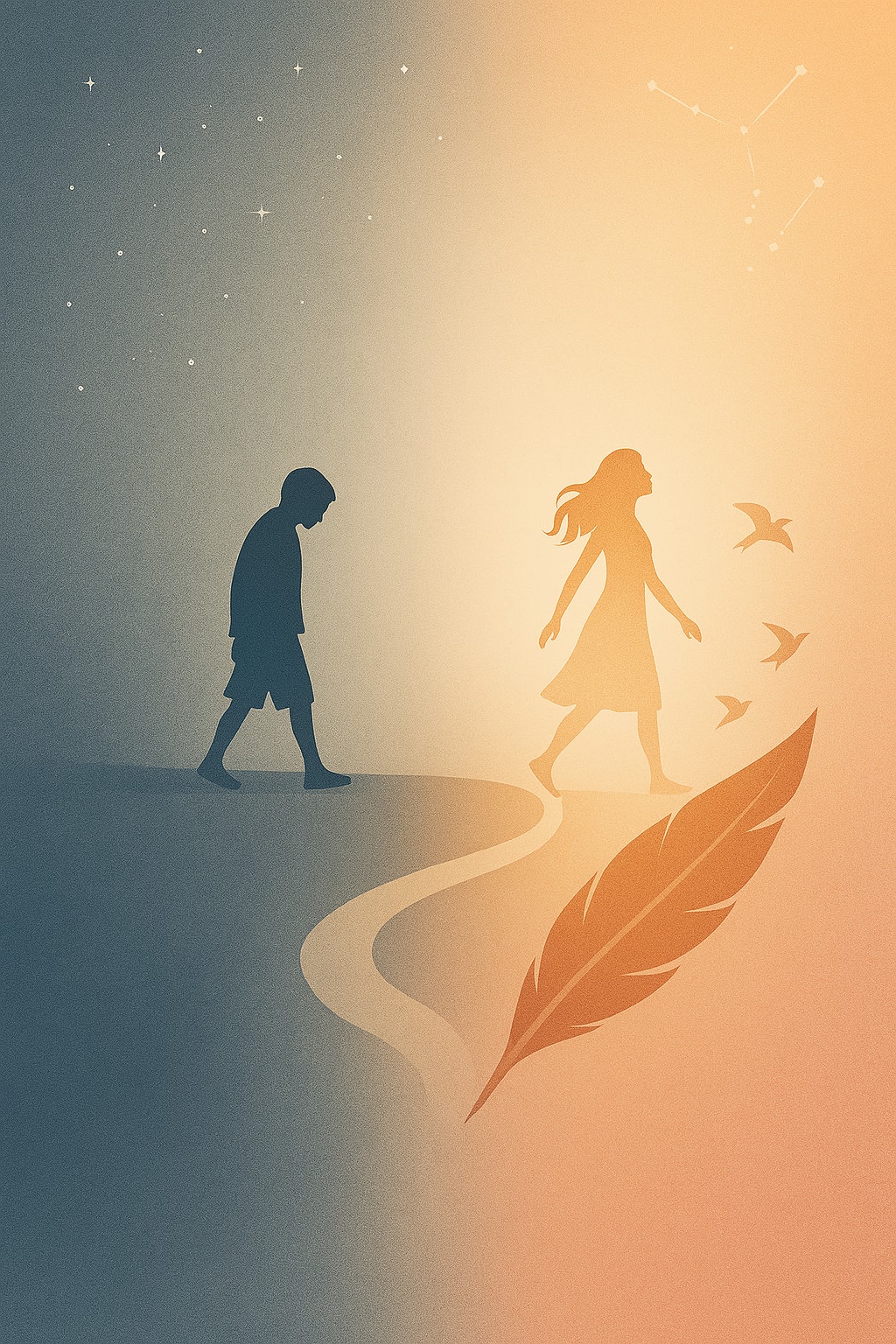
Elina had always lived in the in-between—between the lines of conversations, behind the shelves of forgotten books, beneath the noise of the world.
She worked at a small secondhand bookstore on the edge of the city, a place that smelled of old paper and half-remembered dreams. The shop had no name on the door, only a faded sign that read Open if You Know Where to Look. Elina liked it that way—anonymous, quiet, untouched by the rush outside.
People passed her by every day, their eyes skimming over her like she was part of the wallpaper. And maybe she was. She had made herself invisible, blending into the background with her oversized sweaters, soft steps, and words she swallowed more often than she spoke.
She didn’t quite know when she began to disappear. Maybe it was in school, when she raised her hand too many times and someone told her she was “too much.” Or maybe it was later, when she wrote a poem she loved and her teacher called it “overwrought.” Little by little, Elina had folded herself away like a letter never sent.
But deep down, beneath the stillness, something flickered. A question. A longing. A voice that whispered: There’s more. You are more.
Then one day, he walked in.
It was raining outside, and the bell above the door jingled as a gust of wind followed him in. He shook off his coat, water drops clinging to his hair and beard, and glanced around like he was searching for something he had already missed.
“Elina?” he asked.
She blinked. “How did you—?”
He smiled gently. “Name tag.”
“Oh.”
His name was Aric. He asked for books no one ever asked for—philosophers Elina had only heard of in passing, ancient astronomy texts, poetry in translation, stories lost to time. Every time he spoke, it felt like he was peeling back layers of the world. She listened more than she answered, and he never seemed to mind.
“I like quiet people,” he said once. “They feel more.”
Elina didn’t know how to respond. No one had ever called her quiet with kindness before.
He became a regular. Sometimes they would speak for only a few minutes; other days, he’d linger, telling her stories about constellations in old mythologies or how silence could be sacred. Elina began to look forward to those moments—the warmth of his presence, the way his voice filled the empty corners of the shop.
And slowly, something began to change.
One night, after he had left with a stack of obscure poetry collections, Elina pulled out the journal hidden beneath her bed. She opened it to a blank page and wrote:
“I think I’m starting to be.”
Words flowed like ink spilling from a long-dry pen. She wrote about the bookstore, the smell of rain, Aric’s smile. She wrote about the ache of being invisible, about the fear of being seen. And most of all, she wrote about the girl she used to be—the one who wanted to discover galaxies and write books about stars.
She read more—books Aric had recommended, and then others. She began to speak up, just a little. At first to customers, then to people on the street, and one night, to a microphone at a local poetry café. Her hands trembled, her voice cracked—but she read anyway.
And the room was silent. Listening.
Afterward, a woman touched her arm and whispered, “That was beautiful. I felt every word.”
Elina left the café crying—but they were tears of release, not sadness. She was being heard.
Weeks passed. She and Aric grew closer. He would sit across from her during lunch breaks, sharing pieces of his life—a childhood spent traveling, a love for the stars, a heartbreak he hadn’t yet named. She never pushed for more, and he never asked her to be anything but herself.
“You’re changing,” he said once, brushing a strand of hair behind her ear. “You’re becoming...visible.”
Elina laughed softly. “To who?”
“To yourself,” he replied. “And that’s the hardest kind of becoming.”
They kissed that night, under a sky that had cleared after rain, stars blinking like secrets finally told. It was not a fiery kiss. It was gentle. Certain. Like two people finally stepping into the same story.
But love, like seasons, changes.
One morning, Aric told her he’d been offered a research fellowship abroad. It was his dream—and she knew she couldn’t be the reason he stayed.
“I don’t want to leave you,” he said, holding her hand tightly.
“You’re not,” she whispered. “You helped me find myself. That’s not something that leaves.”
They cried, they kissed, they said goodbye—but the goodbye was soft, like a comma, not a period.
Months turned to years.
Elina’s name appeared on the spines of books now—poetry collections, essays, a memoir titled “Unknown to Known.” She became a voice in a world once too loud. Not because she shouted—but because she had learned to speak from the heart.
And yet, whenever she walked into the bookstore, now hers to own, she still thought of Aric. She wondered if he ever looked at the stars and thought of her too.
One winter evening, as the snow fell softly outside, the bell above the door jingled again.
Elina turned, heart skipping.
And there he was.
Older. A little tired. But unmistakably him.
“I read your book,” Aric said, stepping closer. “You found the words.”
“I found myself,” she whispered, smiling through the tears.
“And I found my way back to you.”
They stood there for a moment, the world hushed around them.
In the place where once there had been silence, now there was understanding. In the place where she had been invisible, now she stood—seen, heard, known.
And as they embraced beneath the warm light of the shop, the title of her journey echoed in her heart:
From Unknown to Known.
About the Creator
Abdul Hameed
"Passionate about sharing fresh ideas, insights, and inspiration. Let’s connect, explore, and spark meaningful conversations together. Dive in and discover something new today!"
Keep reading
More stories from Abdul Hameed and writers in Motivation and other communities.
The Last Bench
Ravi sat on the last bench of a rickety Mumbai local train, the cold steel beneath him biting through his worn jeans. The rhythmic clatter of the train tracks seemed to echo the disarray in his mind. He looked out of the rusted window, watching the city blur into greys and browns—familiar, chaotic, and unforgiving. At 32, Ravi felt like he had become invisible to the world. He was unemployed, broke, and living in a crumbling chawl where dreams came to die.
By Abdul Hameed8 months ago in Motivation
You are not a failure
“ You look sad, David, what’s going on?” the old man noticed, as David pulled out a chair when he entered the room. “ When I look at my life, I’m not happy. Nothing is working. I’m forty-three. I have no house, no money, no kids. I make minimum wage at my job to survive. Not to mention the credit card debts and some health issues. I think that I’m a failure,” David said, almost in tears.
By Michel Tetchi 6 days ago in Motivation
Ludacris and Nelly draw backlash over bookings at MAGA-coded music festival
Ludacris and Nelly headlining a mostly right-wing event is good for them. It’s also great for the genre of hip hop. The two rap veterans have showcased their talents on other stages. Why can’t they perform for mostly MAGA folks and grab that bag?
By Skyler Saunders5 days ago in Beat


Comments