
The Woman Who Walked Into Hell: The Untold Truth of Irena Sendler
She smuggled 2,500 children out of the Warsaw Ghetto in coffins, toolboxes, and body bags. This is the raw story of the woman who outsmarted the Nazis

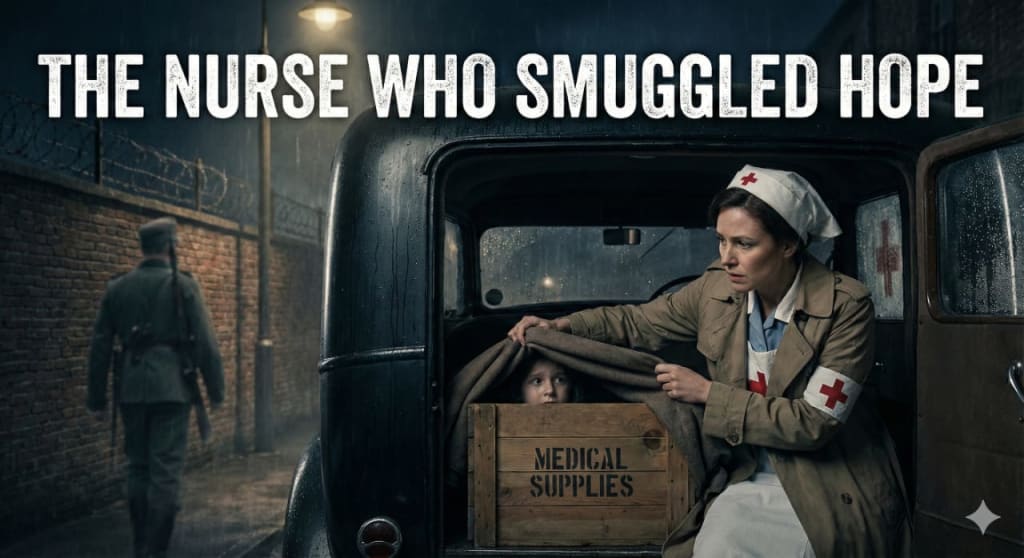
The harrowing true story of Irena Sendler, the Polish social worker who risked execution to smuggle 2,500 Jewish children out of the Warsaw Ghetto, saving them from the Holocaust.
The Barking Dog and the Crying Child
The German soldier was standing three feet away. His hand was resting on his holster. He looked bored. To him, this was just another routine inspection at the gates of the Warsaw Ghetto.
Irena Sendler sat in the driver’s seat of the ambulance, her knuckles white against the steering wheel. In the back, under a pile of dirty, bloodstained rags, was a wooden box.
Inside the box was a six-month-old baby girl.
If the baby cried, Irena would be shot in the head right there on the pavement. The baby would be thrown against the wall. The driver would be executed.
Irena looked at the soldier. She forced a smile. Then, she gave a subtle signal to her driver.
The driver had a dog sitting next to him. A large, trained Alsatian. On command, the dog began to bark. It was a loud, aggressive, rhythmic bark that drowned out every other sound in the immediate vicinity.
The soldier stepped back, annoyed by the noise. He waved them through, disgusted by the smell of typhus and death that clung to the vehicle.
As the ambulance rolled forward, crossing the line from Hell into the "Aryan side" of Warsaw, the baby in the box let out a wail. But the dog was still barking. The soldier didn't hear a thing.
Irena didn't exhale. She didn't celebrate. She just drove.
That was one child.
She had 2,499 more to go.
Part I: The Architect of Resistance
History likes to paint heroes as larger-than-life figures—people who were born fearless.
Irena Sendler was not a soldier. She was not a spy. She was a 29-year-old social worker, barely five feet tall, with a soft face and a quiet demeanor. Before the war, she was just a woman living in Warsaw, influenced by her father, a doctor who died treating poor Jewish patients during a typhus epidemic when Irena was a child.
His last lesson to her was the only one that mattered: "If you see someone drowning, you must jump in to save them, whether you can swim or not."
In 1940, the Nazis invaded Poland and created the Warsaw Ghetto. They took 400,000 Jewish people—men, women, children, the elderly—and shoved them into an area the size of Central Park. Then, they built a wall around it.
It wasn't a prison. It was a slow-motion execution chamber.
Inside the walls, the conditions were apocalyptic. People were dying of starvation in the streets. Typhus was rampant. There was no medicine, no food, no hope. The Nazis’ plan was simple: Let them die of disease and hunger, and then ship the survivors to the gas chambers at Treblinka.
Most of the world looked away. Irena Sendler looked closer.
Because she was a social worker, she pulled off a stroke of bureaucratic genius. The Germans were terrified of typhus spreading from the Jews to the German soldiers. Irena convinced the Nazi authorities that she and her team needed passes to enter the Ghetto to inspect sanitary conditions and prevent a plague.
The Nazis, driven by fear of disease, stamped her papers.
They handed Irena Sendler the keys to the Ghetto.
They thought she was going in to check for lice.
She was going in to organize the largest smuggling operation of human life in history.
Part II: The Mechanics of Salvation
You don’t save 2,500 children with good intentions. You save them with logistics, bribery, and nerves of steel.
Irena joined Zegota, the Council for Aid to Jews, an underground resistance organization. She became the head of the children’s division. Her code name was "Jolanta."
The operation was complex. It wasn’t just grabbing a kid and running. It required a network of safe houses, forged documents, and willing convents.
But the hardest part was physically getting the children out.
Irena and her network of ten female associates became creative in the darkest ways possible.
* The Toolboxes: For infants, Irena carried a mechanic’s toolbox. She would sedate the baby with a small dose of sleeping pills, place them in the box, cover them with tools or bricks, and walk out the gate.
* The Potato Sacks: Older toddlers were placed in burlap sacks in the back of delivery trucks, hidden under piles of potatoes or goods.
* The Coffins: This is the grim reality. Sometimes, to save a life, you had to pretend it was already gone. Irena used false bottoms in ambulances and even hearses. Children were hidden in coffins, lying still, pretending to be corpses.
* The Sewers: For the older children who could walk, the route was filthier. They were guided through the labyrinth of Warsaw’s sewers, wading through human waste in pitch blackness for hours to reach the other side.
* The Courthouse: The old courthouse stood on the boundary of the Ghetto. Irena would sneak children into the building, hide them under heavy winter coats, and walk them out a different door that opened onto the "Aryan" side.
Every single trip was a death sentence. If a child sneezed, if a guard looked too closely, if a sleeping pill wore off too soon—it was over.
But the physical smuggling was actually the easier part.
The hardest part was the conversation that happened before.
Part III: The Nightmare Choice
Imagine you are a mother.
You are starving. You are watching your children waste away. You know that any day, the soldiers will come to put you on a train to the East. You have heard the rumors. You know what happens at the end of the train line.
Then, a strange woman knocks on your door. She looks like a Polish Catholic. She tells you she can save your child.
But there is a catch.
You cannot come.
You must give your child to a stranger.
You will likely never see them again.
And she cannot guarantee they will survive.
Irena later said that these scenes haunted her nightmares for the rest of her life.
"Father, mother, grandma, I have to take the child away," she would say.
The parents would ask, "Can you promise me he will live?"
And Irena, who refused to lie, would look them in the eye and say, "No. I cannot promise that. I can only promise that if he stays here, he will die."
The screams of the mothers as they handed over their babies were sounds that no human should ever hear.
Grandparents would try to hide the grandchildren, refusing to let them go. Fathers would physically restrain mothers who tried to run after the ambulance.
Irena wasn't stealing these children. She was asking parents to rip their own hearts out in the desperate hope that the heart might keep beating somewhere else.
Once the child was handed over, the clock started ticking.
Part IV: The Erasure of Identity
Saving the body was step one. Saving the soul was step two.
Once a child was on the Aryan side, they could not be "Jewish." A Jewish child in Warsaw was a dead child.
They had to be scrubbed of their identity.
Irena and her team forged thousands of birth certificates.
* Avram became Artur.
* Rachel became Roma.
They were taught Catholic prayers. They were taught to cross themselves. They were taught that if a German soldier asked, "Who are you?", they must recite their new name and their new lineage without hesitation.
Irena placed them in convents, orphanages, and with sympathetic Polish families.
But she made a silent vow.
"This erasure is not permanent."
She refused to let the Nazis win by wiping out a generation’s heritage. She knew that if she survived, and if the children survived, they would need to know who they were. They would need to know their mothers' names.
So, she kept a record.
Part V: The Jars Under the Apple Tree
This is the detail that makes Irena’s story legendary.
She couldn't keep a ledger in her office. If the Gestapo raided her home (which they eventually did), a list of names would be a death warrant for 2,500 children and the families hiding them.
But she couldn't memorize 2,500 names and their false aliases.
So, Irena wrote them down on thin strips of tissue paper.
* Real Name: Elzbieta Ficowska.
* New Name: Elzbieta Kowalska.
* Location: Convent of the Sisters of the Family of Mary.
* Parents' Names: Henia and Izrael.
She rolled up these strips of paper tight. She put them into glass jars.
And she buried the jars deep in the ground under an apple tree in her friend’s garden at 9 Lekarska Street.
While Europe burned, the true identities of 2,500 future survivors were sleeping in the dirt, waiting for the war to end.
Part VI: The Gestapo Knocks
It was inevitable. You cannot trick the Third Reich forever.
On October 20, 1943, the Gestapo kicked down Irena Sendler’s door.
They had been tipped off. They tore her apartment apart. They ripped up the floorboards. They slashed the mattresses.
But they didn't find the jars. Irena had already given them to her friend.
Irena was arrested and taken to Pawiak Prison, a place known as the waiting room for the graveyard.
This is where the story turns from heroic to horrific. The Nazis didn't just want to kill her; they wanted the network. They wanted the names of the leaders of Zegota. They wanted to know where the Jewish children were hiding.
They tortured her.
For days.
They beat her with clubs. They broke her feet. They broke her legs. They shattered the bones so badly that for the rest of her life, Irena Sendler lived in chronic pain and had difficulty walking.
But through the blood and the agony, she said nothing.
She gave them fake names. She invented stories. She played the "stupid social worker" card.
She did not reveal the location of the jars.
She did not reveal the location of a single child.
Enraged and unable to break her, the Gestapo sentenced her to death.
Part VII: The Execution That Wasn't
The morning of her execution arrived.
Irena was in her cell, unable to stand on her crushed legs. A German officer came to collect her.
But something strange happened. Instead of leading her to the courtyard to be shot, the officer led her to a side exit. He shoved her into the alleyway and shouted at her to run.
He crossed her name off the list as "Executed."
Why? Not because of mercy.
Because of bribery.
Zegota, the underground organization, had managed to gather a massive sum of cash and bribed the high-ranking German executioner. Even in the depths of Nazi ideology, greed was a universal language.
Irena Sendler crawled into the shadows. She was officially dead.
The next day, she saw posters up in Warsaw announcing her execution. She read her own name on the death list.
She went into hiding. But she didn't stop working. Even while "dead," she continued to coordinate the rescue of children from the shadows, managing the money and the logistics until the Soviets liberated Warsaw in 1945.
Part VIII: The Bitter Harvest
The war ended. The Nazis were gone.
Irena went back to the apple tree. She dug up the jars.
The glass was cold, but the paper was dry. She began the impossible task of reuniting the children with their families.
This is the tragedy that Hollywood movies leave out.
She had the list of 2,500 children. She had the names of their parents.
But when she tried to find the parents, she found only ghosts.
Almost all of the parents had been murdered at Treblinka.
The mothers who had screamed as they handed over their babies? Dead.
The fathers who had held back their tears? Dead.
Irena realized with devastating clarity that she hadn't just saved children for their parents. She had saved the last remnants of entire bloodlines.
She worked tirelessly to place the children with surviving relatives, or to send them to Israel to build new lives. She handed the lists over to the Jewish organizations.
She had done her job.
Part IX: The Silence of the Hero
For decades, nobody knew who Irena Sendler was.
Poland fell under the Iron Curtain of Communism. The new Soviet-backed government didn't like the Polish resistance. They viewed Zegota and the Warsaw Uprising fighters as enemies of the state.
Irena was interrogated by the Communist secret police. She was pregnant, and the interrogation was so brutal she miscarried her child. She was silenced.
She lived a quiet, poor life in a small apartment in Warsaw. She worked as a social worker and a teacher. She raised her own children. She grew old.
The world celebrated Oskar Schindler, a man who saved 1,200 Jews.
Irena Sendler, a woman who saved 2,500, was invisible.
It wasn't until 1999—fifty years after the war—that her story was unearthed. Not by a historian, but by four high school girls in Kansas who were doing a history project titled "Life in a Jar."
They found a reference to her in an old article. They thought there must be a typo. "Saved 2,500 children?" they thought. "That’s impossible. We would have heard of her."
They dug deeper. They found out she was still alive.
They flew to Poland to meet her. Irena was 90 years old, sitting in a nursing home.
When the world finally realized what she had done, the accolades poured in. She was nominated for the Nobel Peace Prize (though she lost to Al Gore, a controversy that still angers many). She was declared a national hero.
But Irena Sendler, with the same steel that allowed her to stare down the Gestapo, rejected the title of "hero."
In one of her final interviews before her death in 2008, she said:
"I was brought up to believe that a person must be rescued when drowning, regardless of religion and nationality. The term 'hero' irritates me greatly. The opposite is true. I continue to have pangs of conscience that I did so little."
So little?
She saved 2,500 universes.
Conclusion: The Weight of a Choice
The story of Irena Sendler is not a "feel-good" story. It is a story about the brutality of goodness.
We like to think of courage as a moment of adrenaline—charging into a burning building.
Irena showed us that real courage is a grind. It is waking up every morning for four years, vomiting from fear, and then walking out the door to do it again.
It is looking a mother in the eye and telling her that the only way to love her child is to give them away.
It is enduring the breaking of your own bones to keep a secret.
Irena Sendler died at the age of 98.
She never considered herself special. She simply saw a problem—innocents dying—and realized that waiting for someone else to fix it was a form of complicity.
Her legacy is not just in the history books. It is in the blood of the thousands of children, grandchildren, and great-grandchildren of the survivors who are alive today because a small Polish social worker had the audacity to bring a toolbox and a barking dog to the gates of Hell.
She proved that even in the darkest hour of human history, a single candle can burn the whole house down.
And she proved that evil is loud, but good is quiet, persistent, and eventually, victorious.
About the Creator
Frank Massey
Tech, AI, and social media writer with a passion for storytelling. I turn complex trends into engaging, relatable content. Exploring the future, one story at a time
Keep reading
More stories from Frank Massey and writers in Motivation and other communities.
The Power of Thinking in Decades
Introduction: The Trap of Urgency Modern life trains you to rush. Fast results. Quick validation. Immediate feedback. Urgency feels productive. It creates motion, pressure, and the illusion of progress. But urgency is often a reaction—not a strategy. It narrows your vision and compresses your decision-making into the present moment.
By Chilam Wong7 days ago in Motivation


Comments
There are no comments for this story
Be the first to respond and start the conversation.