
The Weight of White
At midnight, the quiet descent of snow can either bury a man or uncover him.
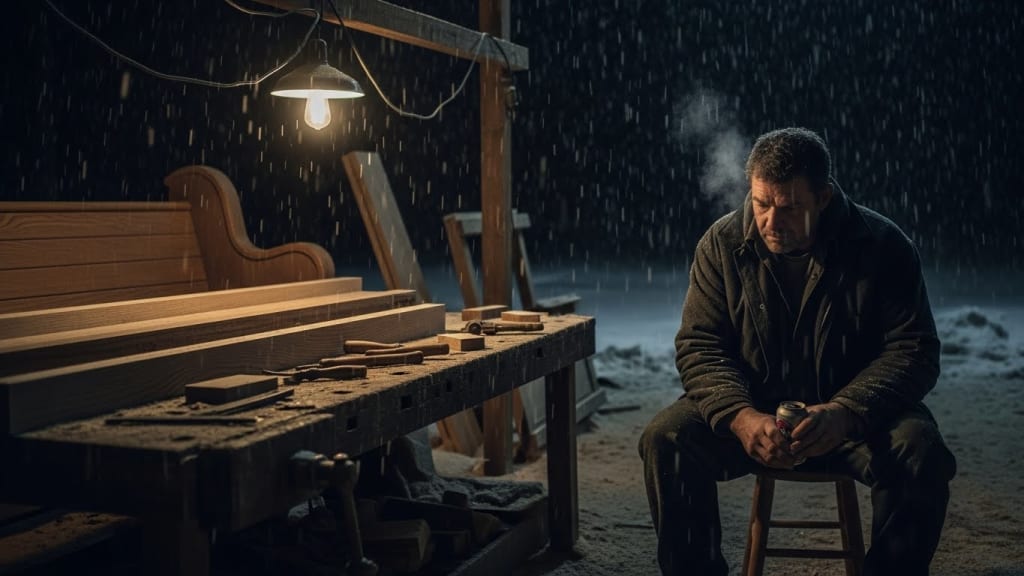
Arthur sat in the cold, a can of flat beer sweating in his grip. The workshop air was thick with the ghost of sawdust and the acrid tang of burnt ambition. It was well past midnight. Outside, the world was muffling itself under a heavy, relentless fall of snow. He hadn’t turned on the heater, couldn't justify the electric bill. His breath plumed in the dim light cast by a single bare bulb hanging over his workbench, illuminating nothing but the stacked failures: unfinished cuts of oak, a half-sanded pew leg, a ledger filled with red ink.
The pastor had called again. Said it politely, of course. 'Just checking in, Arthur. Hope everything's alright with the pews.' Everything was not alright. Nothing was alright. The pews were due last month. Mrs. Henderson, a sweet old lady who'd been commissioning his work since his dad ran the place, deserved better than his empty promises and slurred apologies. He pictured her, hunched in the front row every Sunday, looking at the same threadbare cushions, waiting for the new ones, the ones he'd promised to carve with his own hands.
He lifted the beer, took a long, flat sip. It tasted like regret and old pennies. His ex-wife, Sarah, would have had a fit. 'Arthur, you're killing yourself with that stuff.' She wasn't wrong. She just wasn't here to say it anymore. He'd lost her, lost the house, was rapidly losing the shop. Losing himself. He felt it, a slow erosion, like water wearing down stone. He was just a shape, a shadow, holding a can of beer in a freezing room, watching the snow fall.
The silence was what got him. Not just the quiet of the night, but the quiet that snow brought with it. It pressed down on the city, on the street outside, on the rattling windows of his shop. It sucked the sound right out of the world, leaving nothing but the thrum of his own blood and the frantic, echoing thoughts in his skull. You're a damn mess, Arthur. You always were. His father, a gruff, honest man, wouldn't have understood this kind of paralysis. He'd have just picked up the plane, squared the wood, and kept going.
He remembered the first time he'd seen his dad carve. A child's rocking horse. The way the wood shavings curled, delicate and fragrant, around his father's calloused hands. The sheer concentration. The love for the material. Arthur used to feel that. Used to feel the grain, hear what the wood wanted to be. Now, the oak just felt heavy, dead weight, an adversary.
He pushed himself up, a grunt escaping him. His back ached. Every joint screamed a protest. He shuffled to the big bay window, wiping a patch of condensation with his sleeve. The streetlights glowed, haloed and diffused by the falling flakes. Everything looked soft, blurred, pure. Pristine. A clean slate. And suddenly, for a split second, he hated it. Hated its perfect, indifferent beauty. He just wanted to lie down, let the white smother everything, him included.
But then, through the glass, a flicker. A memory. Not of the rocking horse, but of a different night. His first big project, a complicated mantelpiece for old Mr. Abernathy. He'd been twenty, cocky, and then the piece had split. He'd cursed, thrown his tools, wanted to quit. His dad had walked in, not a word, just picked up the broken wood, examined it. 'It happens,' he’d grunted. 'You fix it. Or you start again. But you don't quit.' He'd stayed up all night, piecing it together, learning the repair, making it stronger than it had been before.
He looked at the unfinished pew leg again. It wasn't split. It wasn't fundamentally broken. He was. The wood just sat there, waiting. Waiting for him to stop wallowing. Waiting for him to remember what his hands were for. Not holding a can of beer, not gripping his forehead in despair. But shaping, carving, building.
The silence outside pressed on, but it felt different now. Less a smothering blanket, more a quiet demand. A challenge. The world wasn't going to fix itself around him. The pews weren't going to magically appear finished. He took a shaky breath, the cold air biting his lungs. His fingers twitched, a phantom memory of the chisel's cool steel. He could still do it. He knew the steps. He knew the feeling. It was buried, deep under the sludge of his failures, but it wasn't gone.
He walked back to the bench, his movements stiff, deliberate. Picked up the rasp. It felt strange, foreign, after so long. But the familiar weight of it, the cold bite of the metal against his palm, was a small, insistent anchor. He stared at the oak, its unfinished curve. He didn't know if he could finish it tonight, or even tomorrow. Didn't know if Mrs. Henderson or the pastor would ever forgive him. But he knew, with a certainty that cut through the fog, that he couldn't just sit here. Not anymore. He brought the rasp down, a whisper of wood dust rising into the cold air.
About the Creator
HAADI
Dark Side Of Our Society
Keep reading
More stories from HAADI and writers in Motivation and other communities.
The Ink-Stained Ledger
The diner air hung thick, a greasy shroud of burnt coffee and yesterday’s bacon. Leo traced a finger through the dust on the counter, the fluorescent lights humming a low, miserable tune above him. Another Friday night, another handful of regulars, another stack of bills that felt heavier than the griddle itself. Mama’s Diner. Her legacy. His burden. He wiped his hands on his apron, the cloth already stiff with grime. He was tired, bone-deep tired, the kind of tired that seeped into your marrow and made every breath feel like a chore.
By HAADI8 days ago in Motivation
Tiny Choices, Lasting Impact
Morning Habits For a long time, I believed change arrived loudly. I imagined it as a clear moment—an announcement, a decision that split life into before and after. But most mornings didn’t feel like that at all. They began quietly. An alarm I considered ignoring. A glass of water I sometimes drank, sometimes didn’t. A notebook resting on the corner of my desk, unopened. Nothing about those moments felt important. I moved through them automatically, believing real change belonged to bigger decisions. Career choices. Relationships. Major risks. The small things felt like background noise—too minor to matter. Yet they repeated themselves. Every day. Without effort or drama. And repetition, I later learned, is where impact hides.
By Talha khan6 days ago in Motivation
Violence Begets
"Any last words, cowboy?" "None you'd understand, sodbuster." "Funny. That's Marshall Sodbuster to you. But I meant some last nugget that would help us in the adjudication of the myriad offenses counted against you and your gang. I wasn't asking for penitence."
By Adam Diehl4 days ago in Fiction


Comments
There are no comments for this story
Be the first to respond and start the conversation.