
The Paper Boat
From childhood hope to a lifeline for many

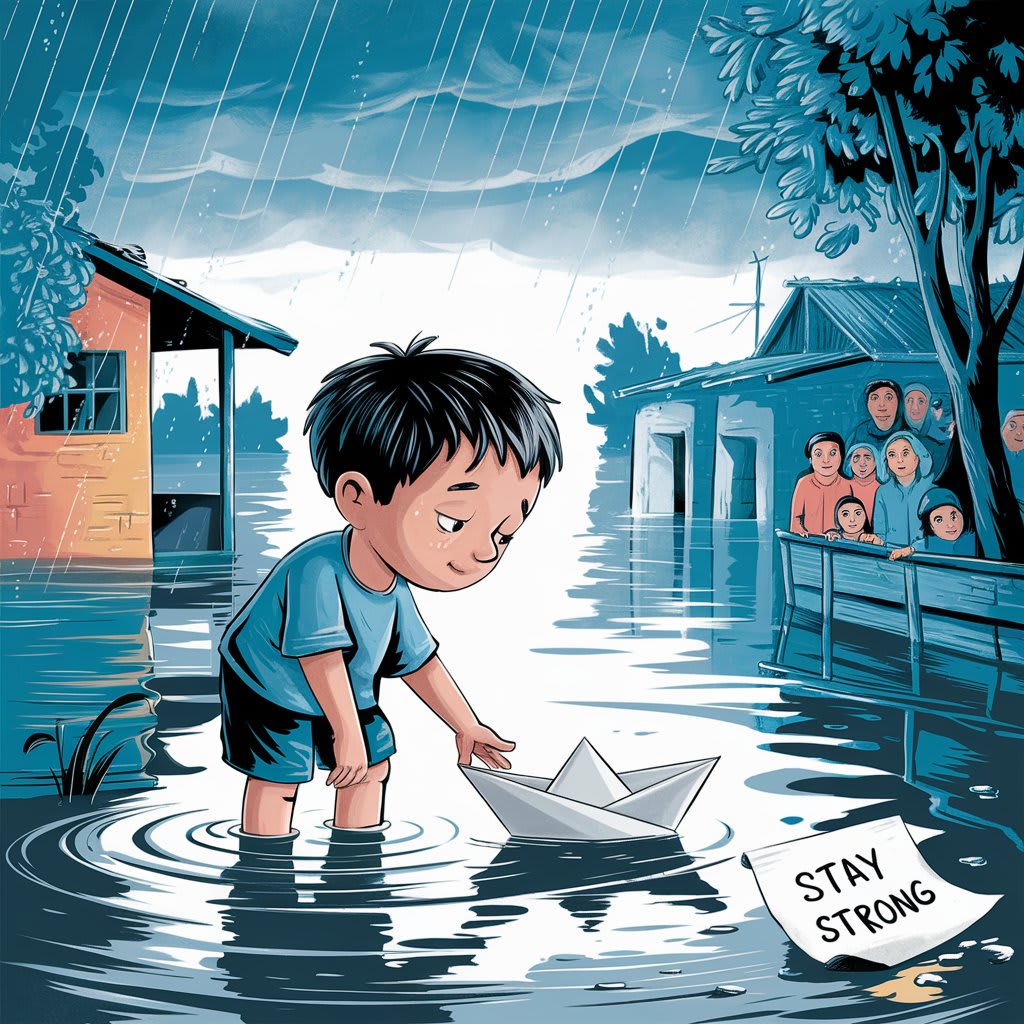
In a small village near a wide river, floods were a regular part of life. Every year, the heavy rains would come and the water would rise. The streets would fill with muddy water, and people would climb onto rooftops or seek shelter in nearby schools and temples.
In one of those little houses lived a boy named Aarav. He was only eight years old, full of curiosity and imagination. His family didn’t have much, but Aarav found joy in simple things—especially in making paper boats.
Whenever the rains came, while the adults worried and worked, Aarav would tear out pages from old notebooks and fold them carefully into little boats. He would float them on the rising water, watching them glide past the flooded paths. Sometimes he would even write little messages on them like “Don’t be afraid” or “The sun will come soon.”
Neighbors often smiled at him. “Look at that boy,” they’d say, “He turns floods into playtime.” What they didn’t see was how much Aarav watched and learned. He saw people losing homes, families wading through deep water, and helpers coming late—or not at all.
Years passed, and the floods kept returning. When Aarav grew older, he moved to the city to study. He chose to learn about disaster management, because he remembered how helpless his village had felt. In college, while others wrote reports, Aarav shared stories—about children playing in floods, families waiting for food, and paper boats carrying hope.
One day, during a seminar, Aarav shared an idea.
“What if we created a program that helps people before the flood comes? Not after. We teach them how to stay safe, how to work together, and how to prepare in advance.”
At first, people didn’t take him seriously. He was still young. But Aarav didn’t stop. He designed kits that included emergency food, water filters, flashlights, first-aid, and simple instructions. The kits were small, affordable, and easy to carry. On the front of each kit, he printed a symbol: a paper boat.
It became his brand—The Paper Boat Project.
He returned to his village and started there. He taught children how to pack bags in case of emergency. He trained families on how to make floating rafts from bottles and ropes. He worked with local volunteers and turned schools into shelter centers. Word spread quickly.
People loved the name. The paper boat reminded them of childhood, of hope, of something small that could survive the flood. Aarav’s simple symbol started appearing on trucks, banners, and relief tents in villages across the region.
A few years later, when a massive flood hit several towns, the Paper Boat Project responded faster than the government. Boats filled with kits reached stranded families within hours. Volunteers, many of them trained by Aarav himself, moved through the water with confidence and care.
News channels picked up the story:
“The Boy Who Fought Floods With Paper Boats.”
But Aarav didn’t care about fame. He cared about saving lives. His favorite moment came when he saw a child floating a paper boat in a calm puddle after the flood had passed—just like he used to.
That’s when he knew: his message of hope had truly reached hearts.
Moral of the Story:
Big changes often start with small dreams. Even a simple paper boat can grow into something powerful when guided by care, courage, and compassion.
About the Creator
Nihal Khan
Hi,
I am a professional content creator with 5 years of experience.
Keep reading
More stories from Nihal Khan and writers in Motivation and other communities.
The Rainy Stall
In a small town, on a crowded street full of noise and people, there was a tiny tea stall. It didn’t look like much—just a wooden table, a big kettle, a few cups, and an old umbrella for shade. But what made the stall special was the woman who ran it.
By Nihal Khan11 months ago in Motivation
The Inmate Who Conquered Hollywood: The Brutal Redemption of Danny Trejo
You already know the face. It is one of the most unmistakable visages in the history of modern cinema. Deeply lined, scarred, and weathered like worn leather, framed by a sweeping mustache and a gaze that looks right through you. When Danny Trejo walks onto a screen, he does not have to act tough. The toughness is etched directly into his bone structure. He is the ultimate Hollywood enforcer, the cartel boss, the rugged anti-hero swinging a blade in Machete.
By Frank Massey 6 days ago in Motivation
This Is What I Do When People Throw Rocks At Me
Rocks have been thrown at me for a greater part of my life. Some have been small and missed hitting me. When people don't get a reaction from me, they throw bigger rocks with a better aim. Many have been hurled at me with precision over the years. For a long time, I thought my only options were to dodge them or be crushed by them.
By Margaret Minnicks5 days ago in Confessions


Comments (3)
Love it ♦️⭐️⭐️⭐️
I like it
It was a nice story I liked it