

We’d been married ten years and Janie still believed in me. That’s why I didn’t tell her the truth: that my meeting wasn’t on the executive floor of the publisher’s office, but in a café down the street. It was the café where we’d met when I was an upcoming editor at a successful magazine, writing my great American novel at night, and she was a junior editor at Vogue. Now she was senior management and I wrote ‘contributing articles’ for anything that paid. The great American novel was on the backburner and had been for years.
“I could come up and say hello.” She glanced down the street toward the publishing house. “For old time’s sake.”
“I’m going to grab a coffee here and prep my elevator speech.”
We both laughed. I could give a summary of my book if wakened from a dead sleep on a falling airplane.
“I may change it up, don’t want it to sound old and worn.”
She heard the unspoken defeat. “Sell this book, it’s a start, and that will sell the next one.”
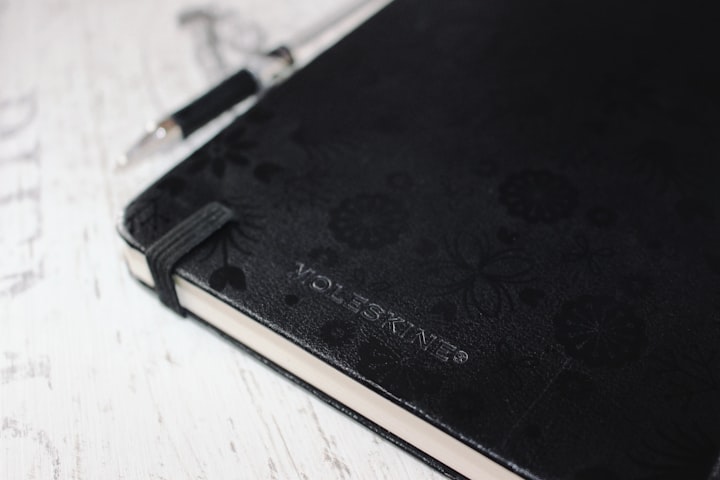
I looked around, pretending to be in a hurry. The posture of a man of business. Janie reached into her leather satchel, gripping something, hesitating. With a quick smile she thrust a small black notebook into my hands. I touched the cover, supple, not slick like a kid’s. Two ribbons attached to the spine marked pages. I opened it. The white sheets were all blank.
“For the next book.” Her words spun out, accelerating. “I know you write on the computer, but this could be for ideas. Or even for this meeting. Notes.” She grinned. “Notes about the big contract.”
My fingers twitched, as if they already missed two-thumbed note-taking on my phone. Janie touched my jacket, feeling for the fat ink pen hidden in the pocket. An affectation, even if it had been my father’s. A reminder of his Pulitzer Prize winning book, the one written from a foxhole during an overseas war.
“It’s great,” I said, waving her gift. “I’ll use it today.”
I watched her go, waiting for her to turn at the corner and flash a final smile, but she didn’t. Her head was down as she disappeared into the morning commute, shoulders hunched even though there wasn’t any wind.
The café tables were small, barely big enough for my laptop, but I opened it anyway, willing my nose to acclimate to the smell of hot frothed milk and cinnamon scones before the waitress took my order. This wasn’t my part of town, not anymore, and the prices belonged to my old life.
The waitress frowned at me: black coffee, two sugars, no cream. I wondered if she understood my need to spread out small purchases as hourly rent on the table. I needed the time. Time to convince myself this was the book that would sell before I had to convince Mark. He’d heard the premise already, spewed out in a hurried exchange of hellos after fifteen years of not seeing one another.
How could I have known that the boy who’d snubbed backyard soccer with me was now a ‘man in charge.’ As teenagers, we’d bonded over a mutual hatred of required school sports, two boys who loved words and books and despised gymnasiums and playing fields. Now we were two men living out a dream at opposite ends of a string. Each tied to this great city, one affixed to the pulsing center, the other losing his hold.
The chance meeting was three days ago. Mark waiting for a hired car, me crossing to the subway entrance. Instant recognition despite the years. His brief: “What are you up to now?” My answer, quick, too quick: “I’m a writer.”
Our words had overlapped, my tried and true description of my book tangling with his “I’m looking for a new manuscript, something to really shake things up.”
My book wouldn’t shake things up and we both knew it.
I angled the computer to avoid glare and opened a document, skimming through the first chapter, reading words I’d crafted until every comma was as precious to me as a child. They smelled stale through the glass screen. I needed new words.
Other documents nestled in the virtual folder. Plot charts, character bios, research, old versions, archaic versions. Where was the folder titled inspiration?
The waitress refilled my coffee and, to placate her, I ordered a scone. It was cold and the butter pat balanced on top, pulling crumbs when I spread it. I lifted the ironstone mug, inhaling twice. She’s given me hazelnut by mistake, normally an upcharge. Appreciative, I closed my computer. This might be the highlight of my day, this cup of coffee.
My father’d never talked about the wars he covered, you had to read about his experiences in print. He’d only say that it gave him an appreciation for a hot cup of joe. He’d written in a tiny wirebound notebook, in crabbed shorthand as illegible as enemy codes, his hand shaking with fear.
Remembering Janie’s gift, I pulled my father’s pen from my inside pocket, dabbing the nib on a wet napkin, triggering the flow of ink before making loops on the heavy paper of the first page. Losing myself in the repetitive shapes I imagined my story, the book I had to sell. What could I say about it that would cause my old friend to pay me even a dime?
Years before, my father had told me about going off to war only to return and find the world moving in parallel time. I’d not understood him then, too young to imagine anything other than past, present, and future. Now I knew it was possible to live alongside my contemporaries but not as a part of them. Mark and I lived in the same world. We lived in opposite worlds.
I felt myself but not myself. A boy exploring these parallel spaces. The words traveled from my brain to the page like an electric current seeking ground. Each word encouraged the next, connected by the tiniest thread of ink, running one into the other. The sentences formed line by line as if they craved a place to land and couldn’t be stopped. The pages turned. More ink. I couldn’t control my hand, it kept moving.
I felt warm and shifted away from the sun before realizing there was no sun. I used a paper napkin to wipe the sweat from my neck, but my writing hand didn’t pause. The story flowed. The pages of the notebook filled. I couldn’t stop. I had to reach the end.
The waitress ended her shift, irritated at the passing of tips to the next girl, but I couldn’t be bothered to find my wallet. My world had shrunk to the width of a white page.
“John. John?”
A shadow fell across the table, disorienting me.
Mark smiled nearly quickly enough to hide his concern. I closed my notebook, surprised that the ribbon marked a page near the back cover. I felt satisfied and tired and exhilarated and ill. I suspected I looked it, and took a long drink of water while Mark ordered.
We covered the expected questions about parents and siblings and old school friends until the waitress delivered fresh coffee. Mine hot and black, his a complicated mixture even she had trouble understanding.
I knew the time had come. Mark spoke. “I’ve had a talk with my team, you know that it’s a team, and we’re not sure —”
I interrupted, laughing. “I should have told you right away that the bit I mentioned on the street isn’t the real story. You know how it is, everyone wants a preview once they know you’re a writer. It’s habit to roll out the expected tripe.”
I settled back in my chair, pushing the small black notebook to the center of the table, keeping one hand on it. Heart pounding.
“The real idea, that’s not something I throw around, especially not around people in publishing. Not unless it’s a serious conversation.” I paused, feeling like I was about to jump off a cliff into a pool of clear cool water. Was it deep or were there rocks?
“Read it for yourself.”
Mark looked at the notebook. I suspected he wondered if I’d been drinking. But I’d been his friend, his brilliant literary teenage friend and the reluctance was mixed with something. Hope?
I headed to the restroom, feeling like I’d sweated through my shirt. How would I explain this to Janie? What was there to explain? That Mark had passed on the book before he’d even looked at it? Or that I’d handed him a notebook – her gift – filled with straight-from-the-heart scribbles.
I returned, carrying a glass of wine like a trophy. Mark turned a page, stealing a glance at me. He didn’t speak and I took a gulp of relaxation, savoring the taste of twelve dollars poured into a six-ounce glass.
The pages turned. I tried to read my own words upside down. My walk across the café had erased the fever of creation. Maybe my trance was that of a crazy man.
Mark closed the notebook, pressing it down. He blew a stream of air between his lips.
“I don’t know what to say.”
I didn’t either.
When Janie opened the door, she could tell I’d been drinking. I watched the shadow fall across her eyes, preparing to fix what others had torn down, remembering my last bender. My only one, when the magazine had closed and my writing life had destructed.
“We’re going out,” I said. “We’re going out and having a bottle of champagne, then dinner at the fanciest place we can get a reservation.”
She gripped my shoulder. “He liked the book?”
“Yeah, he liked the book. He wrote me an offer right there in the café, signed and dated on the back of a damn menu.” I leaned close and whispered the dollar amount to her. An unbelievable advance. An amount that would make headlines.
She shrieked and I laughed.
The million dollar notebook.
About the Creator
Tracee de Hahn
Author Tracee de Hahn's latest mysteries are set in Switzerland and published by Minotaur Books. Prior to writing fiction she began her career in the practice of architecture.
Keep reading
More stories from writers in Motivation and other communities.
Influential Women Magazine Celebrating Purpose-Driven Women
Influence in today’s world is no longer defined by popularity alone. It is shaped by purpose, values, and the ability to create meaningful impact. Women across the globe are leading businesses, movements, and communities with intention and integrity.
By influentialwomenmagazine3 days ago in Motivation




Comments
There are no comments for this story
Be the first to respond and start the conversation.