
The Human Seal: Guðlaugur Friðþórsson and the Impossible Mile
In 1984, a fishing boat sank in the freezing North Atlantic. The science of hypothermia dictated that everyone should be dead within twenty minutes. One man swam for six hours, walked across a lava field, and knocked on a door.

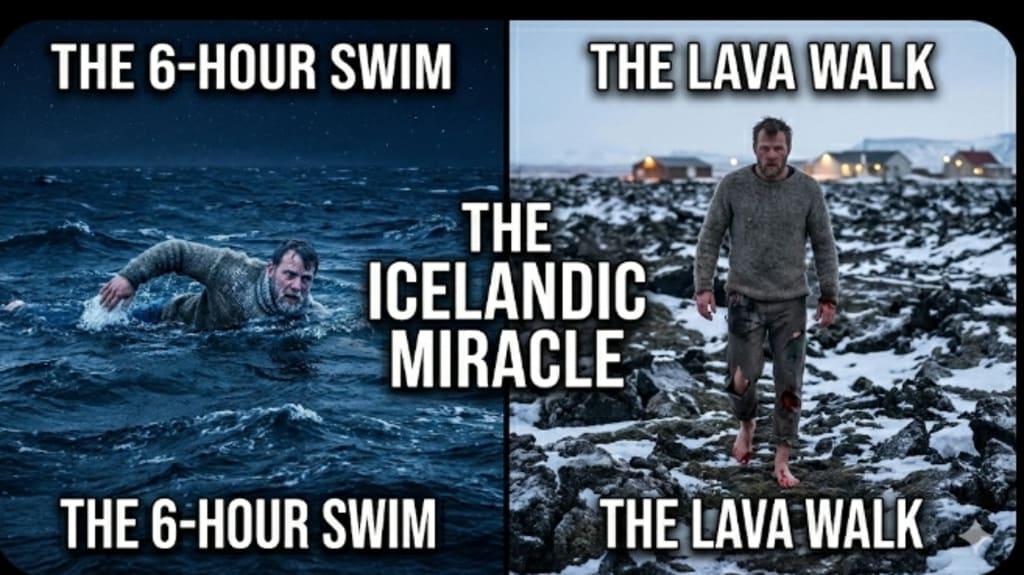
The miraculous true story of Guðlaugur Friðþórsson, the Icelandic fisherman who defied medical science by swimming six hours in near-freezing water after a shipwreck.
Introduction: The Liquid Ice
To understand this story, you must understand the North Atlantic Ocean in March.
It is not a romantic setting. It is a hostile, indifferent machine. Off the coast of the Westman Islands (Vestmannaeyjar) in Iceland, the water is not just cold; it is a physical assault. The temperature hovers around 5°C (41°F) for the air and 2°C (35°F) for the water.
At that temperature, water acts like fire. It burns the skin upon contact. Within minutes, the blood retreats from the limbs to protect the organs. Within ten minutes, fine motor skills vanish. Within twenty to thirty minutes, the heart enters fibrillation, and consciousness is extinguished.
The sea is a graveyard. It does not bargain.
On the night of March 11, 1984, the ocean claimed the fishing vessel Hellisey. It took the boat. It took the gear. And it intended to take the five men on board.
Four of them obeyed the laws of physics and died.
The fifth man, a 22-year-old giant named Guðlaugur Friðþórsson, decided that the laws of physics were merely suggestions.
Part I: The Snag
Guðlaugur—known to his friends as Guli—was not an athlete. He was a large man, standing over six feet tall, with a thick layer of body fat that he was often teased about. He liked to party. He liked to eat. He was a typical Icelandic fisherman: stoic, hardworking, and fond of the land he rarely stood on.
The night was clear but freezing. The Hellisey was trawling for cod.
It happened in seconds. The net, dragging deep along the jagged seabed, snagged on a rock. The winch strained. The boat, reacting to the immense tension and the heave of a rogue wave, listed violently.
Before the crew could cut the lines, the ocean poured in.
There was no time for a Mayday call. No time for life jackets. The boat capsized instantly, flipping upside down like a toy in a bathtub.
Guli found himself underwater, in the pitch black, tangled in gear. He didn't panic. He fought his way up, his lungs burning, until his head broke the surface.
The air was freezing, but it was air.
He saw the keel of the upturned boat. Two other men had made it out—the captain and another deckhand. They scrambled onto the slippery hull.
They stood there, shivering violently, watching their home disappear beneath them. They were three wet men in the middle of a frozen void.
They knew the truth immediately: No one knew they were gone. No rescue was coming.
Part II: The Plunge
They stood on the keel for forty-five minutes.
They could see the lights of the Westman Islands in the distance. They looked close, maybe three miles away. But in the ocean, distance is a lie.
The boat began to settle. The air pocket keeping it afloat was leaking out.
"We have to swim," the captain said.
It was a suicide pact. Swimming three miles in near-freezing water is impossible. But staying on a sinking hull was a guarantee of death.
They slid into the water.
The shock was absolute. The cold slammed into them like a sledgehammer.
The three men started to swim toward the lighthouse beam sweeping across the dark horizon. They tried to talk to keep their spirits up. They joked grimly about the cold.
But the ocean works fast.
Within ten minutes, the other deckhand went silent. His body shut down. He slipped under the black water without a sound.
Guli and the captain kept going.
Twenty minutes later, the captain, a strong and experienced man, began to hallucinate. He spoke nonsense words, his limbs flailing as the hypothermia scrambled his brain.
"Guli," he whispered. And then he was gone.
Guðlaugur Friðþórsson was alone.
Part III: The Conversation with the Birds
This is the moment where Guli should have died.
He was three miles from shore. He was wearing jeans, a shirt, and a sweater. He was barefoot. He was soaking wet in water that kills in minutes.
But Guli didn't die. He didn't even stop.
He entered a state of mind that scientists and psychologists have studied for decades since. He refused to acknowledge the reality of his situation.
He realized that if he swam hard, he got tired and swallowed water. If he stopped, he froze. So he found a rhythm. A slow, plodding breaststroke.
He became a part of the water.
To keep his mind from snapping, he began to talk.
He talked to the stars. He talked to God. But mostly, he talked to the seagulls.
A flock of seabirds, attracted by the disturbance in the water, began to circle him. They dove at his head, pecking at him, thinking he was carrion.
Instead of screaming at them, Guli conversed with them.
"Not yet," he told the birds. "I am not dead yet. Go away."
He hallucinated that he was back in his kitchen. He thought about a glass of milk. He thought about his bed. He pushed the pain of the cold into a box in the back of his mind and locked the door.
He swam for six hours.
Six. Hours.
Part IV: The Cruel Shore
The sun began to hint at the horizon when Guli reached the sound of breaking waves.
He had made it. He had swum the impossible distance.
But the ocean had one final cruelty waiting for him.
The spot where he made landfall was a sheer cliff face. The waves were smashing against the rocks with lethal force. If he tried to land here, he would be pulverized against the stone.
He grabbed a rock, his fingers numb and useless, and tried to pull himself up. A wave smashed him back down.
He tried again. He fell again.
He realized he couldn't get out.
Most men, having swum six hours to reach safety only to find a wall, would have given up. They would have let the current take them.
Guli pushed off the rock.
He turned his back on the land and swam back out into the ocean.
He knew the geography of the island. He knew there was a sandy cove further down the coast.
He swam for another hour.
Part V: The Lava Field
He finally felt sand beneath his feet.
He dragged himself out of the surf. He was unable to stand. His legs were jelly. He crawled on his hands and knees, vomiting seawater, shaking with convulsions.
He was alive. But he was not safe.
He was on a remote part of the island. The nearest town was two miles away.
Between him and the town lay a lava field.
Icelandic lava is not smooth rock. It is essentially broken glass. It is jagged, sharp, and unforgiving.
Guli was barefoot.
He stood up. His jeans were frozen solid, stiff as boards. He had to break the ice on his clothes just to bend his knees.
He began to walk.
Every step was agony. The lava sliced his feet open. He left a trail of bloody footprints in the snow.
But the cold was still the enemy. If he stopped walking, his core temperature would drop below the point of no return.
He walked like a zombie. He saw a tub of water in a field—a trough for sheep. It was covered in an inch of ice.
He was dying of thirst. The salt water had dehydrated him.
He walked over to the trough. He didn't have the strength to break the ice with his hands. He fell forward and smashed the ice with his forehead. He drank the freezing water mixed with his own blood.
He stood up and kept walking.
Part VI: The Knock
At 7:00 AM, a homeowner in the town of Heimaey heard a strange sound.
It was a thud against the door.
The homeowner opened it.
Standing there was a monster. A man covered in frost, smelling of the sea, bleeding from his feet, his eyes wild and red.
"The boat sank," Guli whispered. "I need the police."
He didn't ask for a blanket. He didn't ask for pity. He asked for the police because he wanted to report the deaths of his friends.
The homeowner pulled him inside. They wrapped him in blankets. They called an ambulance.
When the paramedics arrived, they couldn't find a pulse. His skin was cold to the touch. The thermometer didn't register his body temperature because it was below the scale of the device.
By all medical logic, the man sitting in the chair was a corpse.
But the corpse was drinking tea.
Part VII: The Seal Man
Guðlaugur Friðþórsson survived.
He didn't lose any limbs to frostbite. He recovered.
But the world couldn't understand how.
Researchers from the University of Iceland and London flew in. They put Guli through a battery of tests. They put him in a tank of cold water alongside Navy SEALs and athletes.
The elite soldiers started shivering uncontrollably within twenty minutes. Guli sat in the water, bored, chatting with the researchers.
They discovered two things.
First, Guli’s body fat was strictly unique. It was more like seal blubber than human fat. It provided an insulation layer that was almost genetic.
Second, and more importantly, his mental state.
During the tests, while other men panicked as their bodies froze, Guli remained calm. He had the ability to control his metabolism, to keep his heart rate steady, to refuse the panic signal.
They called him "The Human Seal."
Part VIII: The Quiet Aftermath
Guli became a national hero in Iceland. A monument was built to the crew of the Hellisey.
But Guli didn't want the fame. He didn't write a self-help book. He didn't go on a speaking tour.
He went back to work.
He continued to fish. He stood on the decks of boats in the same freezing ocean that had tried to kill him.
When reporters asked him about that night, he would shrug. He didn't see himself as a superhero. He saw himself as a man who simply had more work to do.
He regretted only one thing: that he couldn't save his friends.
"I am not a hero," he told a journalist years later. "I just didn't want to die. I had things to do."
Conclusion: The Verdict of the Will
The story of Guðlaugur Friðþórsson is technically a story about biology. It is about body fat and insulation.
But that is the boring explanation.
The real story is about the verdict.
When the boat flipped, the Ocean passed a verdict: Death.
When the captain died, the Cold passed a verdict: Death.
When the cliff blocked his path, the Land passed a verdict: Death.
Guli simply vetoed them all.
He reminds us that the human animal is capable of things that cannot be measured in a lab. We are capable of enduring the unendurable, provided we keep our minds steady.
Life, like the North Atlantic, is indifferent. It will strip you of your resources. It will freeze you. It will put a cliff where you expected a beach.
But Guli’s footprints across the lava field teach us the ultimate lesson of survival.
When the water is black, and the cold is absolute, and you are alone in the void...
You don't have to be fast. You don't have to be strong.
You just have to be the one who decides to take the next stroke. And then the next.
Until you knock on the door.
About the Creator
Frank Massey
Tech, AI, and social media writer with a passion for storytelling. I turn complex trends into engaging, relatable content. Exploring the future, one story at a time
Keep reading
More stories from Frank Massey and writers in Motivation and other communities.
The Blind Guitarist Who Healed a Broken City: A Story of Unlikely Resilience
Date: February 27, 2010. Time: 3:34 AM. Location: Concepción, Chile. The world did not just shake; it roared. If you have ever experienced an earthquake, you know the feeling of the ground betraying you. But the 2010 earthquake in Chile was different. At a magnitude of 8.8, it was one of the most violent seismic events in recorded history. It released energy equivalent to thousands of atomic bombs. In the coastal city of Concepción, the earth churned like an ocean in a storm. High-rises buckled. Bridges snapped like dry twigs. The electricity grid failed instantly, plunging a terrifyingly loud world into absolute, suffocating darkness.
By Frank Massey about 24 hours ago in Motivation
One Hard Thing
Stop me if you’ve heard this one before: You have the number, you know your schedule- you’ve even picked out the perfect day and time to make this appointment. Shoot, you’ve even picked out alternative days and times just in case their schedules can’t accommodate you!
By Taylor Rigsby2 days ago in Motivation
How Life Taught Me about the Value of Pain and Suffering.
I often find myself reflecting on moments in life that, at the time, felt like the end of the world. The weight of those experiences seemed unbearable — as if everything I had built was crumbling, slipping through my fingers no matter how tightly I tried to hold on. But with distance and perspective, I see now that every detour, every loss, and every ending was gently guiding me to where I was always meant to go.
By Catherine Nyomenda3 days ago in Motivation


Comments
There are no comments for this story
Be the first to respond and start the conversation.