
The Courage of Bilal (RA)
The Voice That Called for Freedom and Faith
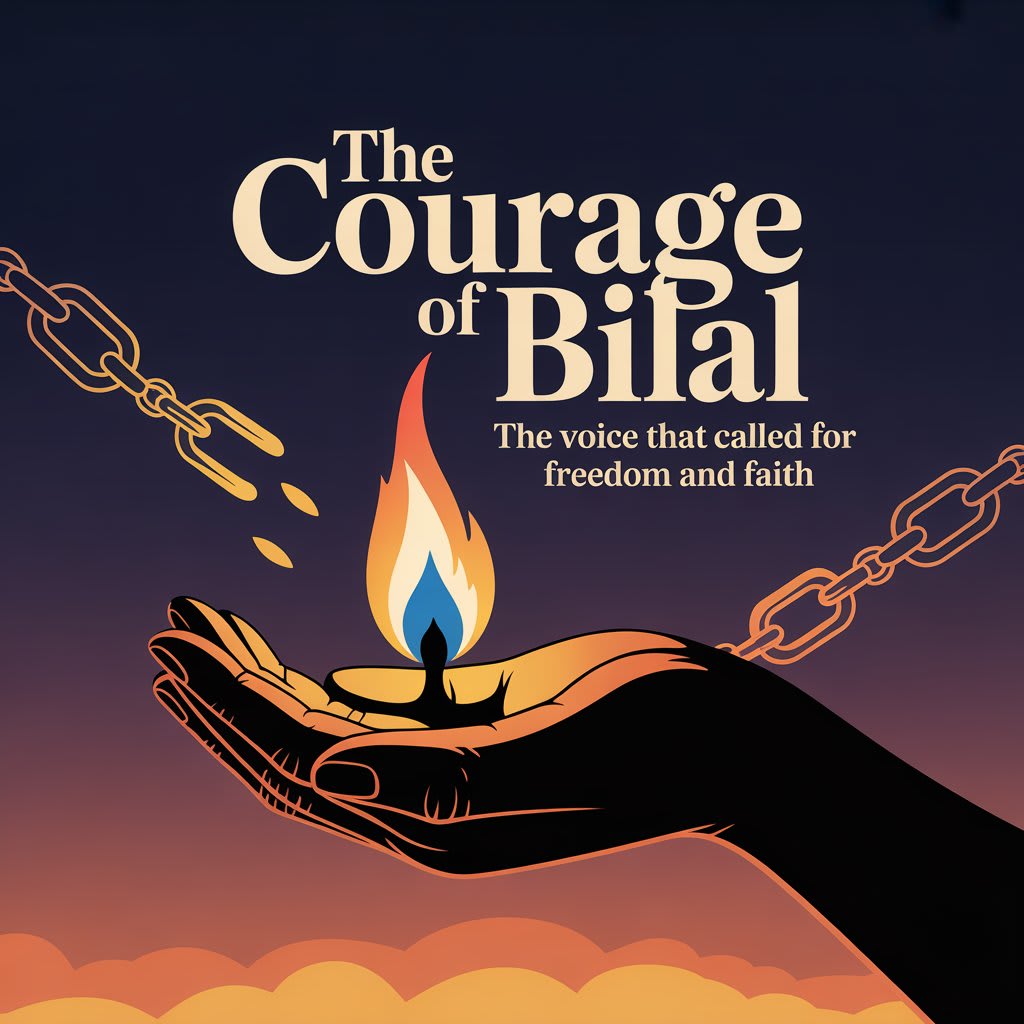
In the early days of Islam, when the message of one God challenged the powerful idols and traditions of Mecca, many brave souls stood firm in their faith despite facing unimaginable hardships. Among these was Bilal ibn Rabah, a man whose courage and steadfastness made him a shining symbol of freedom, faith, and resilience.
Bilal was born into slavery in Mecca, of Ethiopian descent. As a slave, his life was filled with hardship and injustice, but his spirit remained unbroken. When the message of Islam reached him through the teachings of Prophet Muhammad (peace be upon him), Bilal found a truth that changed his life forever. He embraced Islam wholeheartedly, proclaiming his belief in the oneness of Allah and the prophethood of Muhammad (PBUH).
However, accepting Islam in those days was not easy, especially for a slave like Bilal. The Quraysh leaders, who controlled Mecca, were fiercely opposed to this new faith that threatened their wealth and social order. They targeted the early Muslims with cruelty and torture, hoping to force them to renounce their beliefs.
Bilal’s owner, Umayyah ibn Khalaf, was one of the most ruthless opponents of Islam. When he discovered Bilal’s conversion, he subjected him to brutal torture in an attempt to break his will. They would drag Bilal into the scorching desert sun, lay heavy stones on his chest, and beat him mercilessly. Despite the pain, Bilal would only repeat one phrase with unwavering determination: “Ahad, Ahad” — meaning, “One, One” — affirming the oneness of Allah.
His courage in the face of such torture amazed many. Even when other slaves or companions lost hope, Bilal’s faith never wavered. His steadfastness became a beacon of inspiration for the Muslim community, showing that true freedom comes not from chains being broken, but from the soul being free in faith.
Prophet Muhammad (PBUH) himself recognized Bilal’s strength and devotion. One day, after hearing of Bilal’s suffering, the Prophet approached Abu Bakr (RA), a close companion known for his generosity and courage, and asked him to purchase Bilal’s freedom. Abu Bakr did so immediately, rescuing Bilal from slavery and granting him his rightful dignity.
Once free, Bilal’s role in the growing Muslim community became even more significant. The Prophet appointed him as the very first Muezzin — the one who calls Muslims to prayer. His powerful and melodious voice echoed across Medina, calling the believers five times a day to worship Allah. This was a position of great honor and responsibility, and Bilal carried it with humility and pride.
Bilal’s story is not only one of personal courage but also a testament to Islam’s revolutionary message of equality and justice. In a society that valued lineage and wealth, Bilal—a former slave—was elevated to a position of respect and prominence purely because of his faith and character. His life challenged the norms and inspired countless others to embrace the truth regardless of their status or background.
One of the most moving moments in Bilal’s life came during the Prophet’s final pilgrimage, known as the Farewell Pilgrimage. Standing alongside the Prophet, Bilal’s voice rose in the call to prayer, reminding all present of the unity and brotherhood that Islam stood for. His call was a reminder that in the eyes of Allah, no one is superior except by piety and good deeds.
Bilal’s courage continued even after the Prophet’s passing. During the reign of the first caliph, Abu Bakr, Bilal remained a close companion and continued to lead the call to prayer. His life was a living example of how faith could transcend the deepest scars of oppression.
His legacy lives on today in every call to prayer heard around the world. The sound of the Adhan carries with it the spirit of a man who refused to let chains—whether physical or spiritual—define him. Bilal’s voice reminds Muslims everywhere that courage, faith, and freedom are intertwined and that true strength lies in steadfast belief.
Bilal ibn Rabah’s story teaches us many lessons: the power of patience in the face of suffering, the importance of standing firm for justice, and the revolutionary nature of Islam’s message of equality. His life is a timeless reminder that no matter one’s beginnings, faith and courage can transform destinies.
About the Creator
Keep reading
More stories from Muhammad Salman and writers in Motivation and other communities.
The Day the Wind Stood Still
The wind had always been a constant companion in Elara’s life. It whispered through the trees near her home, carried the scent of blooming flowers across the fields, and sang softly as she walked the narrow paths of the old village. To her, the wind was more than just air in motion; it was a messenger, a friend, a reminder that life never truly stopped moving.
By Muhammad Salman6 months ago in Motivation
Looking back: 2025 was a beast
It's difficult to know how to start this. I've suggested that it's been a tough one from my title and in many ways, it has; however, there is an argument that it's not been that extraordinary at all, merely this wonderful thing we call "life" with all its climaxes and pitfalls.
By Rachel Deeming29 days ago in Motivation
Start Now, Not Tomorrow
I used to believe I had time. Time to grow. Time to change. Time to chase my dreams. Whenever life felt uncomfortable, I told myself, “I’ll start tomorrow.” Tomorrow felt safe. Tomorrow felt forgiving. Tomorrow didn’t ask anything from me except patience.
By Fazal Hadiabout 19 hours ago in Motivation



Comments
There are no comments for this story
Be the first to respond and start the conversation.