
The Color of Returning
A Story of Unfinished Conversations and the Healing Power of Forgiveness
Every town has a name, but some names carry more than just a place—they carry echoes. For Mikal, the name “Darya” wasn’t just a town. It was regret in brick and stone.
He left when he was nineteen. Angry. Proud. Unapologetic.
He returned sixteen years later. Tired. Changed. Carrying a letter he never thought he’d need to deliver.
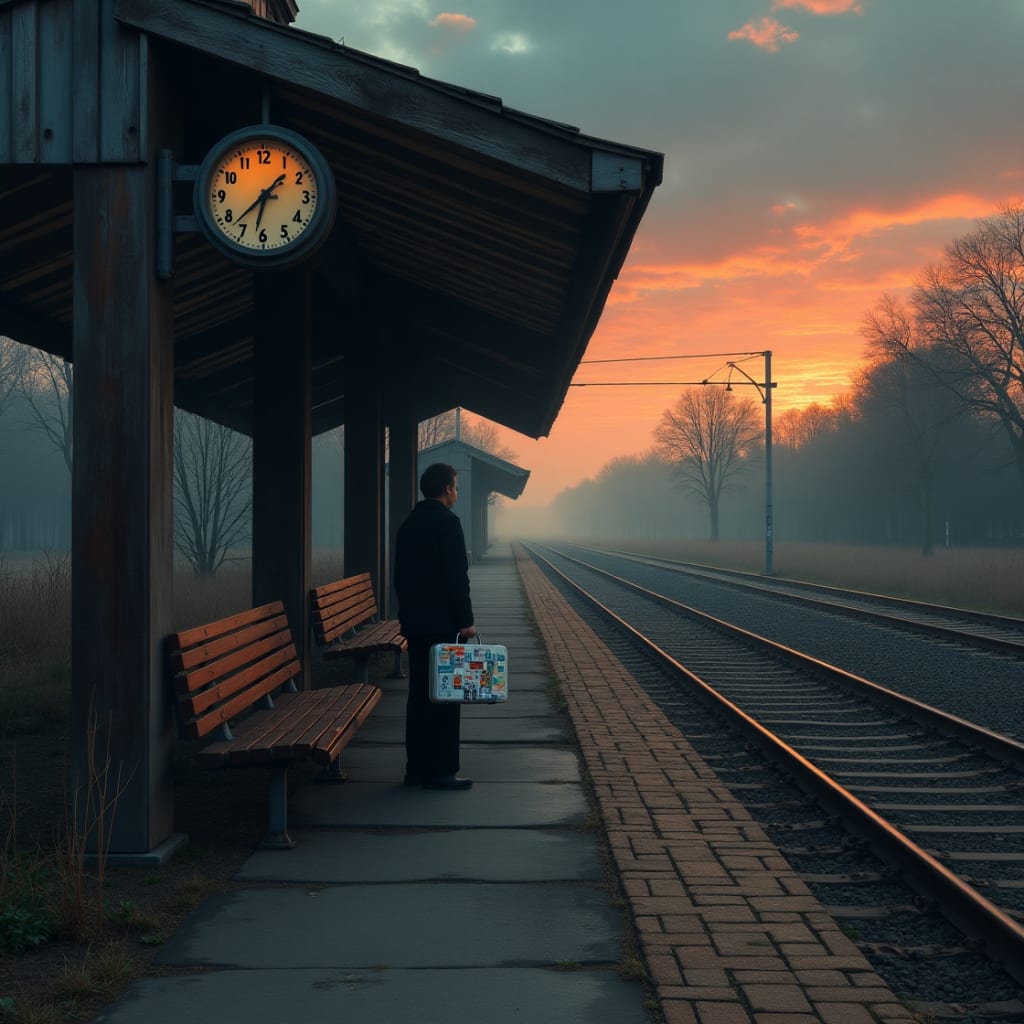
The train hadn’t run in ten years, but the station still stood. That was the strange thing about places left behind—they waited longer than people ever could.
Chapter One: The Letter
It was written in shaky cursive.
“Mikal, if you ever come back, please read this before you say anything.”
It was signed: Aba.
His father had passed three months ago. A distant cousin found him in a small cottage outside the town, alone, heart failure they said. Among his belongings were old photos, a rusted fishing rod, and the letter with Mikal’s name on it.
They hadn’t spoken since the night Mikal stormed out—after a screaming match that shattered dishes, slammed doors, and left words in the air that neither of them ever took back.
Mikal hadn’t even known his father wrote letters. The man barely spoke in complete sentences when he was angry.
The letter began with something unexpected:
“Son, I never knew how to love you gently. But I never stopped loving you.”
That was the first crack in the dam.
Chapter Two: The Old House
Darya hadn’t changed much. The bakery still had the same chime when the door opened. The librarian still wore thick glasses and a cardigan, even in summer. Kids played cricket in the alley near the mosque, just like they used to.
But the house?
Empty.
Dust clung to everything like memories. His old room still had the sketch he drew of a rocket taped to the wall, corners curling. In the drawer, he found a faded photograph of the two of them—Mikal at age six, fishing rod in hand, his father smiling just a little.
On the back, in almost invisible ink: “He caught nothing, but said it was the best day of his life.”
That night, Mikal sat on the porch, staring at the stars. He whispered, “Why didn’t you ever say any of this when you were alive?”
And that’s when he learned the first thing:
Some hearts are loud in silence, and some apologies arrive in the form of a letter you’re not ready for.
Chapter Three: The Girl with the Red Scarf
At the town’s edge stood a flower stall, still painted blue, still surrounded by wild marigolds. Behind it stood Zoya.
She used to wear a red scarf every Thursday in high school. Mikal remembered because it clashed beautifully with her dark hair and the sadness in her eyes.
He didn’t expect her to recognize him. But she did.
“I thought you’d never come back,” she said, no anger in her voice. Just quiet surprise.
“I thought I didn’t need to,” he replied.
“Did you?”
“No,” he whispered.
She poured him tea, just like she used to do during long study nights. They sat beside the flower stall as the sun dipped behind the hills.
“I heard about your father,” she said gently.
“I didn’t even say goodbye.”
“You came back. That’s something.”
She handed him a small bouquet of jasmine.
“For the grave,” she said. “Even the unspoken deserves flowers.”
And he realized then:
Coming back doesn’t erase the leaving, but it makes space for forgiveness to grow.
Chapter Four: The Color of Walls
Mikal spent the next few days cleaning the house. He found a small journal behind the sofa—his father’s. It wasn’t much, just a few lines scribbled every now and then.
But one entry stood out:
“He painted his room green before he left. I never told him it was my favorite color too.”
That line made Mikal sit down, head in hands.
Why do we say everything except what matters?
The next day, he bought a can of green paint. The same shade. He spent hours repainting the room, stroke by stroke, like he was trying to rewrite time.
That was when he truly understood:
Memories aren’t locked in things—we repaint them every time we choose to return.
Chapter Five: The Broken Clock
At the old railway station, Mikal found the clock still stuck at 5:17.
That was the time of their last argument. He remembered because when he walked out that day, he glanced up at the clock, swearing he’d never look back.
It felt poetic now, almost cruel.
He climbed up the rusty ladder, opened the back of the clock, and adjusted the hands. Slowly, deliberately, he moved them forward.
Tick. Tick. Tick.
The sound returned, soft and steady.
Sometimes, forgiveness is fixing what doesn’t ask to be fixed.
He sat on the edge of the platform and watched the town breathe beneath the dusk.
A small voice interrupted him.
“Excuse me, are you the man who used to live in the green house?”
A girl, no older than ten, stood with a paintbrush in one hand and a notebook in the other.
“Yes,” he said, smiling. “I used to.”
“My teacher said you were an artist. We’re painting the school fence. Can you show me how to make leaves look real?”
He nodded. “Of course.”
And in that moment, something shifted.
Not grand. Not dramatic.
But real.
He taught her how to layer the greens, how to shade the edges.
Later, as she ran off, he looked at his hands.
Still steady. Still capable.
And that was the final thing he learned:
You’re never too late to give something good to the world—even if it’s just teaching a child to paint a leaf.
Epilogue: The Return Never Ends
Mikal never moved back to Darya completely. But every season, he visited. The green house became a place for weekend art workshops. The flower stall and Zoya’s laughter filled his Sundays with color. And the train station? He turned it into a storytelling cafe.
Every wall had a letter framed on it.
Some from strangers. Some from parents. Some never sent.
One wall held a single letter behind glass. The one that changed everything.
"Mikal, if you ever come back, please read this before you say anything..."
Because returning isn’t about the distance you traveled.
It’s about the door you’re finally willing to open.
And once opened, some doors don’t close again.
About the Creator
Atif khurshaid
Welcome to my corner of the web, where I share concise summaries of thought-provoking articles, captivating books, and timeless stories. Find summaries of articles, books, and stories that resonate with you
Keep reading
More stories from Atif khurshaid and writers in Motivation and other communities.
Echoes of the Rain
The rain had always spoken to Elina. When she was a child, it spoke in giggles as she jumped barefoot into puddles. When she was fifteen, it whispered comfort the night her mother didn’t come home from the hospital. And now, at twenty-six, it murmured gently outside the old library window as she turned the final page of a letter she had read a hundred times.
By Atif khurshaid11 months ago in Motivation
The Breakthrough You’re Waiting for Is Already in Motion
Most people quit right before the breakthrough. They quit when the grind gets loud, when the effort outpaces the reward, when progress seems invisible. They confuse silence with failure, struggle with stagnation, and patience with passivity.
By Imran Pisania day ago in Motivation
Two Grumpy Old Men Solve the Problem
Marty and Steve were two grumpy old men who lived together. They had known each other for years. Marty had been a bachelor all his life. Steve said it was because no one could stand to ever live with. Marty’s standard reply was “Well, you are, so what sort of a moron does that make you!”
By Calvin London2 days ago in Humor


Comments
There are no comments for this story
Be the first to respond and start the conversation.