
The Boy Who Walked on His Hands: A Tale of Courage and Burden
How ten-year-old Raheela Mughal Yohan overcame paralysis to reach school while our children struggle under heavy backpacks.

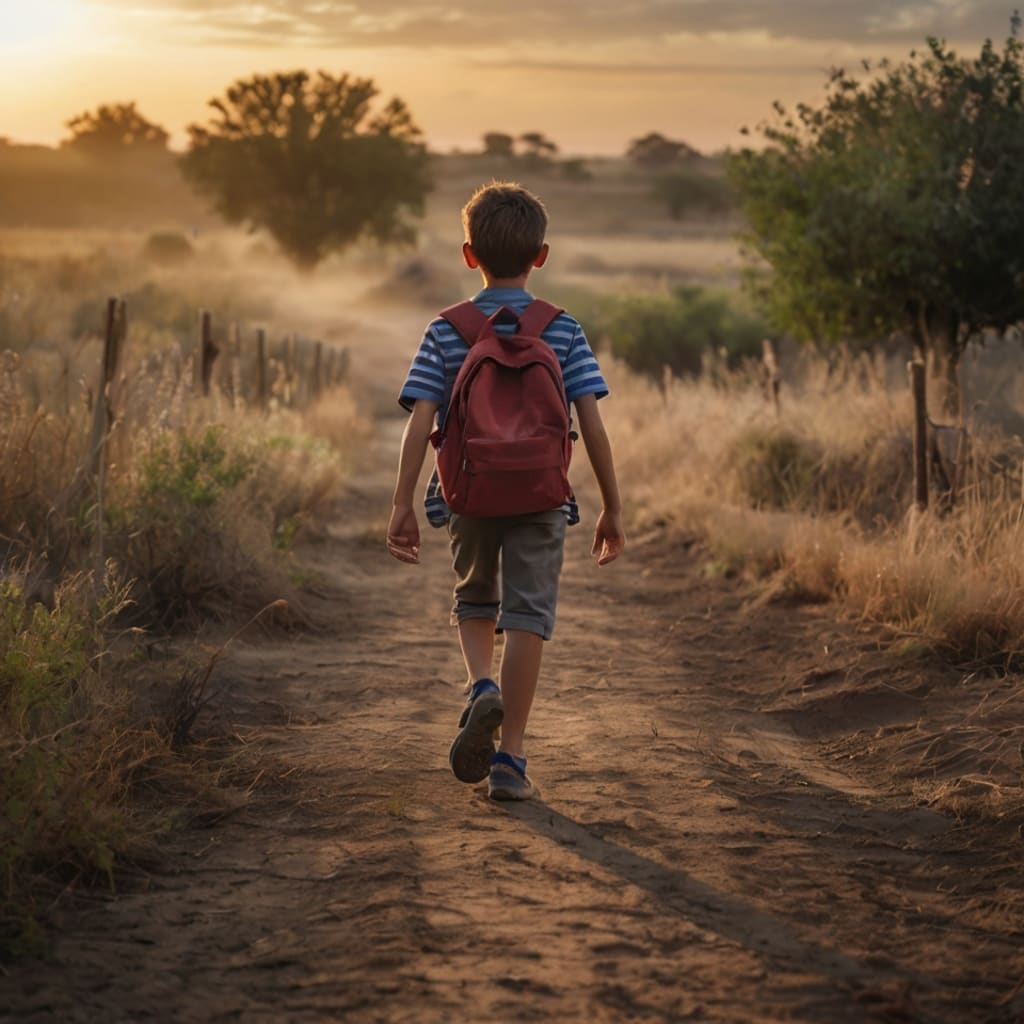
The Courage of Raheela Mughal Yohan — and the Burden Our Children Carry
BY: Ubaid
Raheela Mughal Yohan is a ten-year-old boy from China, but his story carries a lesson for children across the world. He was only a year old when a sudden illness left the lower half of his body completely paralyzed. For many, such a life-altering disability might have closed the doors to childhood dreams and ambitions. But Yohan refused to let physical limitations turn into mental barriers.
As he grew older and watched other children his age walking to school every morning, a fire awakened inside him — a desire to learn, to grow, and to stand tall in the only way he could. He decided that disability would not decide his future.
And so, he made school a part of his life.
Since he could not stand or walk like others, Yohan created his own way of moving forward. Balancing on his palms, lifting his entire body weight on his hands, he would slowly “walk” to school. Every morning, before the sun fully rose, he would begin his journey. It took him nearly one and a half hours to reach the school gate. His younger sister accompanied him, carrying his schoolbag on her shoulders. Together they crossed rough paths, uneven roads, and long distances.
Whenever Yohan grew tired, the two siblings would stop to rest for a few minutes — and then continue again. There were no complaints, no excuses, and never a day when Yohan used his disability as a reason to avoid homework or school. His palms became his feet, his determination became his strength, and education became his dream.
Yohan’s story is, at first glance, a tale of extraordinary courage. But it also forces us to look closely at our own societies — especially in countries like Pakistan — where countless young students carry a different kind of burden.
Walk along any busy street at sunrise, and you will see them: small children with heavy backpacks strapped to their shoulders, their steps slow, their bodies bent, their faces sleepy yet determined. The metal rods on school vans are covered with dangling schoolbags, packed so tightly they look like they might drag the children backward.
These are not students carrying the weight of dreams — these are children carrying the weight of books heavier than their bodies can bear.
A sixth-grade child in Pakistan is usually around 11 to 12 years old and weighs roughly 30 to 32 kilograms. Yet the backpack he carries often weighs far more than the recommended limit. A fifth-grader, just 10 or 11 years old, weighs about 28 to 30 kilograms. Fourth-graders, 9 to 10 years old, weigh around 24 to 26 kilograms. And it continues downward: third-graders weighing 22 to 25 kilograms, second-graders 20 to 22, first-graders barely 16 to 18, and kindergarten children just 14 to 16 kilograms.
Medical experts around the world agree on one simple rule:
A schoolbag should never exceed 10–15% of a child’s body weight.
But in reality, we see children whose bags feel closer to 30–40% of their tiny frames — a slow punishment disguised as education. Their shoulders remain tilted all day. Their spines strain. Their young bones carry stress they were never designed to handle. Their walk to school resembles not a journey of learning, but a silent struggle.
Where Yohan overcame the weight of disability, our children struggle under the unnecessary weight of educational systems. Where Yohan found strength in hardship, many of our children lose health because of avoidable burdens.
And that contrast is what makes his story so powerful.
Yohan, a boy who cannot use his legs, accepted school as a blessing. He turned his pain into purpose. He found a way forward with nothing but the strength of his palms and the support of a loving sister.
Meanwhile, in our cities and villages, thousands of children fully capable of walking are being held back by something much simpler — the weight of their schoolbags. They are not disabled, yet we unintentionally disable them with pressure, load, and neglect.
Imagine the possibilities if our systems were as determined as Yohan.
Imagine the strength of a generation whose physical and mental health were protected.
Imagine children walking freely, not bent under unnecessary loads.
Yohan’s journey teaches us more than courage. It teaches us gratitude, perspective, and responsibility. It reminds us that education is not supposed to break a child’s back — it is meant to build their future.
As we admire the bravery of a boy who learned to walk with his hands, let us also think of the children in our own neighborhoods, walking with bent shoulders. Their struggle is different, but just as real.
If a ten-year-old boy with paralyzed legs can reach school every day with determination and hope, then surely we can lighten the burden on our own children — literally and emotionally.
Because the true purpose of education is not weight, but wisdom.
About the Creator
Keep reading
More stories from Ubaid and writers in Motivation and other communities.
Why We Compare Ourselves to Others
Have you ever scrolled through social media and suddenly felt like everyone else is doing better than you? Someone got a new job, someone started a business, someone is traveling, and another person seems to have the perfect life.
By Being Inquisitive6 days ago in Motivation
Why Didn't Anyone Tell Us
Men, move along. This is not for you. This is for the women. I was forty-five when I began menopause. It is pretty young for that to be going on in a woman’s life, but I had undiagnosed PCOS, my entire life. Thank you to all the gynecologists I had seen my entire life. That in itself should encourage women to keep seeking second opinions, especially when you are not getting correct answers or any at all.
By Alexandra Grant6 days ago in Humans


Comments
There are no comments for this story
Be the first to respond and start the conversation.