
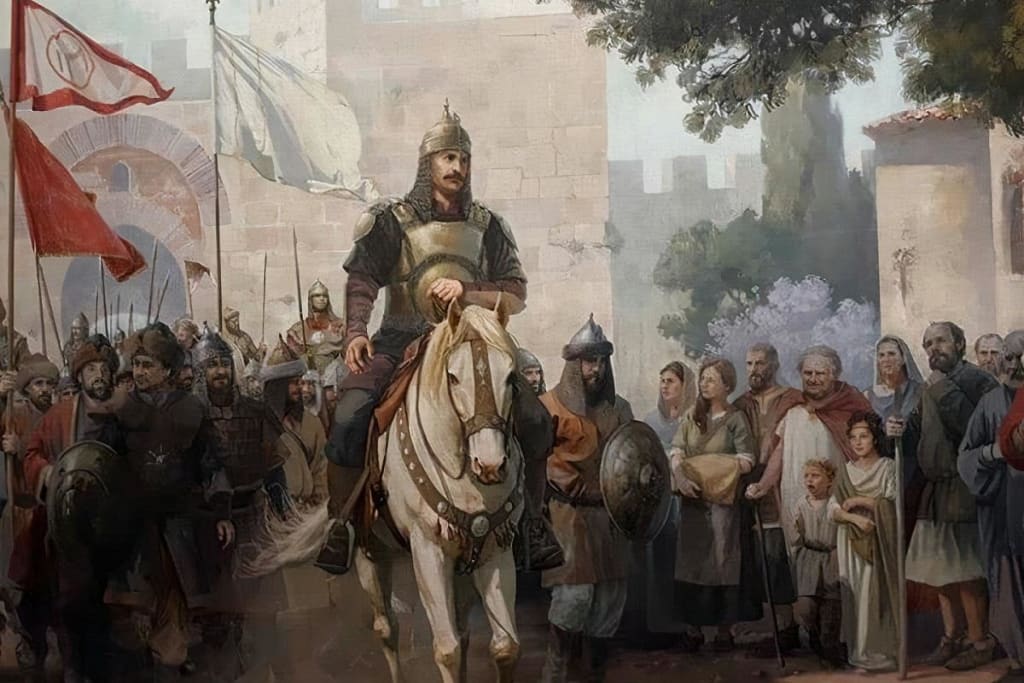
Sultan Orhan Gazi was the second ruler of the mighty Ottoman Empire, a name remembered with great reverence in Islamic and world history. He was born in “1281 CE”, during a time of political chaos and the weakening of the Seljuk Sultanate. His father, “Sultan Osman Gazi”, had laid the foundation of what would become a powerful Islamic empire after the collapse of the Seljuk rule. Following his father’s death, Orhan ascended to the throne and began to build on the legacy he had inherited.
Sultan Orhan Gazi's reign began in “1326 CE” and lasted until “1362 CE”. During these 36 years, the Ottoman state grew from a small principality into a significant regional power. Orhan Gazi was known not only for his military prowess but also for his keen strategic insight, administrative skills, and deep religious devotion.
From his early years, Orhan was trained in horsemanship, military strategy, and Islamic education. His youth was shaped by the battlefield rather than the palace. His leadership abilities and courage were proven in several battles even before he became sultan. When he assumed power, the Ottoman borders were still limited. However, under his command, a wave of successful campaigns rapidly expanded Ottoman influence.
One of his earliest and most significant achievements was the “conquest of Bursa” in 1326, which was then one of the most important cities under Byzantine control. Following its capture, Sultan Orhan made Bursa the capital of the Ottoman Empire. This marked a major turning point in Ottoman history and was symbolic of the growing power of the Turks in Anatolia.
Understanding the importance of a strong, disciplined army, Sultan Orhan established a professional military unit that later came to be known as the “Janissaries (Yeniçeri in Turkish)”. This elite force played a crucial role in Ottoman victories for centuries and formed the backbone of the empire’s military might. It was under Orhan’s leadership that this army was organized and trained, making the Ottomans one of the most formidable powers in the region.
Sultan Orhan was also a wise political strategist. He saw the internal weaknesses of the “Byzantine Empire” and used them to the advantage of the Ottomans. By forming timely alliances and launching decisive military campaigns, he expanded Ottoman territories significantly. He was the first Ottoman sultan to “send troops into Europe”, marking the beginning of the Ottoman expansion into the Balkans — a historical shift that would continue for centuries.
Among the major cities he conquered were “Izmit (Nicomedia)” and “Iznik (Nicaea)”, both vital centers of trade and culture. These victories further solidified the Ottomans' hold over northwestern Anatolia and weakened Byzantine resistance.
Despite his numerous military campaigns, Sultan Orhan was not solely a man of war. He is equally remembered for his “just governance and administrative reforms”. He established a system of justice that became a model for other Islamic states. Courts were set up, laws were codified, and both Muslims and non-Muslims were treated with fairness under his rule. This commitment to justice won him the admiration and loyalty of his subjects.
Furthermore, Sultan Orhan invested heavily in public welfare. He ordered the construction of “mosques, madrasas (Islamic schools), caravanserais (inns for travelers and traders), and public baths”, facilitating both religious and commercial life. Education and trade flourished during his rule, and these foundations paved the way for the Ottomans' transformation into a cultural and economic powerhouse.
Sultan Orhan’s rule was not just about expanding borders, but also about “building institutions” that could support a long-lasting empire. His governance laid the framework for the administrative and military structures that would serve the Ottomans for generations.
After ruling for nearly “four decades”, Sultan Orhan Gazi passed away in “1362 CE”. By the time of his death, the Ottoman Empire had grown significantly, both in size and strength. What began as a small principality under Osman had become a formidable Islamic state under Orhan.
After his death, his son “Sultan Murad I” succeeded him and continued the expansion into Europe, eventually reaching deep into the Balkans. The groundwork laid by Orhan was vital in enabling this future growth.
Today, “Sultan Orhan Gazi is remembered as one of the greatest rulers in Turkish and Islamic history”. His legacy is honored in Turkey, especially in the city of Bursa, where he is buried. His tomb is a site of respect and remembrance, visited by thousands of people each year who come to pay tribute to a man who helped shape the destiny of an empire.
Sultan Orhan Gazi’s reign represents a “golden era in early Ottoman history” —an era marked by vision, valor, justice, and enduring achievements. His life is a powerful reminder that leadership is not just about winning battles, but about building institutions, serving justice, and uplifting society.
About the Creator
Ahmad shah
In a world that is changing faster than ever, the interconnected forces of science, nature, technology, education, and computer science are shaping our present and future.
Keep reading
More stories from Ahmad shah and writers in Motivation and other communities.
The Lion of Khwarazm
I. The Only Man Who Dared History remembers many conquerors, but rarely does it preserve the name of a man who stood alone against a storm, defying fate itself. One such name is Sultan Jalaluddin Khwarazm Shah – the only warrior who challenged the wrath of Genghis Khan and emerged with honor. Not once, but time and again, Jalaluddin faced the Mongol juggernaut with unmatched courage and tactical brilliance. Of all the warriors Genghis Khan ever fought, only Jalaluddin earned his admiration.
By Ahmad shah7 months ago in Motivation
How Great Leaders Communicate
The moment she walked in the room, skeptics. The business was losing money. Moral reached its lowest point. Engineers updated their resumes without fuss and board was three weeks away from pulling the plug completely. Maya had no PowerPoint deck, no images and no expensive corporate script when she stepped to the front of that conference room.
By StoryNest3 days ago in Motivation
The Marathon of Hope: The Story of a Man Who Never Ran Out of Courage
Sometimes life takes away something very precious from us just to see how strong we really are. This is the true story of a young man named Terry Fox. Terry was a very active boy who loved sports. He was a basketball player and a runner. He had big dreams for his future. But when he was only eighteen years old, he felt a sharp pain in his right knee. When he went to the doctor, he received the most terrible news: he had bone cancer.
By Hazrat Umer3 days ago in Motivation
Flower Bloom 369
FLOWER Bloom 2/25/26 Wednesday By Mariann Carroll Karen had been with Tony for 7 years. Tony started acting strangely after her surgery. He would mow the lawn in the rain and be on his cellphone. He started pushing Karen away. Tony came clean about seeing someone. Karen moved out two months later. Karen moved in with a friend. She felt betrayed.
By Mariann Carroll5 days ago in Fiction



Comments
There are no comments for this story
Be the first to respond and start the conversation.