
Stop Procrastinating
Get work done without distraction


According to Dictionary.com procrastination means:
the act or habit of procrastinating, or putting off or delaying, especially something requiring immediate attention
Procrastination can be a very harmful behaviour which all of us exhibit at times, where we choose the easy short-term in favour of doing something harder now, like getting that work for the ever encroaching deadline complete.
"Tomorrow is the killer of dreams" - saying 'I'll do it tomorrow' has ruined countless dreams.
Choosing to take the easy option now will only make things harder for us in the future, so be kind on your future self and take some action, it doesn't have to be a lot, just a little will add up over time.
So what ways are there to reduce distractions and increase productivity?
- Remove distracting apps
- Move your phone
- Start small
- Play focus music
- Timetable yourself
- 52-17 rule
- Burn off excess energy
- Make your bed in the morning
- Avoid working whilst in bed
- Less than 2 minutes rule
1. Remove distracting apps

Avoiding distraction can be as simple as removing that pesky app from your phone home screen.
If you find yourself always going on TikTok, Facebook, Instagram or any other app when your brain begins to wonder, and it has become almost instinct through reinforced habits to fall back on mindlessly stroking your phone like so many of us do, then a good first step would be to remove the widget from your home screen.
You don't have to uninstall the app completely, but by making it harder to access by having to troll through all of your apps on your phone to reach it, you will be much less inclined to habitually fall back on it when your mind has time to think, this will also give you time to consciously stop yourself from being sucked into these apps that are forever fighting for your precious time.
And if you still find yourself making your way to this app whenever you go on your phone when you should be getting other things done, then it may be worth considering getting rid of this app for a time so that it stops distracting you and you can begin to work without the temptation of it. This may seem hard without it to begin with, but you will quickly find other, often more productive, things to do with your time now that it isn't being taken up so much by these scroll hole applications.
2. Move your phone

With your phone on the desk next to your work station, it may be convenient for you to check social media updates and texts, but when you need to get work done it can present a real distraction.
You go on there to quickly respond to a message, and before you know it an hour has gone by and all you've done is scroll through superficial content on an app designed to do exactly that, steal your time and keep your attention with just the right amount of dopamine at the right times.
Algorithms for apps such as Instagram know exactly what type of content you like, they only give it to you in moderations so that you keep scrolling for the good ones, it is an addiction. An addiction you need to fight if you want to be productive and get work done.
So take your phone, put it on mute, and place it out of arms reach. Out of sight, out of mind as the saying goes. Place it so you can't see or hear it and would require you to get up out of your chair to get it.
Now once you start working, you won't be distracted by the notifications or the temptation to use your phone for that instant fix of dopamine. Instead you will achieve a higher form of gratification once you have done some productive work that will help you out now and in the future.
3. Start small

"A journey of a thousand miles begins with a single step" as the Chinese proverb goes.
Instead of getting overwhelmed about the sheer volume of work that needs to be completed, break the task down. Look at the first bit of the task, how you would start, and plan what needs to be done.
Then start. Not with the expectation of doing hours of work, but start simply with 15 minutes. Aim for doing just 15 minutes of concentrated uninterrupted work.
You will find that psychologically, this is a much less daunting task, and you will find it a lot easier to get started. Getting started is often the hardest part and once you've overcome this initial obstacle you'll be in a much better place to get work done.
Now that you are started, and are in the flow of working, if you have time and are able to, do some more work. Continue working until you begin to slow down and the flow of work isn't as smooth anymore.
Obviously the closer the deadline, the more you should push yourself, which is why your should start early and do little by little on a regular basis.
If your deadline is in a week, work out how much work you would need to complete each day to get it done in time, leaving the least amount of work till the last day so you can proof it and make sure it is up to standard.
Then make it a habit to do just 15 minutes a day; and if you feel like it, carry on. The more you do now, the less you have to do in the future, you will be glad when tomorrow comes that you did that work and you will feel fulfilled as you have been productive.
4. Play focus music

Music can be a good way of stopping noise distractions around you, and stopping your mind from wandering as the silence will be filled with the sound of music.
However, lyrical songs can be distracting as you may get caught up on the words and meanings of the lyrics in the songs. And more lively and energetic music is also likely to waver your attention to your work.
More relaxed music such as Classical pieces or Low Fi beats are goods ways of having music to increase your productivity and make doing the work more enjoyable whilst not distracting you as other music may do.
What works best for you may vary and you may need to experiment to see whether silence works best for you, or the soothing sound of jazz, or classical pieces.
It will also likely depend on the environment in which you are working, as in a busy coffee shop there will be much more noise and conversational distractions around you than in a quiet room at home. So you may have to vary up your methods, where silence may work at home, the interesting topics of a stranger's conversation may sway your attention to your work.
5. Timetable yourself
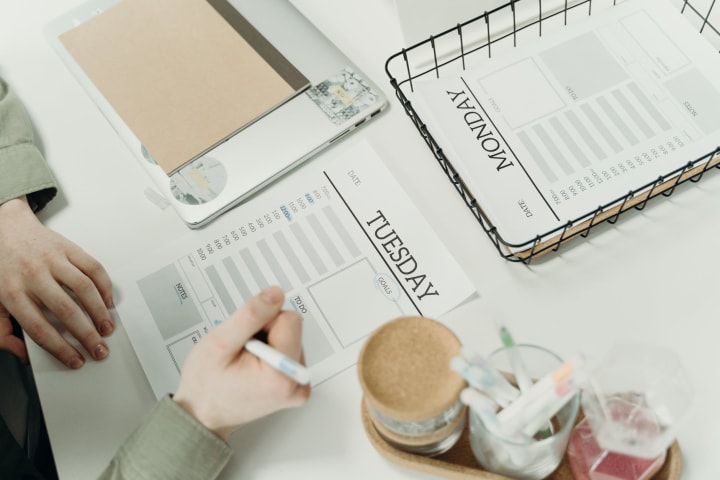
Using daily and weekly planners are good ways of keeping track of goals and the tasks needed to be completed to achieve those goals.
Planning out your goals for the week allows you to allocate tasks to each day that needs to be done so you can follow your progress and make sure you are on top of the work.
Daily planning is then essential to make sure you get the work done that you need to for that day. When you wake up in the morning, especially if you have a busy schedule wake up early, then get out your daily planner or a sheet of paper that you then write the hours of the day down the side in half hour chunks, then begin to schedule in what you will do for the day.
First put in the necessary time needed for breakfast, lunch and dinner if you will be working past dinner time, this way you make sure you have time to relax and have some food. Then any other obligatory time sensitive requirements like if you have an appointment or meeting booked.
Now that you have the pre-existing times and activities scheduled in, you can fit in the tasks around them and you'll be able to see when you can fit in time to complete work required for an objective for the day.
Give yourself a little bit extra time for each task in anticipation that it'll run over, so if it is likely going to take 20 minutes, give yourself the full half hour slot for it.
This should only take a few minutes to organise what you need to do for the day and when. Once you have your timetable, you follow it and do the allotted task in the time you gave yourself.
You will find it easier to complete the tasks for the day and not procrastinate them till later when you have scheduled in a time for yourself to do them, and it will feel much more achievable having also followed the advice from the previous section about breaking the task down.
6. 52-17 rule

Draugiem Group found that the most effective employees worked at a ratio of 52 minutes working to 17 minutes break.
By working for a set amount of time at a time, you not only have an achievable objective to aim for before each break, but the break also gives you a chance to revitalise and refresh your brain. This means that when you come back from your break you will have a new look on what you were doing which will help with creativity and motivation and make you work harder and better than you did before.
Getting up and away from the computer also gives your body the necessary movement to prevent damage to joints from sitting in front of the computer for too long. Also getting the blood pumping around the body even with the steps from your desk to the kitchen and back for a glass of water means that your brain will get a boost of oxygen which also helps your thinking process.
Psychologically as well, doing less than an hours work between breaks means that it will seem less daunting and you will be more easily able to persuade yourself to focus on the work and do the best you can whilst you're working knowing that the break is not far away.
Setting a timer for yourself can be useful so you don't find yourself checking the clock every few minutes to see how far along you are. Simply wait for your alarm to sound and you stop what you're doing and give yourself a nice 17 minutes break.
If you prefer working and having the break within each hour, you can carry this same ratio of work to break over to 45 minutes of work and 15 minutes break, although the most effective according to studies still remains 52-17 if you are able to.
7. Burn off excess energy

Along with walking around the house during your break, it is a good idea to burn off the excess energy you have from sitting still all day.
If you haven't had the chance before working to get in some exercise, even a 15 minute walk as part of your commute or near your house, then give yourself this time during the day.
With excess energy during the day, you may find it hard to work and find yourself more fidgety and restless than normal. So when you get the chance, possibly during your lunch break or whatever time you have available, go for a short walk or do a short workout to get that energy out of your body so you can relax more and focus on your work when you get back to it.
This may also help if you find yourself restless at night and can't sleep, possibly due to physical inactivity during the day, so to help your health and productivity do a little bit of exercise during the day.
Going for a walk, especially in nature, can be very calming for the mind and, as mentioned before, can help you to reset and reinvigorate your brain with the energy it needs to continue to come up with innovative new ideas.
Standing desks can also be a good way of getting in some mild physical exercise whilst also working, especially when you're able to swing your legs under the desk to burn off some of that energy, although they aren't for everyone.
8. Make your bed in the morning

By making your bed in the morning, you start the day with some productivity. It may only be a small task, neatening the covers and pillows and making your bed look nice for when you return to it in the evening, but it puts you in a productive mood and sets you up to achieve lots more throughout the day.
As small and meaningless the task of making your bed in the morning may seem, by making it you are taking an action to improve the state of the environment around you and being productive right from the offset of the day.
This can easily lead to continued small productive tasks throughout the day which add up and mean you've done good work during the day in an effort to improve your situation.
9. Avoid working whilst in bed

It may also be worth avoiding working on your bed, or even if possible not in the same room as your bed as this will allow your brain to keep the association of work and rest separate. However, by working on your bed your brain may find it hard to detach from the work mode when trying to fall asleep, or the opposite where you may find yourself struggling to be productive and focus on getting work done as your brain will be in relaxed mode and preparing to fall asleep.
Not only the cognitive associations but also the pure fact of how comfortable our bed can be may make it much more difficult to work whilst laying in bed, and we may find ourselves slipping away into a drowsy state just wanting to melt into the world of dreams.
This will depend on yourself, as some people find no trouble in working in their bed then falling asleep in it once they are finished working. However, if you find yourself struggling with the work or sleep whilst working from on your bed, it may be worth trying moving to another room, or just up out of bed at a desk.
10. Less than 2 minutes rule

This is where, when you know a task will take less than two minutes to complete, you do it right then. When you recognise it needs to be done, you quickly do it in the moment.
Such as having a cup on your workspace that you need to take to the kitchen. It won't take more than 2 minutes, so in the moment you recognise it needs to be done, you grab the cup, bring it to the kitchen, and return to your work.
Only a minor task, but these little tasks add up. They help to declutter your space, improve your mental wellbeing as a clean space has been shown to make us happier, and leave you less to sort out at the end of the day. As with all procrastination techniques, you will thank yourself later.
Conclusion
Putting off tasks that need to be done can be a destructive habit that means we miss out on opportunities, such a promotion or personal development opportunities, fall behind on deadlines, and possibly lose the desired state of our workspace or room.
It is never too late to improve our productivity and get our goals back on track. Setting clear objectives that need to be completed to achieve those goals, then planning out the tasks required to achieve those objectives are also very important so we can keep track and keep on top of our progress to make sure we're going in the right direction to achieve our goals.
Some tasks only take a matter of minutes, such as applying for a job, but can change our lives. It is up to us to sieve the desired opportunities that we find and that we are fortunate enough to have presented to us.
Use these strategies to improve your productivity over time. It isn't a quick fix process and will require practice and determination, but you know how valuable your goals are to you, and by making habits of some of these strategies that work for you, you could find yourself getting more work done easier than you have before.
We all know of someone with ambitions that they want to achieve, but are struggling to complete the tasks required along the way, for many that applies to us personally.
Help out a friend or family member and share these strategies with them, and together you could build good productive habits to get more work done.
Good luck, and I hope you find this helpful and that you enjoyed reading.
About the Creator
Connor Felix
I am interested in following the latest develops in technology, innovations in automobiles, and best financial practices.
Keep reading
More stories from Connor Felix and writers in Motivation and other communities.
4 Business Books Everyone Should Read
Reading books is a really good way of learning and developing new skills to improve our personal and professional lives. This list here compiles the highest recommended books among entrepreneurs and self-help enthusiasts alike. For best experience and to learn the most from all these books, it is advised that you re-read each book quarterly (every three months).
By Connor Felix6 years ago in Journal
The Last Voice Message
It was a quiet Sunday evening when Daniel’s phone vibrated on the kitchen table. He had just returned home after a long day at work, the kind of day that left your mind empty and your body tired. Outside, the sky was fading into deep shades of blue, and the city lights were slowly flickering on. Daniel poured himself a cup of coffee and glanced at his phone. 1 New Voice Message. The notification made him pause. He frowned slightly when he saw the sender's name. Lucas. Daniel’s heart skipped. Lucas had been his best friend since childhood. They had grown up together, shared secrets, dreams, and countless late-night conversations. But Lucas had died three days ago. A car accident on a rainy highway. The kind of sudden tragedy that leaves people staring at the floor during funerals, unsure what words could possibly make sense. Daniel had stood there at the funeral home, staring at the closed casket, trying to convince himself it wasn’t real. And now… A voice message from Lucas. Daniel stared at the screen, his coffee forgotten. Maybe it was an old message delayed by the network. Maybe Lucas had sent it earlier and it only just arrived. That had to be it. Still, his hands felt strangely cold as he pressed play. For a moment, there was only static. Then a familiar voice spoke. “Hey, Daniel… if you're hearing this, something probably went wrong.” Daniel froze. Lucas’s voice sounded calm, but there was something unusual in it. A strange heaviness. “I’m recording this because… well, I have a feeling something bad might happen tonight.” Daniel felt his chest tighten. Lucas continued. “You know how I always trust my gut. And right now it’s screaming at me.” A quiet laugh followed. “But you’ll probably call me dramatic.” Daniel remembered saying exactly that many times. Lucas had always been the intuitive one. The message continued. “I’m driving back from the lake house right now. It’s raining pretty hard, and the roads are terrible.” Daniel’s grip on the phone tightened. The accident had happened on that same road. Lucas paused for a few seconds before speaking again. “I didn’t want to call because I’d probably just sound paranoid. But there are things I’ve been meaning to say for a long time.” The rain could be heard faintly in the background of the recording. “First… thank you.” Daniel blinked, confused. “For sticking by me all these years. You’re more than a friend, man. You’re family.” Daniel swallowed hard. Lucas’s voice softened. “I know I don’t say stuff like this often, but you deserve to hear it.” Daniel suddenly felt a deep ache in his chest. The kind of ache that only comes from words that arrive too late. Lucas continued. “And there’s something else…” The sound of a windshield wiper swept across the background. “If anything ever happens to me… don’t let Mom stay alone in that house. She pretends she’s strong, but she’s not as tough as she acts.” Daniel closed his eyes. Lucas always worried about his mother. “Visit her sometimes. Even if she says she’s fine.” The message went quiet for a moment. Then Lucas spoke again, slower this time. “And Daniel… there’s one more thing.” A faint rumble of thunder echoed through the recording. “You keep putting your life on pause.” Daniel frowned slightly. “You always say you’ll chase your dreams later. Later when you have more money. Later when things are safer.” Lucas sighed. “Stop waiting.” The rain in the recording grew louder. “You wanted to write stories. You wanted to travel. You wanted to start that podcast we talked about.” Daniel’s throat tightened. “Life doesn’t wait for the perfect moment.” Lucas chuckled softly. “And clearly… neither does fate.” Daniel felt a chill run down his spine. “I guess what I’m trying to say is… don’t waste time the way I did.” The car engine could be heard revving slightly. “If you’re hearing this, it probably means I never made it home.” Daniel’s eyes filled with tears. There was a long pause in the recording. Then Lucas spoke one last time. “But I’m not scared.” Daniel leaned closer to the phone. “I’ve had a good life.” The rain softened slightly in the background. “And I had a great friend.” Daniel wiped his eyes. “Take care of yourself, okay?” A faint smile crept into Lucas’s voice. “And hey… if there’s Wi-Fi in the afterlife, maybe I’ll send you another message someday.” Then the recording ended. Silence filled the kitchen. Daniel sat there, staring at the screen long after the message had finished. Outside, the wind rustled softly through the trees. For the first time since the funeral, Daniel let the tears fall freely. But mixed within the sadness was something unexpected. Clarity. Lucas had known something might happen, and instead of fear, he had chosen to leave behind words that mattered. Daniel slowly stood up and looked out the window at the city lights stretching into the distance. For years he had postponed his dreams. Waiting. Delaying. Convincing himself there would always be more time. But Lucas’s final message echoed in his mind. Life doesn’t wait for the perfect moment. Daniel picked up his phone again. Not to replay the message. But to open a blank document. At the top of the page, he typed the title of his first story. “The Last Voice Message.” And for the first time in a long while, Daniel began to write.
By Sahir E Shafqatabout 17 hours ago in Motivation



Comments
There are no comments for this story
Be the first to respond and start the conversation.