
Shackles of Addiction
Reflecting on addiction after a phenomenal read of "In the Realm of Hungry Ghosts."


Several years ago on a wet December evening in Lehi, UT I bought dinner for a homeless addict woman. On my way to a White-Elephant Sock Exchange Christmas party, I had stopped at Walmart to purchase a pair of infant socks. Yes, I’m that kind of guy. Everyone gifted regular socks while I gave baby socks. As I left the parking lot I noticed a woman shivering on the curb. She wasn’t begging, but did look cold and miserable. The stained puffy jacket gave away her homely state.
I don’t quite know what came over me, but I parked my car and had her follow me across the lane to a nearby Wendy’s. Inside the restaurant I let her order what she wanted. We sat at a window table while she daintily ate chicken tenders. During this time she shared her story.
Drug addict on cocaine, she was in recovery and had been waiting at the corner for her sister. She told me how she’d been in and out of being clean and wanted nothing more than to take custody of her daughter once again. Things were looking good.
I don’t know what health issues she had, but her hair, unwashed and wiry, coupled with sunken skin and yellow teeth, showed the effects of cocaine use, but she said she’d been clean for nearly a year. I believed her. Now that it was Christmas, she was eager to visit her sister and daughter. She also told me how she started to attend church again and was soon to be rebaptized into the Church of Jesus Christ of Latter-day Saints, also known as the Mormon church, the dominant religion of Utah.
A lot of what she said was optimistic. Throughout her meal she continually glanced out the window in case her sister arrived. Her story was a story of fight. After she finished eating, she thanked me for the meal and went back out to the corner. I wished her luck in reuniting with her daughter, getting baptized, and, hopefully, forever abandoning the shackles of addiction.
After our exchange, I went to my party and this woman, who’s name I’ve long forgotten, became a memory of a spontaneous interaction. I should also note, one of the couples at the party was expecting and fought hard and won that pair of infant socks. Win-win.
Eight years later with rarely a thought of that woman and her trials, I read a fascinating book by Gabor Maté titled In the Realm of Hungry Ghosts. Written about addiction, the book details the origins, cause, and potential solutions to an ongoing humanity crisis. Having faced my own behavioral addictions from video game addictions and sex addictions, this book enraptured me.
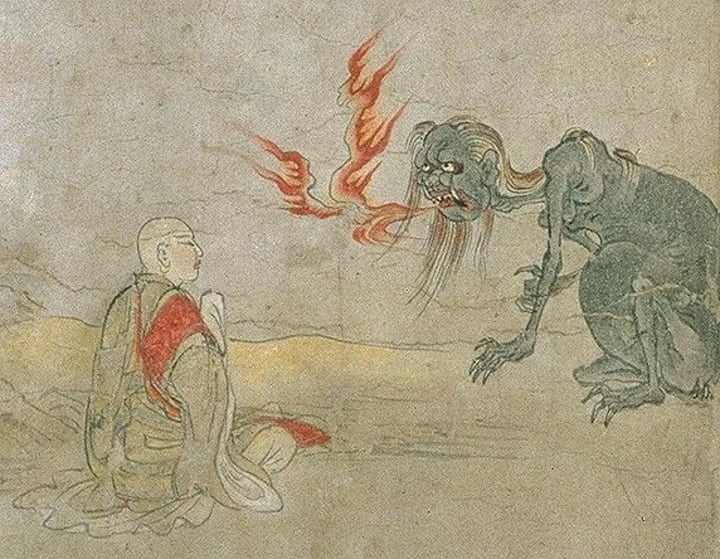
As a side note. A Hungry Ghost is an afterlife being within Buddhism beliefs. People who are gluttons enter the next life and suffer the consequences of their indulgences. They are forever tormented with bulging empty stomachs and constricted throats that let no water, food, or substance enter. They are forever desiring but never relieved. Hollow and seeking only satisfaction, Maté relates drug addicts to these shifting, shambling, zombie-like entities.
Maté is a Hungarian WWII infant-survivor now a doctor in Canada caring for the addicted and cast out. His book shares the stories of many of the people passing through his office, and each story is heartbreaking. From pregnant women trying to wean off drugs for the health and prosperity of their children, to the Aids diseased and infection ridden soul unable to quit despite the excruciating pains, each account left me aching and appalled at humanity. But not the addict. No, I was appalled at their families and the lack of societal support. The lack of true healing.
After spending several chapters beating your emotions with a club, Maté explains the origins of addiction behavior. He talks of upbringing and environmental impacts. Nature vs. Nurture. He explains how modern research claims that thought heroin and cocaine may have addictive tendencies; they are not the cause, and many people can take these and not necessarily become addicted.
Wait. What?
He give an example of soldiers during Vietnam who abused morphine and other drugs to dull the misery of their experience, but once they returned to America many forsook their addictions. I was shocked. Nearly all substance abuse and addictions are tied to the users’ traumatic past and environmental conditions. Nurture, not nature. I knew it was a factor, but Maté presents it as the driving force. Addiction is a symptom, a disease born of horrific pasts. He shares many of his patients' stories. You learn of the abuse and neglect many of these poor people endured. From sexual abuse as small children to neglect and shame. Because of these incidents, most of the addicts seek asylum in drugs or alcohol to escape the emotional pain and memories of their childhood.
Many addicts are victims of sexual abuse or child-pornography. Both women and men had stories of their family members, uncles and fathers or grandfathers, raping them. Unsupported by family or society, poor and destitute, these addicts sought solace from these debilitating traumas the only way they could: substances. Due to the criminalization of drugs, they were labeled criminals and incarcerated or cast out to rot on the streets.
Decriminalization of drugs has always been a change I’ve been in favor of, but being politically inactive, I’ve never voiced such thoughts. I’ve always believed addicts need healing not punishment, but reading this book cemented such fervor. Many tangential crimes such as fraud, stealing, cheating, and muggings are side-effects of addicts attempting to fund their fixes. If we restructured our policies to rehabilitation, give them safe places to wean off the drugs, and provide love and support, I wonder how many of these addicts would recover and rejoin society. How much less would we have to worry about our cars or homes getting broken into?
Maté gives a personalized example of his own addiction to compulsively purchasing CD’s. At first it sounds silly, but he explains the thousands upon thousands of dollars he’s put into purchasing a wide array of classical music, many of which he owns multiple copies. His purchasing habit went so far he deceived his own family about time and money spent in pursuit. His workaholism is another addiction he talks of, and how that is often, sadly, accepted and praised by our economy. He reflects on the impact it's had with his wife and children and to this day he fights the impulses. He traces his trauma to infancy during WWII when he was separated from his mother for a time in Nazi occupied Hungary. Even infant trauma can have a lasting effect.
For me, when a teen, I had addictions to video games and pornography, but really screens in general. For video games, I was obsessed with StarCraft. It consumed me. Made me a petty player and person. Pornography resulted from getting mixed up with friends who smuggled pictures into my middle school. I slipped down the slippery slope.
I was lucky to be born in a home where parents never fought or raised a hand against me. My mother and father loved me. At most, there was a period in my life where my father worked from sunup to sundown to make ends meet, buckling to the pressures of his company. I can’t attribute any trauma to my family, but perhaps to my social life where I was bullied in preschool through middle school. Kid threw a brick at my head when I was four and nearly broke my arm when I was five. I'm a skinny fellow, and my ears grew before my head. Dumbo or lurpy were adjectives following me every hour at school. Even my community friends excluded me from adventures and kids I considered friends bullied me by hiding my things or throwing them in the girls bathroom to get me in trouble. In the end, however, games are fun and sex is well… sex… so, getting caught in their allure is easy for any half-wit teen such as I was. I have a strong control over the two these days and rarely battle with them anymore. The occasional cellphone game gets the better of me and I have to delete it, but for pornography I’m proud of my seven year streak.
Wherever you are in life, be it cruising along or grappling with your own addictions of drugs, alcohol, gambling, eating, or shopping, know that there might be demons in your past you may need to confront. Being open with it, and being open to a 12 step group, are good ideas. At the very least, finding a close friend or partner to trust and confide in is the first step. If you know someone either fighting opioid addiction or come across a homeless person pedaling for cash on the street, the best thing we can do for them is love them. Find a way to create a system where they feel safe, judgment-free, and supported.
I hope someday America, Canada, and any other criminalized states can rethink their approach to combating drugs. Though the substances are harmful and should never be commercialized, the addiction is a symptom, not a crime. We need to look at those poor people and see how they were victims at one time in their life.
I think back to that woman I bought dinner for eight years ago. I wonder what past horrors she endured. What escape did drugs provide for her? Many addicts, despite long spans of abstinence, will often relapse. I wonder if she’s clean. If she got all she wanted. Her daughter. The membership in her family religion. Or if she’s still lost in the depths of those substances. I wonder if she simply recited to me a story of what she thought I wanted to hear… or maybe what she wanted to hear of herself.
Maté’s book struck a strong cord with me. After passing my seventh anniversary of being porn-free, I’ve been deep in reflection of how I overcame the addiction and how much better my life has been. The benefits have resulted in a deeper, richer relationship with my wife whom I’m open with about my tendencies. She supports me, loves me, and never judged me ill for indulging in sexually objectifying media. Such unconditional love aids me in avoiding stimuli which could trigger relapse.
We’re never free of the demons, that’s life, but is there a way that we can support addicts so they can face their demons? Slay their dragons? Will our society become a place where they can find support in people and love? Can we create a way to shake the shackles off the addicted instead of binding them tighter?
About the Creator
Christopher Michael
High school chemistry teacher with a passion for science and the outdoors. Living in Utah I'm raising a family while climbing and creating.
My stories range from thoughtful poems to speculative fiction, fantasy, sci-fi, and thriller/horror.
Keep reading
More stories from Christopher Michael and writers in Motivation and other communities.
Sanitary and Wholesome
If walls could talk, I’d tell you the miracle that I am. I contain the essence of survival, of ingenuity, of human compassion. I also contain the sorrows and the pains, the sufferings and afflictions. I am sanitary and wholesome. Wires snake through my walls like a pulse of dedication to feed into technology that scans and cuts and diagnoses. Mortality is a fragile reality, and too often people are snuffed out of such marvels. But here within my domain, I watch individuals come together to clutch at threads, pull, weave, fasten, and save a life that would have otherwise been consumed to injury, infection, or malicious cells.
By Christopher Michael3 years ago in Fiction
The Breakthrough You’re Waiting for Is Already in Motion
Most people quit right before the breakthrough. They quit when the grind gets loud, when the effort outpaces the reward, when progress seems invisible. They confuse silence with failure, struggle with stagnation, and patience with passivity.
By Imran Pisani4 days ago in Motivation


Comments
There are no comments for this story
Be the first to respond and start the conversation.