
RUN WITH THE PACK : CHAPTER 1
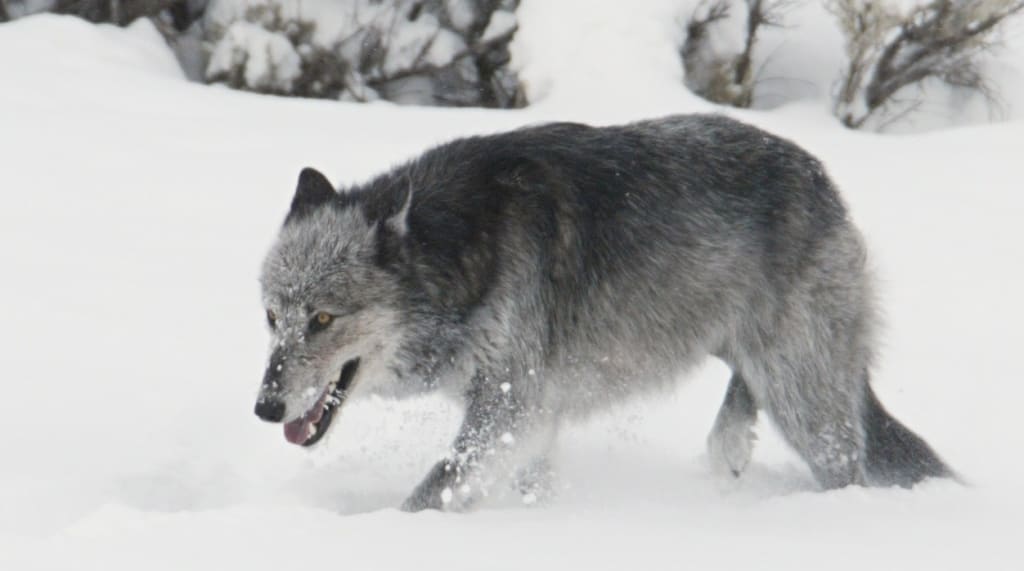
CAST OUT BY HAS FAMILY SHE NEEDS TO FIND FOOD TO SERVIVE THE UNREMTING WINTER
When I needed a word to describe the kind of fiction I sometimes write, there wasn’t one. So I invented a new word
THERIOCENTRICITY
It means putting animals at the centre of things. This might be in a home, in public or corporate policy, or at a zoo. Or, as in my usage of the word:
Writing fictional stories in which the characters and dramatic action are centred on animals.
In the best examples, the whole world within the story revolves around the animal characters. The story is told from the creature point of view, seen through their eyes, felt with their senses.
Please feel free to use this word or to emulate the style that I have suggested with some of my stories. And:
Congratulations to Diane Foster
...for the best definition of this neologism and for giving a definition that is so delightfully written in this Limerick:
THERIOCENTRICITY
by Diane Foster
A scholar with great eccentricity
Preached loud about theriocentricity.
"Let beasts lead the way—
Not humans!" they'd say,
With passion and curious felicity.
Well done for this wonderful whimsical verse and for exactly capturing the intended theme of the word. This completes the challenge and I will be awarding the prize of a $20 tip to Diane Foster, and hoping that she will enjoy spending it on a glass of wine and some poetry to immerse herself in.
Do we need a new word to describe fiction that centres on creatures? Don't we have one in anthropormorphic? Well, yes and no. Yes, you could describe Peter Rabbit, or 101 Dalmations as anthropomorphic – the attribution of human characteristics or behaviour to a god, animal, or object – but Watership Down? The thing about about the bunny book by Richard Adams is that it doesn't give human characteristics to the rabbits. Far from it, Adams describe a world in which humans do not exist, only rabbits and their world. I like to think my Run with the Pack takes a similar approach. A bit like Watership Down or that other book by Adams: Plague Dogs, but with a lot more bite.
There are no people in Run with the Pack (well not yet anyways) and, although the wolf characters in my book appear to converse in English, this is only because if they spoke in wolfish, the reader would not understand. Apart from dialogue, there is no desire for these wolves to behave as if they had human attributes. On the contrary, the aim is to delve into wolf behaviour and social ecology, based on substantial research into the subject. I have even written the dialogue to sound like dogs barking or howling. Here is another of my stories that includes a scene written from two points of view, one being the human protagonist's, the other being that of the wolf this young girl encounters when she runs off into the woods. I hope you like it, as it is one of my favorites.
Here is another story with a wolfy angle. Not sure if it has an element of Theriocentrism or not. What do you think?
How about:
Song of the seagull ?
More anthropomorphic than theriocentric, I'd say
Likewise:
The town fox and the country fox
Stag with a fag
Passed a weary time
How the Earth came to be blue
Is there life on Mars?
Fishy Dishy
Pretty pike
Enough of the resets
Anthropomorphism in literature can be fun. I like to think my Town Fox and Country Fox is an entertaining read and a nice retelling of the mousy myth. On the one hand it attributes mythical qualities to the fox (cunning, deviousness) while on the other it gives them human characteristics. Like speech, and a willingness to be hospitable, inviting a friend to stay.
Yet, while it is easy to write anthropomorphic fiction, theriocentric fiction can be a challenge. If you want to write an anthropomorphic story, you just have to write a normal drama but substitute animal characters. If you have seen the Y2000 movie Chicken Run, you probably realize it is a retelling of The Great Escape but with the action transferred to a Chicken farm. In Chicken Run, the cartoon chickens try to outwit their human captors, rather than wartime German guards.
With theriocentric fiction, it is necessary to present a convincing depiction of animals as characters in their own right, not as cartoon human-like actors. To write theriocentric stories it is important to try to understand how animals see themselves and their world. There is an element of this in Dody Smith's book 101 Dalmations, in which the dogs see the humans as their pets and not the other way around. Perhaps this is the starting point of good theriocentricity writing. And I would say the key to theriocentricity is research, research, research. The real trick is to be able to move the point of view from a human one to a creature perspective.
If you like this idea of writing in a certain animal-centric way, please do give it a try and, as a little teaser, here is a hint of what may soon be coming to the world of theriocentric writing...
About the Creator
Alex irfan
"Dreamer. Storyteller. Time-traveler at heart. I write about futures unseen, emotions untold, and moments that linger long after the last word. Join me on a journey through fiction, mystery, and the magic of imagination."
Keep reading
More stories from Alex irfan and writers in Motivation and other communities.
“The Selflessness of Hatim Tai”
In pre-Islamic Arabia, where evils were everywhere, there were still some good people. Among them was Hatim. Numerous stories have been told about Hatim. Even if we set aside the exaggerations in these stories, the truth remains that Hatim’s generosity is proverbial. In Islam, the generosity of Hazrat Uthman (RA) is exemplary, and countless incidents about him are well known.
By Sudais Zakwan7 days ago in Motivation


Comments
There are no comments for this story
Be the first to respond and start the conversation.