
Risk Is the Downpayment on Success: Lessons from Elon Musk
Lessons from Elon Musk

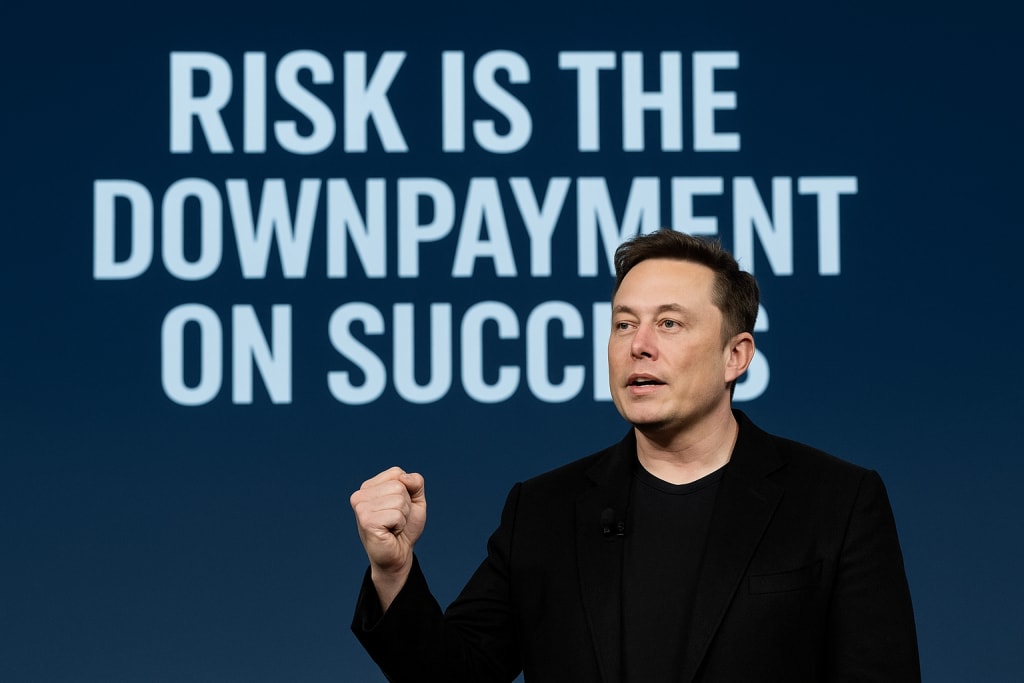
In a world that often clings to comfort and predictability, there are a few individuals who choose a different path. They step into uncertainty, willingly risk failure, and embrace challenges that most would run from. One such figure is Elon Musk, a man whose life and career embody the truth behind the words boldly displayed behind him in this picture: “Risk is the downpayment on success.”
This image captures more than a man giving a speech—it captures a philosophy, a mindset, and a way of life that has turned impossible dreams into world-changing realities.
The Weight of the Quote
“Risk is the downpayment on success.” These words, simple yet profound, remind us that success isn’t earned by chance, luck, or even pure talent. Success demands a price, and that price is risk. Just as a home cannot be purchased without a downpayment, greatness cannot be achieved without stepping into the unknown.
Elon Musk has lived this truth at every stage of his journey. His story isn’t simply about wealth or fame—it’s about courage. He risked financial stability, reputation, and even his mental well-being to pursue visions that seemed unrealistic, if not absurd, at the time.
From Zip2 to SpaceX: Betting It All
Musk’s journey began with Zip2, a startup that sold maps and business directories to newspapers. After selling it, he didn’t retreat into comfort but instead invested heavily in X.com, an online payment company that would later become PayPal. At the time, the internet was still young, and online banking was far from mainstream. It was a risk that could have left him with nothing.
When PayPal was sold, Musk received a fortune—enough to retire comfortably for life. Instead of playing it safe, he poured nearly all of his money into three ventures that most people believed were destined to fail: Tesla, SpaceX, and SolarCity.
Imagine standing at a crossroads with enough wealth to secure generations of comfort, yet choosing instead to gamble it all on companies that experts mocked. Musk didn’t just take financial risks—he risked public humiliation, credibility, and the possibility of losing everything he had worked for.
The Darkest Days
Perhaps the truest demonstration of risk as a downpayment on success came in 2008. The global financial crisis struck, and Musk’s companies were on the brink of collapse. Tesla was struggling to produce cars, SpaceX had suffered three failed rocket launches, and SolarCity faced its own financial hurdles.
Musk described it as the worst year of his life. He had to choose whether to split his dwindling funds between Tesla and SpaceX, essentially risking both, or to give all to one and let the other die. Instead, he chose to risk everything—dividing his last resources to keep both alive.
It was a gamble that could have left him bankrupt. But his risk paid off. Tesla eventually secured funding, and SpaceX succeeded with its fourth rocket launch, winning a NASA contract that saved the company.
Why Risk Matters
Musk’s story proves that risk is not optional—it is essential. Without risk, there is no innovation. Without risk, there is no progress.
The internet we use, the cars we drive, the medicines we rely on—all exist because someone took a risk. Someone dared to say, “What if?” and stepped into uncharted territory.
Musk’s willingness to risk everything is why we now see electric cars leading the future of transportation, reusable rockets making space more accessible, and bold conversations about colonizing Mars becoming mainstream.
Risk vs. Recklessness
It’s important to note that risk doesn’t mean recklessness. Musk does not simply gamble blindly. His risks are calculated, informed, and guided by vision. He surrounds himself with brilliant minds, studies his industries deeply, and commits fully to understanding the challenges ahead.
Taking risks doesn’t mean jumping off a cliff without a parachute. It means building the parachute on the way down, trusting in your ability to figure things out, and accepting that failure is part of the journey.
Lessons for All of Us
You don’t have to build rockets or revolutionize the auto industry to learn from Musk’s approach. Risk applies to every area of life:
Starting a business when you fear financial instability.
Publishing your art or writing despite fear of criticism.
Changing careers when the world tells you it’s too late.
Loving again after heartbreak.
Every meaningful step in life comes with risk. The question isn’t whether risk exists—it’s whether you’re willing to pay it.
The Emotional Cost
What the quote doesn’t mention—but Musk’s story shows—is the emotional weight of risk. Risk comes with sleepless nights, heavy anxiety, and the possibility of watching your dreams crumble.
But that emotional cost shapes resilience. It builds character. And when success finally comes, it means more because you know what you endured to achieve it.
Musk’s ability to withstand criticism, setbacks, and doubt comes not from avoiding risk but from embracing it repeatedly, learning to endure the storms that come with it.
A Call to Dreamers
The picture of Musk standing in front of these words is not just motivational—it’s a challenge. It asks:
What are you willing to risk for your dreams?
Are you ready to trade comfort for possibility?
Can you step into the unknown, knowing failure might come first?
Success doesn’t wait for the timid. It calls to those who are willing to bet on themselves, even when the odds seem impossible.
Final Thoughts
The quote behind Elon Musk—“Risk is the downpayment on success”—is more than a phrase. It is a truth written in the lives of every innovator, artist, and leader who has ever changed the world. Musk’s journey proves that greatness is never handed over—it is purchased, piece by piece, with risk, sacrifice, and persistence.
So the next time you hesitate at the edge of a decision, remember this image. Remember the man who risked everything, and the words that remind us why:
Without risk, there is no success.
About the Creator
Keep reading
More stories from Fazal wahid and writers in Motivation and other communities.
No Risk, No Flight: The Hidden Cost of Success
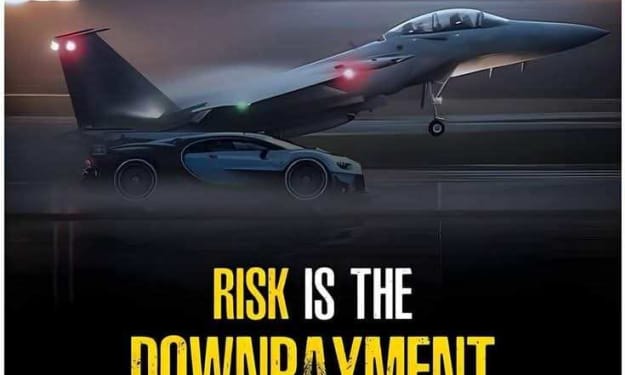
The night was thick with mist, the runway glowing faintly under the scattered beams of light that broke through the fog. A fighter jet stood at the ready, its engines roaring with untamed power, waiting to slice through the darkness of the sky. Beside it, a sleek sports car—a masterpiece of speed and elegance—hummed quietly, its headlights cutting through the haze. Two machines built for greatness, standing side by side, about to take off on their very different journeys.
By Fazal wahid 4 months ago in Motivation
“He Kept Going When No One Was Watching — And That Changed Everything”
No one ever noticed the days he almost gave up. There were no messages asking if he was okay. No one wondered why he became quieter. No one asked how much effort it took just to keep going. To the world, he was just another ordinary man. His name was Ayaan. Ayaan’s life didn’t collapse in one dramatic moment. It slowly faded. Missed opportunities. Rejected ideas. Silent disappointments. Every failure was small, but together they became heavy. He had dreams once. Big ones. Dreams that kept him awake at night, imagining a future where his hard work would finally matter. But over time, those dreams began to feel unrealistic—almost embarrassing. People around him seemed to move forward effortlessly. They celebrated promotions, achievements, and milestones. Ayaan watched from the side, smiling politely while feeling invisible. At work, his efforts were ignored. Among friends, his voice faded. At home, expectations weighed heavily on him. Slowly, a dangerous thought settled into his mind: “Maybe I’m not good enough.” That thought followed him everywhere. It followed him on crowded buses. It followed him into sleepless nights. It followed him every time he tried again and failed. One night, after scrolling through endless success stories online, Ayaan closed his phone and stared at the dark ceiling. His chest felt tight, not because of pain—but because of exhaustion. He whispered quietly, “How long do I keep trying?” There was no answer. But that night, Ayaan made a decision—not a loud one, not a confident one. A tired decision. He decided to keep going, even if nothing changed. The next morning felt the same. The same routine. The same doubts. The same fear of wasting his life. But Ayaan showed up anyway. He worked when no one praised him. He studied when no one guided him. He practiced when no one believed in him. Some days, motivation disappeared completely. On those days, discipline took over. He reminded himself: “I don’t need applause. I need progress.” Weeks passed. Nothing dramatic happened. No sudden success. No recognition. No miracle. But something subtle began to shift. Ayaan became calmer under pressure. He learned to sit with discomfort instead of running from it. He stopped comparing his journey to others. The silence that once scared him now became his training ground. Months later, a serious problem appeared at his workplace. It was complicated, risky, and easy to blame on someone else. Most people avoided it. Some pretended it wasn’t their responsibility. Ayaan didn’t announce himself. He didn’t seek attention. He simply started working. Late nights. Mistakes. Corrections. Learning. There were moments he wanted to quit. Moments when fear whispered, “You’re not ready.” But he answered back, “I’ll learn.” Slowly, the problem began to disappear. Not perfectly—but steadily. People noticed, quietly. One afternoon, his manager called him into the office. Ayaan expected criticism. Instead, he heard a question that stunned him: “Where did you learn all this?” Ayaan paused. How could he explain years of silent effort? How could he explain working when no one cared? He simply replied, “I kept going.” That moment didn’t change his life overnight. He didn’t become famous. He didn’t suddenly become successful. But it changed something far more important. His belief in himself. For the first time, Ayaan understood that life doesn’t always reward effort immediately. Sometimes, it watches. It watches who continues without praise. Who improves without recognition. Who grows in silence. Years later, Ayaan looked back at the version of himself who almost quit. The man who felt invisible. The man who thought no one was watching. And he smiled. Because he finally understood the truth: Life was always watching. Not to judge. Not to rush. But to see if he would keep going when it was hardest. The world doesn’t reward those who only work when they’re seen. It rewards those who build strength in silence. And sometimes, the moment that changes everything doesn’t come with applause. It comes quietly. After patience. After effort. After consistency. That is when everything finally begins to change. Final Message Keep going—even when no one is watching. Especially then.
By Inayat khanabout 23 hours ago in Motivation



Comments
There are no comments for this story
Be the first to respond and start the conversation.