
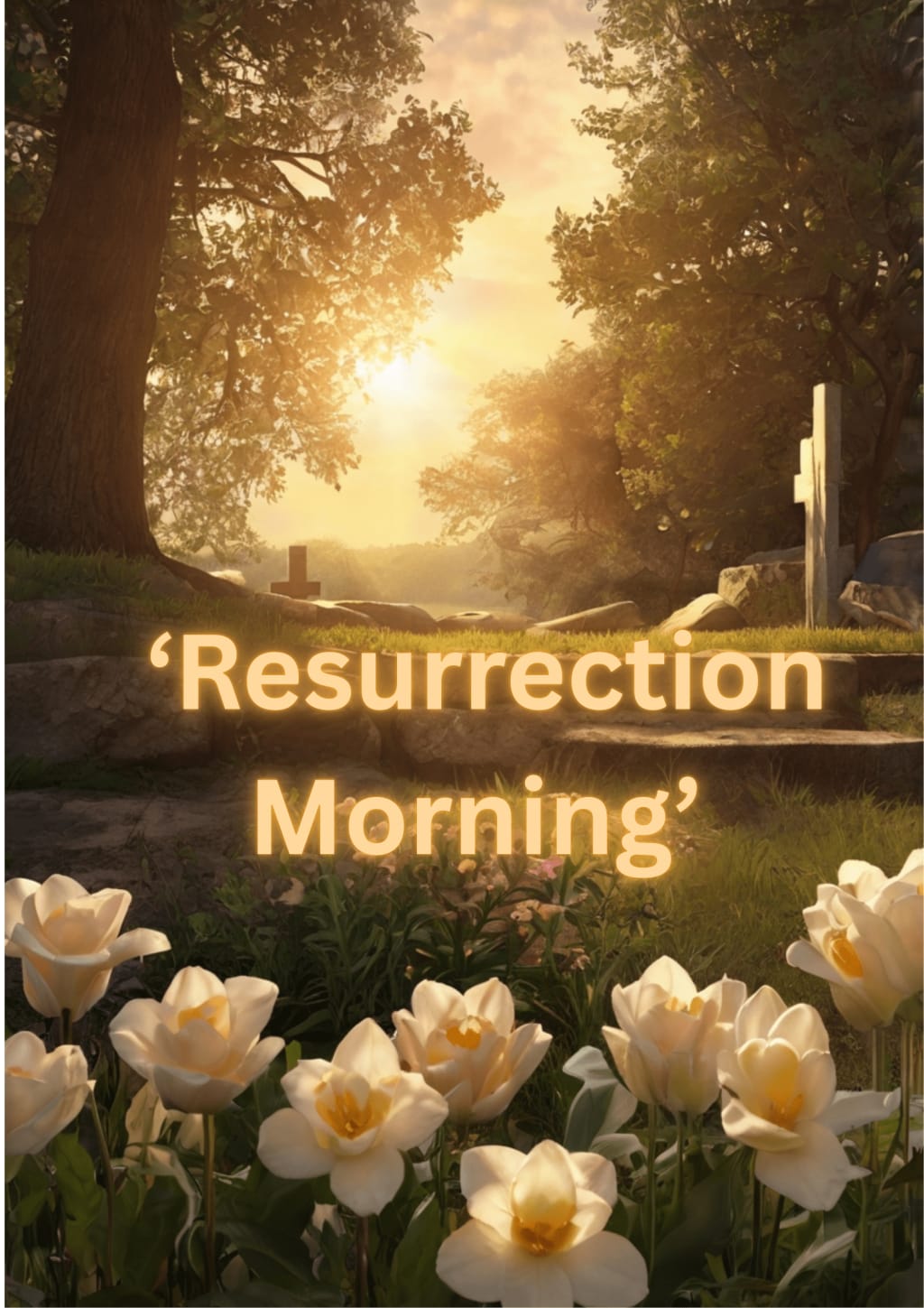
Resurrection Morning
A Story of Hope, Faith, and New Beginnings
📖 Table of Contents
1. Introduction: Dawn of a New Era
2. The Historical Context of the Resurrection
3. The Empty Tomb: Evidence and Eyewitnesses
4. Defeating Death: Theological Significance
5. Justification and Salvation Through the Resurrection
6. Union with Christ: A New Identity
7. The Gift of the Holy Spirit
8. Living Hope: The Promise of Eternal Life
9. Transformation and Renewal
10. The Resurrection and Social Justice
11. Personal Stories of New Beginnings
12. Resurrection in Daily Life
13. Challenges to Faith and How to Overcome Them
14. The Resurrection and Future Glory
15. Celebrating Resurrection: Traditions and Practices
16. The Resurrection's Impact on Art and Culture
17. Comparative Views: Resurrection in Other Faiths
18. Apologetics: Defending the Resurrection
19. Living as Resurrection People
20. Conclusion: Embracing the New Dawn
1. Introduction: Dawn of a New Era
The resurrection of Jesus stands as a defining moment that changed the course of history. In one morning, despair turned into hope, mourning gave way to celebration, and death was defeated by life.
This is more than a statement of faith—it’s a divine turning point. Resurrection morning reveals that no matter how deep the darkness, it will never have the final say. At the break of dawn, a new era began: one where fear no longer reigns, where the impossible becomes possible, and where humanity was offered a second chance.
This eBook is a journey through that moment. A reflection on hope, unwavering faith, and the assurance of a fresh start. It’s a reminder that every morning can be a resurrection morning for those who believe.
2. The Historical Context of the Resurrection
To truly grasp the magnitude of the resurrection, we must understand the world into which it broke forth.
First-century Judea was under Roman occupation, marked by political tension, spiritual longing, and social unrest. The Jewish people longed for a Messiah who would bring political freedom—but Jesus came to offer something far greater: the freedom of the soul.
In this backdrop of oppression and despair, the resurrection wasn't just a miracle—it was a bold declaration that God was doing something new. It disrupted not only Roman power, but the powers of sin and death themselves.
3. The Empty Tomb: Evidence and Eyewitnesses
The resurrection is rooted not in myth but in history. The empty tomb, discovered by women—unlikely and socially marginalized witnesses—speaks volumes about both the authenticity and humility of the gospel narrative.
Over 500 individuals claimed to have seen the risen Christ, as recorded by Paul (1 Corinthians 15:3–8). These accounts, written within decades of the event, form the backbone of Christian belief.
Their willingness to suffer persecution and martyrdom suggests they truly believed in what they saw. For them, this wasn’t just spiritual symbolism—it was life-altering reality.
4. Defeating Death: Theological Significance
The resurrection stands as the greatest triumph over death itself. Where sin first entered through Adam, new life was restored through Christ. In rising, Jesus didn’t just come back to life—He overcame death completely.
By rising from the dead, Jesus didn’t merely return to life—He conquered death. He broke its power, not just for Himself but for all who would believe in Him.
This is the heartbeat of Christian theology: we are no longer bound by death. Through Christ, eternal life isn’t just something we wait for—it's a reality we begin to experience here and now.
5. Justification and Salvation Through the Resurrection
Jesus’ death paid the price for sin, but His resurrection was the divine receipt—proof that the payment was accepted.
Romans 4:25 tells us, "He was delivered over to death for our sins and was raised to life for our justification." This means we stand not guilty before God—not because not because we deserve it, but because the resurrection of Jesus secures it.
Salvation isn't based on effort; it’s based on an empty tomb.
6. Union with Christ: A New Identity
The resurrection isn't just something Jesus did—it’s something we are invited into.
Romans 6:4 tells us that in baptism we are buried with Christ and raised to walk in the newness of life. This is more than symbolism; it’s transformation.
Sin, shame, and fear no longer hold us captive. In Christ, we are new creations. Our identity is no longer tied to our failures but to His victory.
7. The Gift of the Holy Spirit
After the resurrection, Jesus didn’t leave His followers alone. He promised the Holy Spirit—a comforter, guide, and source of power.
On Pentecost, this promise was fulfilled (Acts 2). Because Jesus rose from the dead, that same power resides in those who believe in Him.
This Spirit empowers us to love radically, to serve sacrificially, and to live boldly in a world that often feels dark and chaotic.
8. Living Hope: The Promise of Eternal Life
Hope is not wishful thinking—it's a confident expectation rooted in the resurrection.
1 Peter 1:3 speaks of a "living hope through the resurrection of Jesus Christ from the dead." This means our hope isn’t based on fleeting circumstances but on a risen Savior.
Eternal life isn’t just quantity of time—it’s quality of life. The heart finds rest today and dances with joy for tomorrow.
9. Transformation and Renewal
The resurrection brings renewal not just in a cosmic sense, but in deeply personal ways.
Every time someone turns from addiction, forgives an enemy, chooses love over bitterness, or finds joy in suffering—that is resurrection power at work.
In Christ, we are constantly being made new. The past no longer defines us, and the future is still unfolding. But we are being transformed, day by day.
10. The Resurrection and Social Justice
The resurrection isn’t only a private spiritual experience—it has public, social implications.
It challenges systems of injustice, oppression, and marginalization. Jesus rose to create a new humanity, one where every person bears dignity and worth.
Resurrection people must care for the poor, fight for the oppressed, and champion equity—because Jesus did.
11. Personal Stories of New Beginnings
Throughout the centuries, stories of resurrection echo through personal testimonies—stories of lives restored, marriages healed, prisoners reformed, and addicts made whole.
These modern resurrection mornings remind us that this is not just a first-century event. It is an everyday reality.
Your story, too, may be on the brink of a resurrection. And if you're still in the tomb, take heart: the stone may be rolling away.
12. Resurrection in Daily Life
To live resurrection daily means to carry hope in your posture, in your speech, and in your decisions.
It means speaking life when others speak death, choosing faith over fear, and remembering that every ending can be a beginning in God’s hands.
It's not a date on the calendar; it's a way of life.
13. Challenges to Faith and How to Overcome Them
Faith doesn't mean never doubting. Even the disciples doubted—and they had seen the risen Christ!
We face intellectual doubts, emotional struggles, and spiritual dryness. But the resurrection reminds us that God is patient, that faith can be rekindled, and that truth endures even when our feelings don’t.
Lean into the community. Dive into Scripture. Be honest in prayer. God isn't afraid of your questions—He rose for them.
14. The Resurrection and Future Glory
The fi rst fruit of what is to come is resurrection. Just as Jesus was raised, we too will be raised (1 Corinthians 15:20–22).
Heaven is not just a spiritual escape—it’s a future physical renewal of all creation. A new world where there will be no more mourning, no more crying, and no more dying.
This hope allows us to live today with courage, because we know how the story ends.
15. Celebrating Resurrection: Traditions and Practices
Easter Sunday is more than pastel eggs and lilies—it is the crescendo of Christian worship.
Traditions like sunrise services, baptism, feasting, and joyful music help us tangibly celebrate the resurrection.
But even more, resurrection should be celebrated daily—in morning gratitude, in forgiveness extended, in new beginnings embraced.
16. The Resurrection's Impact on Art and Culture
From Handel’s Messiah to medieval cathedrals, from stained-glass windows to modern film—the resurrection has stirred the imagination of artists for centuries.
Why? Because it’s the ultimate plot twist: what seemed like defeat turned into triumph.
The risen Christ continues to inspire creativity and expression across all cultures and times.
17. Comparative Views: Resurrection in Other Faiths
Other faiths offer concepts of afterlife or spiritual continuation, but Christianity is unique in its claim that God became human, died, and physically rose again.
The resurrection is not a metaphor—it's a miracle. And it's offered not to a select few, but to everyone who believes.
Exploring other perspectives helps us appreciate the distinctiveness—and inclusiveness—of the gospel’s message.
18. Apologetics: Defending the Resurrection
Faith is not blind—it is reasonable.
Christian apologists point to the reliability of the Gospel accounts, the transformation of the disciples, the explosion of the early church, and the historical consistency of resurrection claims.
Books, debates, and testimonies all affirm: the resurrection is not wishful thinking. It is the most plausible explanation for the empty tomb and the birth of Christianity.
19. Living as Resurrection People
To live as “resurrection people” means to embody the message of the empty tomb in every part of our lives. It is a daily decision to live with:
● Hope in suffering – trusting that God can bring new life even in our darkest moments.
● Joy in the midst of hardship—because the resurrection assures us that even our darkest moments are not the end of the story.
● Purpose in mission – recognizing that we are called to be agents of reconciliation and light in a broken world.
This kind of life is radically countercultural. It proclaims that peace can conquer conflict, love can redeem hate, and life can overcome death.
To live as resurrection people is to wake up each morning with the quiet defiance of faith that says: “Today, life wins.”
20. Conclusion: Embracing the New Dawn
As the stone rolled away on that first resurrection morning, something far greater than an event occurred—a new reality began.
The resurrection of Jesus Christ offers more than religious inspiration; it invites a complete reordering of how we understand life, death, and eternity. It assures us that:
● Our past does not define us
● Our present is not without purpose
● Our future is filled with hope
The message of Easter isn’t limited to one Sunday each year—it’s a living truth that speaks into every day of our lives. It brings strength to the weary, restoration to the wounded, and purpose to those simply trying to fi nd their way.
Whether you are facing grief, transition, failure, or simply wondering where to go next, Resurrection Morning is not just Jesus’ story—it’s yours too.
Final Reflection
“He is not here; He has risen, just as He said.” — Matthew 28:6
Every resurrection story begins in darkness. But just as the sun broke over the garden tomb, so too does the light of Christ rise over your life.
Let this be your morning.
Let this be your resurrection moment.
About the Creator
Keep reading
More stories from writers in Motivation and other communities.
Looking back: 2025 was a beast
It's difficult to know how to start this. I've suggested that it's been a tough one from my title and in many ways, it has; however, there is an argument that it's not been that extraordinary at all, merely this wonderful thing we call "life" with all its climaxes and pitfalls.
By Rachel Deeming27 days ago in Motivation
everything happens for a reason
People often say everything happens for a reason. Let's understand why. One day in a forest, a young man came to meet a wise saint. He was very sad and crying. The saint asked what happened. The young man said, "Everything I had is gone." Robbers stole everything. I have nothing left. Not even a way to go home. How can this be good? It's the worst thing ever. How can you say it's for the better? The saint replied, "Let me explain through a story," the saint began. Once a terrible flood hit a small village, washing away everything. A poor farmer's family lost even their little store of grain. The farmer's son said calmly, "It's okay, father. Let it go. Whatever happened happened for good." The farmer got angry and said, "Why are you saying such foolish things? Everything we had is gone. We don't even have food or shelter. He shouted at his son, "Go away. Leave me alone." The boy left in tears. But as evening came and the boy hadn't returned, the farmer felt regret. Suddenly, a rescue boat came and saved them. A villager said, "You scolded that boy for no reason. He was right. We got saved after all." But the farmer said, "How is this good? We still have no home, no food. What will we do now?" His wife said, "We may not have money, but don't lose hope. We'll manage somehow. I'll start working in nearby houses to earn a little. That will help us survive." The next day, the farmer went to the city to find work. He looked everywhere, but didn't get any work. He was worried. How would he take care of his family? They had no real house, just a small heart made from straw. One day, the farmer looked at his poor crops and felt even more hopeless. He said, "My son left home, too. I have lost everything." And people still say, "Whatever happens is for the best. How can this be good?" His wife consoled him. Don't worry so much. Try again. Things will get better. The Palmer agreed and went to search for work again. But again he found nothing. On the way back he met a saint. The saint asked him what was wrong. The farmer explained how the flood took everything. His house food and how life had become very hard. The saint said exactly that's why I'm saying what happened was good. The farmer got angry. How can you say that? I'm suffering. I have nothing. Even my son left me. The saint calmly said, "The answer to all your questions will come with time. Don't worry." That night, after the saint had spoken, the farmer sat quietly, thinking deeply about the words. He wondered if it could really be true that everything happens for a good reason. Later, the farmer got a job at a rich merchant's house. The merchant was kind and paid well. He even offered the farmer a house nearby to live in. One night, someone knocked at the farmer's door. When he opened it, he was shocked. It was his son. The son said, "You moved and didn't even tell me. I searched and found you here. I left that day and went to the city to find work. I got a small job first and then I saved enough to start a little tea stall. Slowly, I built a better life." The farmer was overjoyed. As his son spoke, he realized that even when everything seems wrong, life has a bigger plan, one that only time can reveal. The young man who was listening to this story said, "Okay, but in my case, everything was stolen. What good is in that?" The saint smiled and said, "Actually, I found something in the forest. Here, take this. It was a glowing stone." The young man realized it was a philosopher's stone, a magical stone that turns iron into gold. He said, "If my stuff hadn't been stolen, I wouldn't have come to the forest. I wouldn't have met you, and I wouldn't have found this treasure." So, friends, what did we learn from today's story? No matter how bad things get, time changes everything. Painful moments pass. Never make decisions in bad times that you'll regret later. Even the worst situations often lead to something better.
By nawab sagar6 days ago in Motivation


Comments
There are no comments for this story
Be the first to respond and start the conversation.