
Resilience in the Storm
Embracing Self-Improvement When Life Gets Tough
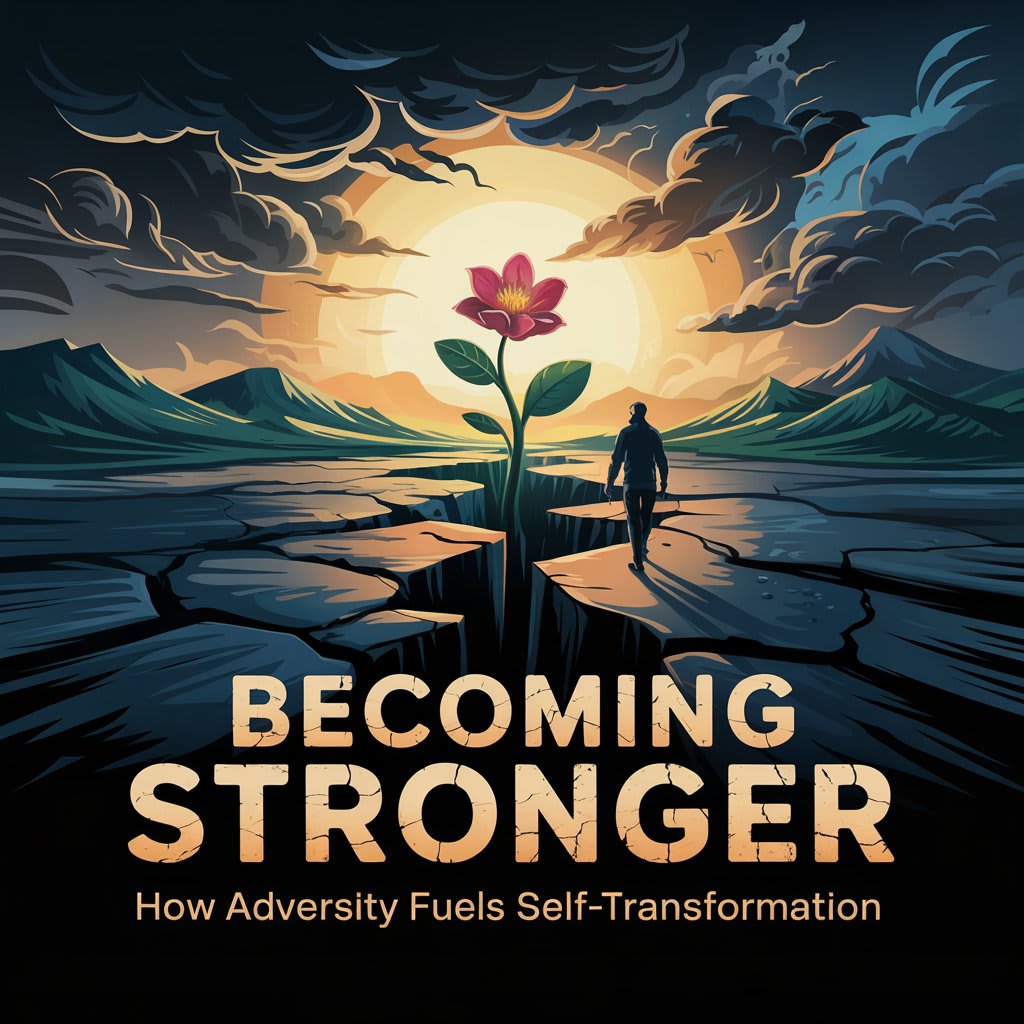
"The Stone and the Seed"
In a quiet village nestled between mountains and time, there lived a man named Aven, who was known not for strength or wisdom, but for his silence. He was a stonemason—one who sculpted mountains into monuments, yet within himself bore the weight of an unseen boulder. To the world, he carved beauty; to himself, he was unfinished marble, flawed and fragmented.
Aven once dreamed of becoming a philosopher. He longed not to sculpt stone, but truth. Yet life, with its familiar indifference, had chiseled away his ambitions. Responsibility came early. His father died with his hands in the soil, and Aven, still a boy, picked up the chisel to keep bread on the table. He laid his dreams in the grave beside his father.
Years passed like falling leaves. Aven aged, not like wine, but like rock: weathered, not richer. Each statue he carved was praised, but he saw in them only echoes of the voice he had silenced long ago. He believed his purpose had passed him by—until one morning changed everything.
On the edge of the village, an old monk came to visit. He was known simply as Oren, a wanderer of thought, a gardener of minds. He watched Aven work in silence for hours before speaking.
“Why do you carve stone, when your eyes beg to sculpt stars?”
Aven paused. No one had ever asked. Not even he.
“I do what must be done,” he replied, wiping the sweat from his brow.
Oren smiled with the patience of rivers.
“Then you are like the seed who thinks he is stone, buried deep and unmoving, when in truth, he waits only for light.”
Aven scoffed. “It’s too late for light. The sun does not rise twice for one man.”
Oren bent and picked up a small, jagged stone. “Then let me tell you a story,” he said.
And so, beneath the shade of still skies, the monk spoke.
'There was once a seed that lay hidden in the darkness beneath the earth. Around him, stones mocked him, for he was soft, and they were strong. “You are fragile,” they said. “You’ll never rise like we do. You’ll rot before you reach the surface.” The seed, for a time, believed them.'
'But within him stirred something deeper than defiance—it was purpose, ancient and unexplainable. He did not know what he would become, but he felt the whisper of becoming.'
'And so, though the earth was heavy, and the stones pressing down unkindly, he stretched. Not out of certainty, but out of hope. He cracked his own shell, broke himself to grow. Pain was his sunrise, and still he reached.'
'One day, he touched the surface. Light fell upon him like a blessing he had forgotten to believe in. The stones remained below, unmoved and unchanging. But the seed, now a tree, reached skyward—and birds made poems in his branches.'
Oren finished and handed Aven the stone. “What appears still is not always at peace. And what is buried is not always dead.”
Aven held the stone and stared at it—not for its weight, but for its silence. He saw in it the years he had buried himself beneath survival, beneath expectation. All his life, he had mistaken endurance for fulfillment. He had carved outwards, but never within.
That night, Aven did not sleep. He sat beneath the stars with his tools, but instead of sculpting stone, he began to write. He poured his unspoken thoughts into pages—about sorrow, about time, about the absurd strength it takes to remain kind in a brutal world.
In the following days, he rose early to carve. Not statues, but spaces—quiet corners in the village, benches in the trees, paths that curved with grace. He left pages of his writings under stones, for strangers to find.
And the villagers, one by one, began to read. They did not know the author. But the words lit lanterns in their chests. Farmers began singing again. Children asked deeper questions. Even the wind seemed to listen.
Aven never stopped carving, but now, his chisel was guided by thought, not duty. The stone was no longer a prison, but a page.
One day, long after Aven had become legend and memory, a child asked a teacher, “Who wrote these words beneath the stone?”
The teacher smiled. “Someone who once thought it was too late to bloom.”
Moral Philosophy:
Life, as seen through Aven’s eyes, reveals a central philosophical truth—that potential is not bound by time, but by belief. The world often mistakes permanence for peace, but growth demands change. As Heraclitus said, “No man ever steps in the same river twice.” Our becoming is eternal. To be buried is not to be forgotten—it is sometimes how seeds begin.
There is no "too late" in the vocabulary of purpose. Whether you are sculptor or seed, the universe is not asking for perfection—it asks only that you begin. The stone may seem final, but even mountains crumble to dust. What endures, always, is the act of reaching.
So reach.
About the Creator
Muhammad Zohaib Khan
A Reader | A Writer | Aspiring Historian | Philospohy |
Keep reading
More stories from Muhammad Zohaib Khan and writers in Motivation and other communities.
Harvest of Feelings
Emotion Farming They used to harvest wheat. Now, they harvest us. The fields stretched like golden veins under a bruised, twilight sky, humming with the soft pulse of buried sorrow. Each crystalline stalk shimmered faintly—tall and ethereal, trembling not from wind, but from a deeper current: the residue of human emotion, cultivated and contained.
By Muhammad Zohaib Khan10 months ago in Fiction
One Hard Thing
Stop me if you’ve heard this one before: You have the number, you know your schedule- you’ve even picked out the perfect day and time to make this appointment. Shoot, you’ve even picked out alternative days and times just in case their schedules can’t accommodate you!
By Taylor Rigsby11 days ago in Motivation



Comments (1)
Appreciations...