
Reed Hastings: The Man Who Changed How the World Watches
NETFLIX STORY

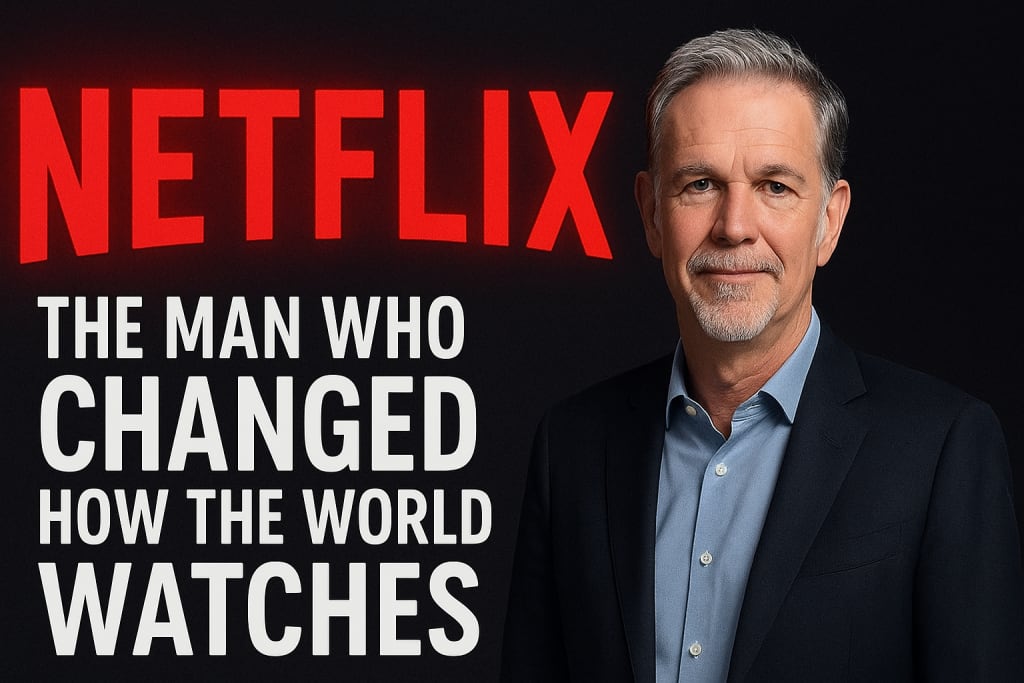
(The Rise of a Reluctant Innovator)
The Spark of a Restless Mind
Before “Netflix and chill” became a global phrase, before entire industries were disrupted and cable television started collapsing, there was a man sitting on his couch in Santa Cruz, staring at a $40 late fee from Blockbuster. His name was Reed Hastings, and at that moment, he wasn’t thinking about conquering Hollywood or reshaping global entertainment. He was thinking about how much he hated that late fee.
It was 1997 — a time when people rented VHS tapes, rewound them manually, and returned them to stores before a ticking deadline. And if you forgot? You paid. Every late fee was a small humiliation, a reminder that the system wasn’t built for the customer.
Reed Hastings, a software engineer with a restless mind, saw it differently. To him, that small annoyance represented a broken system begging to be rebuilt.
But the idea that would change the world didn’t come overnight. It was the product of a journey that started long before Netflix — in a life defined by discipline, failure, curiosity, and courage to start over.
From Peace Corps to Programming
Born in 1960 in Boston, Reed Hastings grew up in a home of educators. His father, a lawyer, had worked for the Nixon administration, while his mother was a passionate advocate for education. Reed’s childhood wasn’t about wealth — it was about questions. Why do systems fail? Why do people stop learning? Why do we accept inefficiency as normal?
After graduating from Bowdoin College in 1983 with a degree in mathematics, Reed did something few graduates with bright futures dared: he joined the Peace Corps. He was sent to Swaziland (now Eswatini), where he spent two years teaching high school math.
Those two years changed him.
He later said, “Once you’ve hitchhiked across Africa with ten bucks in your pocket, starting a company doesn’t seem so intimidating.”
In Swaziland, he saw people living with far fewer resources than he had ever known — yet filled with resilience and creativity. That experience shaped his understanding of human adaptability, something that would later become central to Netflix’s culture of innovation.
When he returned to the U.S., he decided to pursue a master’s degree in computer science at Stanford. There, he met the future — not just in technology, but in thinking.
The First Venture: Pure Software
Reed wasn’t born an entrepreneur. In fact, he once described himself as a “reluctant leader.” But ideas had a way of finding him.
In 1991, he co-founded Pure Software, a company focused on debugging tools for software developers. The idea was technical, not glamorous — but it solved real problems for engineers. Within a few years, the company exploded in growth, going public in 1995.
On paper, it was a dream. Reed Hastings was now a multimillionaire tech founder. But behind the success, he was miserable.
The company had grown too fast. Rules multiplied. Meetings dragged. Bureaucracy suffocated creativity. Reed realized that the very structure he had built — the one he thought represented success — had become a cage.
In a reflective interview years later, he admitted:
“Pure Software became a company that rewarded process over innovation. And I failed as a CEO.”
When Pure was eventually acquired by Rational Software in 1997, Reed walked away with millions. But more importantly, he walked away with a lesson that would define Netflix:
“If you’re not learning, you’re dying.”
The Birth of Netflix
The story has been told many ways, but the essence remains: Reed Hastings once paid a $40 late fee for a rented copy of Apollo 13. Frustrated, he began to imagine a different world — one where people could rent movies without the pain.
But Reed didn’t start Netflix alone. He teamed up with Marc Randolph, his friend and colleague, who had a background in marketing and a love for mail-order systems. Together, they started testing an idea — could DVDs, a new technology at the time, be mailed safely and efficiently?
To test it, they mailed a single DVD in an envelope to themselves.
When it arrived intact, they knew they had something.
With $2.5 million of Hastings’ own money, Netflix was born.
But from the start, the company wasn’t about movies — it was about reinventing the customer experience. There were no late fees, no due dates, no long lines. Just simplicity, freedom, and trust.
Reed Hastings was obsessed with eliminating pain points, not just selling products. That obsession would later reshape industries beyond his own.
The Early Struggles
The first few years were brutal.
Netflix wasn’t an overnight success. The DVD market was still tiny. Most people were still using VHS tapes, and mailing discs seemed slow and impractical. Even with a clever subscription model, growth was sluggish.
To survive, Netflix approached Blockbuster in 2000 and offered to sell the company for $50 million.
Blockbuster laughed them out of the room.
Reed Hastings walked away humiliated — but determined. That rejection became his fuel.
In interviews years later, he’d often smile when recalling that meeting. “They didn’t see the storm coming,” he said. “But we did.”
The Culture of Freedom and Responsibility
Reed had made a silent promise to himself after Pure Software: if he ever built another company, it wouldn’t be strangled by process. It would be built on freedom, trust, and accountability.
That promise became the foundation of Netflix’s culture — now famous through its “Culture Deck,” a document so influential that Sheryl Sandberg once called it one of the most important documents ever written in Silicon Valley.
At Netflix, there were no vacation policies, no strict hierarchies, and no micromanagement. Employees were given immense freedom — but also held to equally high standards.
Reed believed that creativity thrived not in structure, but in ownership.
“Adequate performance gets a generous severance,” the Netflix manifesto said bluntly.
It was radical. Some saw it as harsh; others saw it as genius. But for Reed, it was a moral code — trust people fully, and they will rise to the challenge.
From DVDs to Streaming – The Leap of Faith
In 2007, after nearly a decade of mailing DVDs, Netflix made the most daring move in entertainment history: streaming movies online.
It was risky. Internet speeds were still slow. Studios were skeptical. Customers were comfortable with discs. But Reed knew that technology always outpaces comfort.
He bet everything on the future — a future where people could click and watch instantly.
That leap of faith changed everything.
Within two years, DVD rentals became a relic. Streaming took off, and Netflix became a household name. Competitors laughed less. Investors took notice. Hollywood started paying attention.
Reed Hastings had not only survived the digital transition — he had led it.
The Blockbuster Collapse
By 2010, the irony was poetic. The same company that once rejected Netflix — Blockbuster — was bankrupt.
It was a historic reversal of fortune, a masterclass in business evolution. While Blockbuster clung to its old model, Netflix evolved relentlessly.
When journalists asked Reed how it felt to defeat his old rival, he smiled gently and said,
“We never wanted to kill Blockbuster. We just wanted to change how people enjoyed stories.”
That humility defined his leadership. Netflix’s victory wasn’t about destroying the past — it was about creating a better future.
The Price of Innovation
But success never comes free.
By 2011, Netflix faced a huge backlash. Hastings decided to split the company into two services — one for DVDs (called Qwikster) and one for streaming. Customers were furious. The stock price plummeted nearly 80%.
It was one of the biggest public failures in Silicon Valley history.
Critics called him arrogant. Analysts predicted Netflix was finished. But Reed did what true innovators always do — he listened, admitted he was wrong, and reversed the decision.
It was a rare display of humility from a billionaire CEO.
“We messed up,” he wrote to subscribers. “And we owe you better.”
That moment became a turning point. Netflix rebuilt trust — and grew stronger than ever.
The Birth of Original Content
Reed realized that streaming other people’s content meant living at the mercy of studios. To truly control its destiny, Netflix had to become a studio itself.
So, in 2013, Netflix released its first original series: House of Cards.
It was a revolution. No pilot episode. No weekly schedule. No censorship from networks. All episodes dropped at once — a radical new experience that would soon define the age of binge-watching.
That single show didn’t just succeed; it redefined storytelling. Netflix was no longer a tech company. It was now a global entertainment empire.
Reed Hastings: The Man Who Changed How the World Watches (Part 2)
The Global Empire and the Mind Behind It
A Global Vision Begins
By 2014, Netflix was no longer an American company — it was a global movement.
Reed Hastings’ dream of borderless storytelling began taking shape as the red “N” logo appeared on screens from London to Lahore, Tokyo to Toronto, São Paulo to Seoul.
But global expansion wasn’t a simple scaling of servers. It was a lesson in understanding culture. What worked in California didn’t always work in Cairo.
The secret was listening — and Netflix listened better than anyone.
Reed’s philosophy was rooted in a belief that data and empathy can coexist. The algorithms could predict what you might enjoy, but empathy helped Netflix understand why you enjoyed it.
“Technology tells us what people watch,” Reed said, “but humanity tells us why they watch.”
The Rise of the Global Storyteller
Netflix began investing in local talent. Spanish thrillers like Money Heist turned into international sensations. Korean dramas such as Squid Game shattered records and cultural walls.
Each show was proof of what Reed believed from the beginning — great stories don’t need translation.
When Money Heist was first released, it didn’t find massive success in Spain. But Netflix noticed small sparks of engagement across the world and refused to let the series die. It was relaunched globally, subtitled, and promoted with data-backed precision.
The result? A phenomenon.
Reed smiled when asked about it later:
“That’s the power of the internet. A story made in Madrid can move a kid in Mexico, a mother in India, or a retiree in Canada. That’s why we built Netflix.”
In less than a decade, Netflix went from mailing DVDs in California to streaming dreams to 190 countries. No satellite. No cable. Just connection.
Building a Company Without Borders
Behind every global success was Reed’s unorthodox philosophy of leadership — what he called the “freedom and responsibility” model.
At Netflix, employees didn’t follow rules. They followed principles.
No one needed permission to spend money, travel, or pitch an idea. What mattered was impact, not approval.
This freedom came with trust — and that trust became Netflix’s secret weapon.
Reed believed that innovation comes not from control, but from belief in people.
“If you give people freedom, they surprise you,” he said. “If you give them rules, they obey.”
In a world of corporate rigidity, Netflix became a living experiment in human potential — and it worked.
While other tech companies obsessed over process, Netflix obsessed over purpose.
The Power of Reinvention
Most CEOs would have stopped there. But Reed Hastings wasn’t interested in comfort.
Every few years, Netflix transformed itself — first from DVD rental to streaming, then from streaming to content creation, and later from content to a full-blown global studio.
Each reinvention required destroying what already worked.
To Reed, that wasn’t risky — it was survival.
He told his team:
“If we don’t disrupt ourselves, someone else will.”
And he meant it.
The rise of Disney+, Amazon Prime, Apple TV+, and dozens of regional competitors only strengthened Netflix’s resolve. Reed didn’t fear competition — he welcomed it.
“Competition keeps you honest,” he said. “It forces you to remember why you started.”
The Philosophy Behind the Screen
Beneath Netflix’s algorithms and billion-dollar productions was a man shaped by two things: education and empathy.
Reed was never just a businessman; he was a teacher at heart. He believed that a great company was a learning organism — always curious, never complacent.
He often said:
“The day we stop learning is the day we start dying.”
He made mistakes — big ones.
The Qwikster failure in 2011 taught him humility.
Backlash against controversial shows taught him accountability.
And public criticism of employee culture taught him to balance freedom with compassion.
But every mistake added depth to his philosophy.
To him, failure wasn’t shameful — stagnation was.
The Human Side of a Billionaire
Despite his wealth — over $6 billion at his peak — Reed Hastings lived modestly.
He drove a Toyota, kept his home simple, and avoided the spotlight.
His satisfaction came not from luxury, but from progress.
In Santa Cruz, he spent weekends mountain biking and reading.
He donated heavily to education reform, establishing scholarships and supporting charter schools.
Because to Reed, education was the only technology that never becomes obsolete.
When asked why he focused on schools, he replied,
“I’ve seen what happens when you give people access to learning. It changes everything.”
His foundation poured millions into programs that fostered creativity in underprivileged communities — the same kind of creativity that had saved him from corporate suffocation decades earlier.
The Data Behind Dreams
Inside Netflix, data science became a kind of digital intuition. Every click, pause, or binge told a story — not about numbers, but about human emotion.
Reed didn’t see data as control. He saw it as empathy at scale.
He once said:
“We’re not using data to manipulate people. We’re using it to understand them.”
That perspective revolutionized entertainment. Shows were greenlit not because of executives’ instincts, but because real people wanted them.
Netflix gave voice to stories that Hollywood had ignored — stories about immigrants, women, minorities, and unseen communities.
It became not just a company, but a mirror of humanity.
Pandemic and the Power of Storytelling
When the COVID-19 pandemic hit in 2020, the world went silent — but screens lit up.
People were locked inside, terrified and uncertain. And in those moments, stories became a form of medicine.
Netflix’s subscriber count exploded, but more importantly, it became a source of hope.
From The Queen’s Gambit inspiring millions to take up chess, to documentaries teaching empathy and awareness, Netflix provided not just distraction — but connection.
Reed understood that entertainment wasn’t frivolous. It was vital.
“Stories remind us that we’re not alone,” he said during a virtual interview.
“Even in isolation, stories unite us.”
Passing the Torch
By 2023, after more than 25 years at the helm, Reed Hastings decided to step down as CEO of Netflix.
It wasn’t a dramatic exit — it was peaceful, deliberate, and full of grace.
He had built a company that could run without him.
Greg Peters and Ted Sarandos took over, both trained under his philosophy of freedom, responsibility, and continuous learning.
Reed shifted into the role of Executive Chairman, focusing on strategy, mentorship, and philanthropy.
He said,
“Leadership is not about staying forever. It’s about building something that lasts beyond you.”
In that simple sentence lay the wisdom of a lifetime — that true legacy isn’t control, but continuity.
Lessons From a Disruptor
Reed Hastings’ journey isn’t just the story of Netflix — it’s a masterclass in how to reinvent yourself before the world forces you to.
His principles can be distilled into timeless truths:
Discomfort drives growth.
The late fee that annoyed him sparked an empire.
Freedom demands accountability.
Netflix’s culture worked because it trusted adults to act like adults.
Reinvention is survival.
The courage to destroy what works keeps you alive.
Listen more than you talk.
Data reveals patterns, but empathy reveals people.
Never stop learning.
Whether teaching math in Africa or running a billion-dollar company, curiosity remains the constant.
The Quiet Revolutionary
Today, Reed Hastings lives a quieter life, but his influence echoes everywhere.
Every time someone hits “Play” on a Netflix show, they’re participating in his revolution — one born not of ego, but of frustration, curiosity, and hope.
He never wanted to be famous. He wanted to be useful.
And in doing so, he reshaped culture itself.
Because what Reed really built wasn’t just Netflix — it was a bridge between imagination and possibility, between human stories and human souls.
The Final Reflection
Years ago, when asked what drives him, Reed Hastings smiled and said something simple, something that now defines his entire legacy:
“I’m not trying to predict the future. I’m trying to build a company that will always adapt to it.”
That sentence explains Netflix.
It explains Reed.
It explains why, decades from now, when technology evolves again — when the next generation streams stories through neural implants or holograms — the DNA of Netflix will still pulse beneath it.
Because Reed Hastings didn’t just change how we watch.
He changed why we watch.
He made storytelling a right, not a privilege.
And in doing so, he gave the world its favorite escape — one story at a time.
Epilogue: Beyond the Screen
In classrooms in Kenya, in villages in India, in schools in rural America, there are children with access to education because Reed Hastings believed in them.
In every creative mind that dares to dream differently, his philosophy lives on.
Netflix may have started as a way to avoid a $40 late fee —
but it ended up becoming a symbol of what happens when you question the ordinary.
From math teacher to media mogul, from late fees to legacy —
Reed Hastings’ life proves one eternal truth:
“When you stop being afraid of failure, you start building the future.”
About the Creator
Frank Massey
Tech, AI, and social media writer with a passion for storytelling. I turn complex trends into engaging, relatable content. Exploring the future, one story at a time
Keep reading
More stories from Frank Massey and writers in Motivation and other communities.
Matt Damon: From Rejection to Redemption — The Untold Journey of Hollywood’s Reluctant Genius
Before the world knew him as Jason Bourne or the brilliant Will Hunting, Matt Damon was just another young man from Cambridge, Massachusetts, who dared to dream too big for his small world. His story isn’t just about fame — it’s about resilience, creativity, and the quiet determination to shape his own destiny when the odds were stacked against him.
By Frank Massey 2 months ago in Motivation
What is your calling
What is a model human being? Can anyone follow all of these steps and guides in a life unpredictable? Yes there are privileged individuals out there who take a very structured path to success but for 90% of people in the world this is not reality, and mor
By Malachai Hough4 days ago in Motivation


Comments
There are no comments for this story
Be the first to respond and start the conversation.