
Nikola Tesla: The Man Who Lit the World
"The Forgotten Genius Who Powered the Modern World"

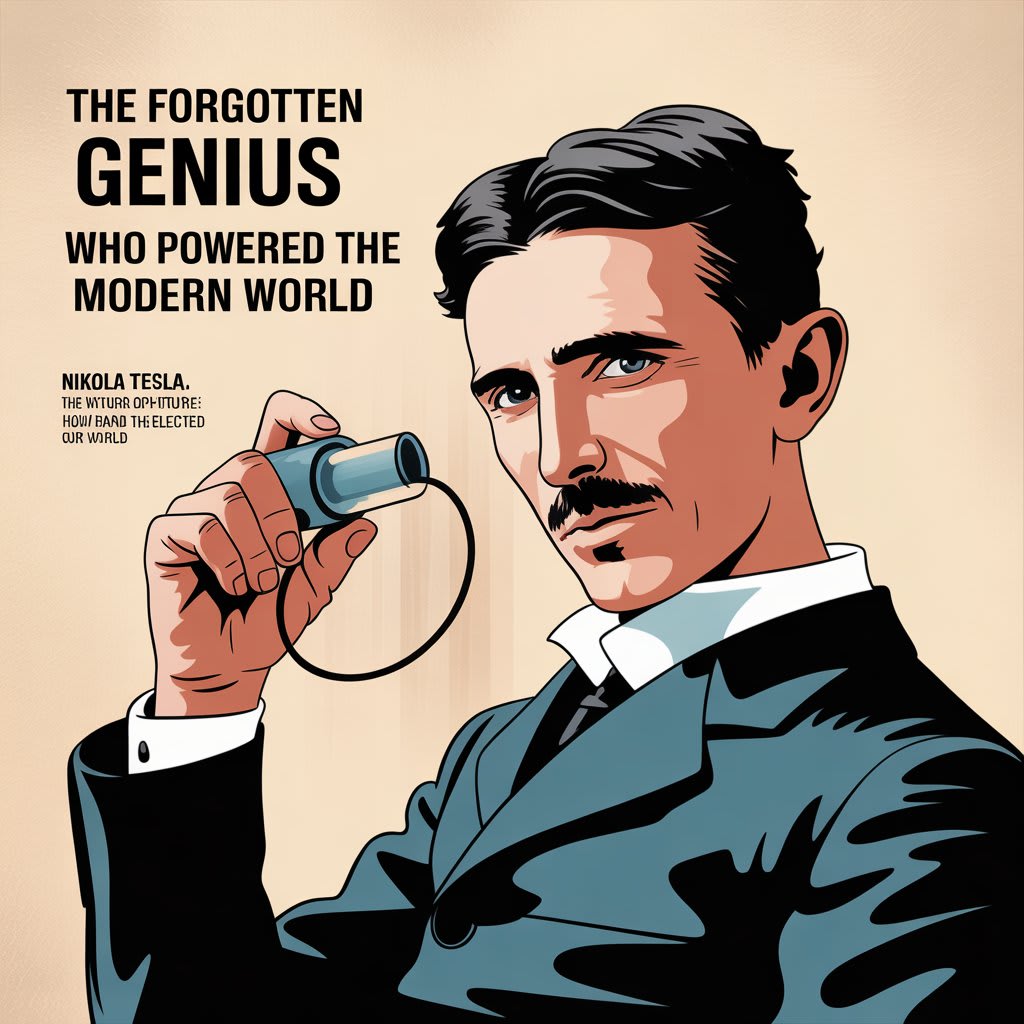
In the shadow of the 19th century’s most powerful industrial titans, there emerged a solitary genius—a man whose visions for the future often teetered between the limits of science and the depths of imagination. His name was Nikola Tesla, and though many know him today for the unit of magnetic flux density, few understand the magnitude of his contribution to the modern world.
Born in 1856 in Smiljan, a village in what is now Croatia, Tesla was a child of light and curiosity. He claimed that his interest in electricity began with the static crackles from a cat’s back, something he called “the light of the heavens.” His early years were marked by a sharp intellect, a photographic memory, and an insatiable hunger to understand the hidden forces that powered the universe.
Tesla’s academic journey was anything but conventional. Though he excelled in engineering and mathematics, he clashed with authority and often ignored formal education structures. After leaving school before graduating, he wandered through Europe, suffering breakdowns and bouts of illness, but always returning to his obsessive thoughts about energy, motion, and power.
Eventually, he made his way to Paris to work for the Continental Edison Company. There, he quickly distinguished himself as a brilliant engineer. But it wasn't enough—Tesla had ideas that stretched far beyond what the company was willing to consider. So, in 1884, with four cents in his pocket and a bundle of clothes, Tesla set sail for America, the land of opportunity—and the home of Thomas Edison.
The War of Currents
In New York, Tesla met Edison, who was already famous for his work with direct current (DC) electricity. Edison hired him, allegedly promising a large bonus if Tesla could improve his DC generators. Tesla succeeded, but Edison refused to pay, claiming the offer was a joke. Betrayed and disillusioned, Tesla left.
But this disappointment led him into one of the most significant technological rivalries in history: the War of Currents. Tesla championed alternating current (AC), a system of electrical transmission far superior to Edison's direct current. AC could travel long distances with minimal loss of power, making it perfect for cities, countries—even the whole world.
Tesla partnered with industrialist George Westinghouse, who saw the potential in AC. Together, they faced fierce opposition from Edison, who waged a smear campaign, staging public electrocutions of animals to "prove" AC’s danger. But Tesla’s vision prevailed.
In 1893, at the World’s Columbian Exposition in Chicago, Tesla and Westinghouse lit up the entire fairgrounds using AC power. It was a triumphant, dazzling display that signaled the future of electricity. Two years later, Tesla’s AC system was used to build the first large-scale hydroelectric power plant at Niagara Falls. The world had entered the Age of Electricity, and Tesla had flipped the switch.
Beyond the Light
Tesla wasn’t content with just illuminating cities. His mind leaped decades ahead of his time. He imagined wireless communication, wireless power transmission, radar, X-rays, remote controls, and even machines powered by the earth's own electromagnetic fields.
In fact, as early as the 1890s, Tesla was experimenting with radio waves, years before Guglielmo Marconi would claim the patent for radio. In 1943, shortly after Tesla's death, the U.S. Supreme Court recognized Tesla's precedence in radio invention. But the credit had already been lost in the shadows of history.
One of Tesla’s most ambitious projects was the Wardenclyffe Tower, a massive structure on Long Island meant to transmit wireless energy across the globe. Tesla envisioned a world where ships at sea, remote villages, and cities alike could tap into free energy from the atmosphere—no wires, no fuel, no pollution.
But this vision threatened powerful interests. J.P. Morgan, who initially funded Wardenclyffe, pulled out once he realized Tesla's wireless system could not be monetized the way traditional electricity could. "Where do we put the meter?" Morgan reportedly asked. Without funding, the project collapsed, and Tesla’s dream of free energy died quietly.
The Fall
As the 20th century marched on, Tesla faded into obscurity. His competitors—Edison, Westinghouse, Marconi—built business empires and secured their legacies. Tesla, by contrast, lived alone in New York hotels, feeding pigeons and writing strange letters to the press.
He became increasingly eccentric, claiming to receive signals from other planets, and insisting that he could split the Earth with a vibration machine. Though his mind remained as brilliant as ever, his credibility began to erode. He was a man out of time—an inventor in a world that favored profit over potential, corporations over curiosity.
In 1943, Nikola Tesla died penniless and alone in Room 3327 of the New Yorker Hotel. He left behind a collection of notes, blueprints, and visions that would take the world decades to begin understanding. Some say many of his notes were seized by the U.S. government and remain classified.
The Legacy
Today, Tesla is hailed as a prophet of the modern era. His name graces the Tesla electric car company, a nod to his pioneering work in electromagnetism. Statues, documentaries, and books celebrate him as the misunderstood genius, the underdog of science.
His inventions form the foundation of the modern electrical grid, radio, wireless communication, and robotics. Without Tesla, we might still live in a dim, disconnected world.
But Tesla’s greatest contribution wasn't just his inventions—it was his belief in the power of imagination. He once said:
"Let the future tell the truth, and evaluate each one according to his work and accomplishments. The present is theirs; the future, for which I really worked, is mine."
Indeed, the future became his. And it still is.
Key Takeaways
Nikola Tesla revolutionized how we generate and transmit electricity with his development of alternating current (AC).
His work laid the foundation for wireless communication, radio, and modern electrical systems.
Despite dying poor and obscure, his visionary ideas and selfless commitment to science changed the course of human history.
About the Creator
AFTAB KHAN
SUBSCRIBE ME AND READ STORY
Storyteller at heart, writing to inspire, inform, and spark conversation. Exploring ideas one word at a time.
Writing truths, weaving dreams — one story at a time.
From imagination to reality
Keep reading
More stories from AFTAB KHAN and writers in Motivation and other communities.
The Elephant and the Ant
Once Upon a Time in the Forest of Sundervan... There lived a mighty elephant named Rajan. He was the biggest, strongest, and most respected animal in the forest. His footsteps made the ground tremble. His trunk could break branches, lift logs, and shower water high into the sky.
By AFTAB KHAN6 months ago in Motivation
A Dart at Dusk
Seconds ago, the sullen sun set on the two of us… my exuberant furry companion and me. A fresh breeze embraces us, delivering welcome relief from the day’s oppressive heat. His typical stumbling and staggering along — apace with a sloth — has turned into trip-trapping, high-stepping, almost skipping along.
By Angie the Archivist 📚🪶3 days ago in Petlife


Comments
There are no comments for this story
Be the first to respond and start the conversation.