
New Release: A Damn Good Business
Make Good Money Meaningfully

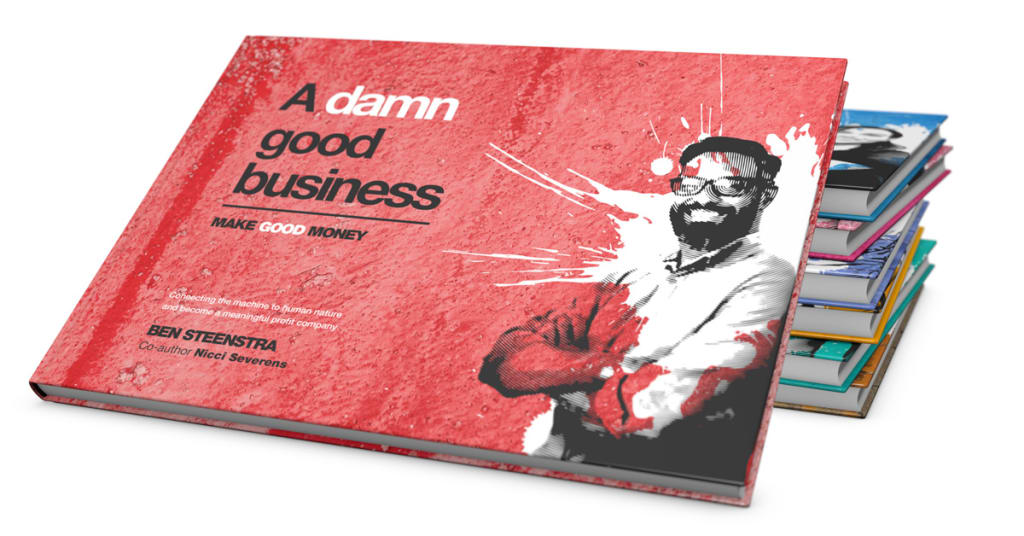
Are you searching for a compelling and practical guide to transform your business into a force for good? "A Damn Good Business, Make Good Money: Building a Meaningful Profit" offers invaluable insights and strategies for entrepreneurs, business owners, and managers who are committed to creating a positive impact in the world while generating meaningful profit.
The book goes beyond the traditional business mindset by exploring the intersection of financial success and social responsibility. Through real-life examples and practical advice, we provide a roadmap for aligning your business values with profitable operations. Whether you're just starting out or have an established company, this book will help you navigate the challenges and opportunities of building a socially conscious enterprise.
By integrating social and environmental considerations into your business practices, you can make a difference while also achieving long-term success. We emphasize the importance of defining a clear mission, engaging with stakeholders, and cultivating a purpose-driven culture within your organization. We also offer practical steps and strategies to implement sustainable practices, attract loyal customers, and build a strong brand reputation.
What sets "A Damn Good Business, Make Good Money" apart is its focus on generating meaningful profit. We demonstrate that businesses that prioritize social and environmental impact can thrive financially. We show how ethical business practices can enhance customer loyalty, attract talented employees, and create long-term value for stakeholders. By following our guidelines, you can build a business that not only makes a positive impact but also achieves financial success.
Take the first step towards transforming your business and making a difference. "A Damn Good Business, Make Good Money" is for sale at Amazone.com as E-book, paperback, and audiobook. It's part of a series published by Become Damn Good.
INTRODUCTION - PREVIEW OF THE BOOK
Many of our many-times-great-grandparents witnessed the birth of the Industrial Revolution. A time when businesses and the economy benefited from innovations like never before. A true revolution that we are still building on today. Machines conquered the world, and solid crafts of yesteryear rapidly disappeared into the history books. It could not go fast enough; it was all one great improvement that made our lives easier in so many ways.
But only some things got better. Not to mention how polluting the machines were that powered the Industrial Revolution in those days. Another thing that certainly proved to counter good progress was that entire companies were slowly but surely set up as machines — anything to produce as efficiently as possible. Man suddenly found himself a robot controlling the machine. Human nature was not considered because that knowledge did not exist back then. The techies with an understanding of mechanics tried to make the human in the machine as efficient as possible.
Words like ‘meaning’, ‘intrinsic motivation’ and ‘self-direction’ could not yet be found in the dictionary. Unfortunately, despite all the fine business and management books written about them since then, the grievous errors of that time have not been sufficiently unravelled to this day.
The Industrial Revolution has accelerated two things that really do us and the world no good but what we have seen as the foundation of a healthy business.
Focus on efficiency: As companies grew, all focus went to finding ways of managing and operating all employees as efficiently as possible.
Profit maximisation: Not community interest and added value, but it was solely profit maximisation that became the highest goal of companies.
Of course, we have learned some things over the past decades about how to do this better. But more is needed! For instance, most companies - and especially their employees - realise that there is more to life than just making huge profits. That you really can't just focus on efficiency anymore. There is nothing wrong with efficiency and profit maximisation at its root, but in many cases, there is still something wrong with how we pursue and implement those goals.
The problem is that the improvements that are mostly being made within business are rooted in the system that dates back to the Industrial Revolution. A time when machines, profit maximisation and efficiency became central. A time when this development dwarfed people and society. Therefore, it is time to talk about reconnecting the machines with human nature. The effect is to make even more profit but with respect for people and society. Profit in a meaningful way that benefits everyone - real, ‘good’ profit, in other words.
THE PROFIT AND NON-PROFIT SECTOR
Every entrepreneur and shareholder dreams of more profit, and it can be done. Especially if you start pursuing Meaningful Profit and adapting the machine, we now call an organisation to human nature. There will be more efficient, creative work and production, more growth and even better continuity of the organisation.
We need to go back in time to understand why this is so. After all, we will have to learn to be ready for the future. Not everything was better in the past, but fortunately, we can use history as a lesson.
The Origin of the For-Profit and Non-Profit Sectors
Before the Industrial Revolution, the primary relief for the less fortunate came from the church and its followers. But that soon changed when the church rapidly began to lose its power and size in the late 19th century. The ever-expanding corporations did nothing either. Instead, they sought to hire labour as cheaply as possible and make as much profit as possible - nothing else mattered. That had become the new normal.
It is, therefore, not surprising that at the very beginning of the last century, the first large non-profit organisations, many of which still exist, were founded. The church's role was replaced by, for example, the Red Cross, the Salvation Army and Save the Children. During a crisis, you see shifts like this occurring more often. The same also happened just before and after World War II.
We now take for granted that there is a distinction between the profit and non-profit sectors. But remember that before 1900, there was no profit or non-profit sector. It is a term that indicates that one organisation is focused on wanting to make a lot of money, and the other is only focused on selflessly serving a noble cause. In doing so, we also take for granted that the word 'profit' is synonymous with money or financial gain, but that is nonsense. Profit literally means benefit. Financial gain can be part of it.
In Latin, the word profit comes from the word: Profectus, meaning growth, benefit and progress.
The fact that a distinction between the profit and non-profit sectors has emerged at all is actually quite unfortunate. If the entrepreneurs of the time had not become so eager, this would not have been necessary. But the word profit has been taken entirely out of context for decades. Why have we been able to improve our prosperity and well-being for thousands of years without these two cleavages, and was it suddenly necessary to change this? What if the two could go hand in hand without one group having to go out and save the poor seals while the other boost profits and efficiency like a slave driver?
The golden mean between the profit and non-profit sectors can exist if we take human nature into account and start adapting to it the machines we now call organisations. After all, humans are not made only to give or only to take. The two should be naturally balanced, especially within your organisation. We call this golden mean ‘Meaningful Profit’ -pursuing profit that you find meaningful.
Authors: Ben Steenstra & Nicci Severens
About the Creator
Ben Steenstra
I have a passion for writing articles and books about the balance between doing good and excelling in a certain field of expertise.
Keep reading
More stories from Ben Steenstra and writers in Motivation and other communities.
3 ESSENTIAL QUESTIONS FOR EVERY ENTREPRENEUR: GOING BEYOND PROFIT
As entrepreneurs or business leaders, you are facing challenging times. Governments increasingly want to regulate in terms of companies’ climate impact, social responsibility, and other issues that do not directly contribute to profits. But is this really the role of government? By definition, shouldn’t entrepreneurs and leaders be asking themselves some questions that would make government intervention not even necessary?
By Ben Steenstra3 years ago in Motivation
Every Successful Person You Admire Took a Risk You'd Probably Avoid
From a distance, success looks polished. It looks like confidence, clarity, and momentum. It looks like someone who “just knew” what they were doing. Someone who found their calling early, trusted themselves effortlessly, and moved forward without hesitation. We see the outcome and assume the path was smooth, or at least smoother than ours.
By Stacy Valentine4 days ago in Motivation



Comments
There are no comments for this story
Be the first to respond and start the conversation.