
Katalin Karikó: The Woman Who Refused to Give Up on Science
Success Story

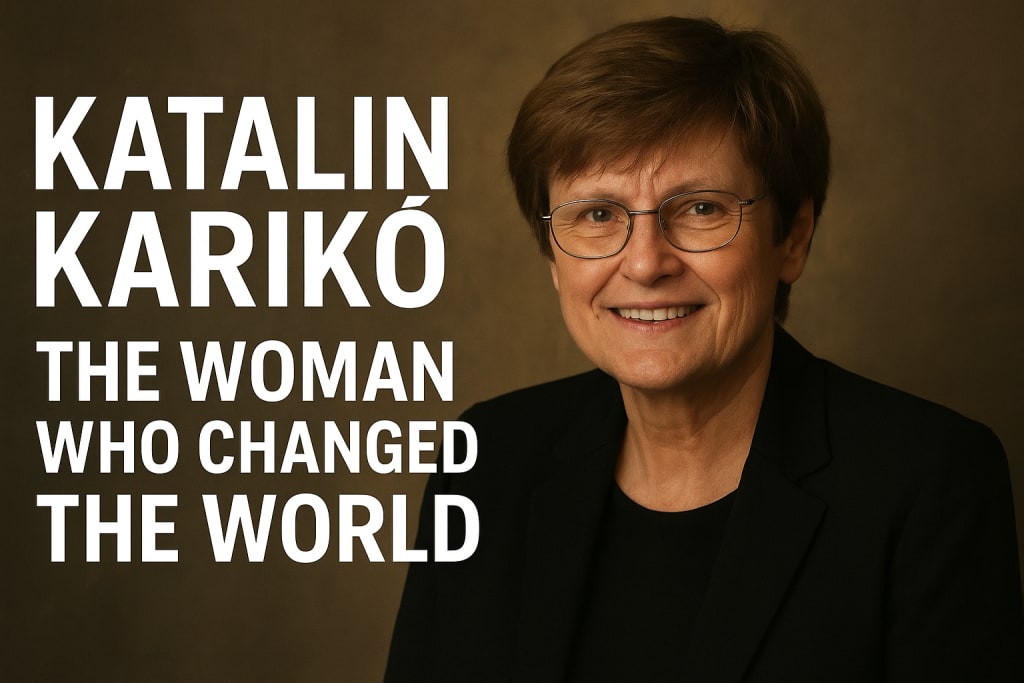
When most of us think about scientific heroes, we imagine people celebrated from the very beginning — geniuses who were supported, funded, and applauded as they changed the world. But sometimes, the people who change history are the ones who were rejected, doubted, even pushed aside for years.
The story of Katalin Karikó, the Hungarian-born scientist whose persistence with mRNA research led to the creation of life-saving COVID-19 vaccines, is one of those rare stories. It is not just a tale of science — it is a story of resilience, humility, and unshakable belief in one’s purpose.
Her path was not glamorous. For decades, she was overlooked, her research rejected, her funding cut. At one point, she was even demoted at the University of Pennsylvania. And yet, she never abandoned her vision: that fragile strands of messenger RNA could be used to teach the human body to heal itself.
This is the human story of how a quiet scientist went from growing up in a tiny Hungarian town to becoming one of the most important figures in modern medicine.
Growing up in Hungary: A Childhood of Simplicity and Curiosity
Katalin Karikó was born on January 17, 1955, in the small town of Kisújszállás, Hungary. Her father was a butcher, and her mother was a bookkeeper. They lived modestly, in a tiny house that didn’t even have running water.
Life in rural Hungary during the Cold War was not easy. Opportunities were limited, resources were scarce, and the country was politically isolated. But even in those conditions, Katalin showed an early fascination with the mysteries of life.
As a child, she would ask questions about everything — why things grew, how cells worked, why some people got sick. She wasn’t content with simple answers. She wanted to dig deeper.
By the time she entered high school, it was clear that she had a gift. Science wasn’t just a subject for her — it was her passion. And even though her family couldn’t provide luxuries, they supported her education as much as they could.
Choosing the Path of Science
Katalin’s love for biology led her to pursue higher studies. She enrolled at the University of Szeged, where she focused on biochemistry. She later earned her Ph.D. at the Hungarian Academy of Sciences, diving deep into the inner workings of RNA — the molecule that would define her life.
Back then, RNA was not considered promising. DNA had captured the world’s attention; it was the “molecule of life,” the blueprint of everything. RNA, by comparison, was seen as fragile, unstable, and not very useful.
But Katalin saw potential. She believed that messenger RNA (mRNA) — the type of RNA that carries genetic instructions to make proteins — could hold the key to treating diseases. If you could deliver the right mRNA into cells, you could teach the body to make its own medicine.
It was a bold idea. And at the time, few people believed in it.
A Leap of Faith: Moving to the United States
In the 1980s, Hungary was still under communist rule. Opportunities for groundbreaking research were limited. Katalin knew that if she wanted to pursue her dreams, she would need to go abroad.
In 1985, with her husband and young daughter, she made the life-changing decision to move to the United States. They sold their car on the black market for about $1,200. She stuffed the money inside her daughter’s teddy bear so customs officers wouldn’t confiscate it.
It was not a glamorous arrival. The Karikó family arrived in America with little money, no safety net, and no certainty about the future. But Katalin had something stronger than security: determination.
Katalin began working as a researcher at Temple University in Philadelphia, and later at the University of Pennsylvania. She was focused on developing mRNA into a medical tool.
But the scientific community was not ready to believe in her.
At the time, mRNA was considered too unstable. It would degrade quickly and trigger unwanted immune reactions. Grants she applied for were rejected. Research papers were dismissed. Colleagues moved on to more “promising” areas.
Funding agencies repeatedly turned her down. Without funding, it became nearly impossible to run experiments. Without results, it became even harder to convince anyone to take her seriously.
By 1995, things hit rock bottom. The University of Pennsylvania, where she had been working, demoted her from her faculty position. For many scientists, this would have been the end. Losing status in academia often means losing credibility, resources, and future opportunities.
But Katalin didn’t quit.
The Power of Perseverance
When asked years later how she kept going, Katalin gave a simple answer:
“Every night I went home, I thought, ‘Tomorrow, I will try again.’”
It wasn’t about fame or recognition. It wasn’t about money. It was about the belief that the science mattered.
Even while working at the very bottom of the academic ladder, she kept conducting experiments. She collaborated with anyone who would listen. She refined her methods, testing ways to stabilize mRNA, trying to solve the puzzle that nobody else wanted to touch.
Her husband supported her emotionally, and her daughter, Susan, was growing up watching her mother quietly battle through obstacles. Susan later became an accomplished athlete, an Olympic gold medalist in rowing — a testament to the resilience that seemed to run in the family.
A Fateful Partnership: Meeting Drew Weissman
In 1997, a chance encounter changed everything. At a photocopier machine in the University of Pennsylvania, Katalin met Dr. Drew Weissman, an immunologist.
Weissman was researching vaccines, particularly how to trigger immune responses safely. When he learned about Katalin’s expertise in RNA, the two began discussing possibilities. Could mRNA be used to create vaccines? Could they make it stable and safe?
This partnership became the turning point in her career. Together, they discovered a way to modify mRNA so that it wouldn’t trigger harmful immune reactions. This was the breakthrough that finally made mRNA practical for medicine.
Still, recognition was slow. For years, their papers were overlooked. Pharmaceutical companies weren’t interested. Funding remained scarce. But the seed had been planted.
The Quiet Years Before the Storm
Through the early 2000s and 2010s, Katalin and Drew kept pushing forward. They published papers, refined techniques, and built the foundation of what would one day become lifesaving technology.
But for the wider world, they were still unknown. While others rose in the ranks of academia and biotech, Katalin remained in the shadows — often working without tenure, without prestige, and without the kind of recognition her work deserved.
She often admitted that she sometimes felt invisible. And yet, she did not stop.
Building the Foundation for a Revolution
Unbeknownst to most of the world, her persistence was laying the groundwork for a revolution in medicine.
The modifications she and Weissman developed eventually caught the attention of biotech companies like BioNTech and Moderna, which began experimenting with mRNA vaccines.
When the COVID-19 pandemic hit in 2020, the world suddenly needed a vaccine — fast. And the technology that Katalin Karikó had dedicated her entire life to, against all odds, was ready to meet the moment.
Katalin Karikó’s story is one of persistence that turned into triumph. After decades of rejection, she was about to play a pivotal role in solving one of the greatest challenges of modern history—the COVID-19 pandemic.
The Breakthrough Moment
By the mid-2000s, Karikó and her longtime collaborator, Drew Weissman, had finally made a crucial discovery. They found a way to modify synthetic mRNA so that the human immune system would accept it without triggering harmful inflammation. This breakthrough was the key to unlocking mRNA as a tool for vaccines and therapies.
Still, recognition did not come immediately. Grants remained scarce, her work was undervalued, and she was even demoted at the University of Pennsylvania. But Katalin pressed forward, fueled not by titles or positions, but by her unshakable belief in science.
From Rejection to Global Recognition
When the COVID-19 pandemic struck in 2020, the world needed a vaccine—and it needed it fast. That’s when the decades of work by Karikó finally shined. Her modified mRNA technology became the foundation for the Pfizer-BioNTech and Moderna vaccines, protecting billions of lives across the globe.
Almost overnight, Karikó went from a largely unknown scientist to one of the most celebrated figures in modern medicine. Her work had changed the course of history.
Awards and Honors
Recognition poured in. Karikó received the 2023 Nobel Prize in Physiology or Medicine, alongside Drew Weissman, for their contributions to mRNA technology. She was awarded the Lasker Award, the Breakthrough Prize in Life Sciences, and countless other global honors.
But perhaps what makes her story even more powerful is her humility. Despite the fame, Karikó often speaks about her failures more than her success. She reminds the world that behind every discovery are years of invisible struggle.
Lessons from Katalin’s Journey
Katalin Karikó’s life teaches us powerful lessons:
Persistence beats rejection. No matter how many doors close, one day persistence opens the right one.
Believe in your vision. Even when others doubt you, self-belief can fuel extraordinary outcomes.
True success helps humanity. Karikó’s work wasn’t about fame or money—it was about saving lives.
Legacy of Hope
Katalin Karikó is more than just a Nobel laureate—she is proof that science, perseverance, and resilience can transform the world. Her work has laid the foundation not just for COVID-19 vaccines, but for future therapies against cancer, genetic diseases, and beyond.
Her journey inspires every dreamer, every struggler, and every believer that no matter how impossible the odds, persistence can truly change the world.
About the Creator
Frank Massey
Tech, AI, and social media writer with a passion for storytelling. I turn complex trends into engaging, relatable content. Exploring the future, one story at a time
Keep reading
More stories from Frank Massey and writers in Motivation and other communities.
Chris Hemsworth: From Humble Beginnings to Hollywood’s Doorstep
When most people think of Chris Hemsworth, they picture the mighty Norse god Thor — hammer in hand, cape flying, saving the universe alongside the Avengers. But behind the superhero persona lies a very human story of grit, persistence, and resilience. Chris Hemsworth’s path to fame was not straightforward. It was marked by humble beginnings, early rejections, self-doubt, and the relentless pursuit of a dream.
By Frank Massey 4 months ago in Motivation
Life Will Never Wait for You to Be Okay: Why You Must Keep Moving
We often spend our lives waiting. We wait for the perfect moment, the perfect opportunity, and most commonly, we wait until we "feel better" to take the next step. We tell ourselves, "I’ll start that project when I’m less stressed," or "I’ll pursue my dreams when my heart is healed." We believe that emotional readiness is a requirement for progress.
By World Knowledge 7 days ago in Motivation




Comments
There are no comments for this story
Be the first to respond and start the conversation.