
Inspired To Persevere
Women Who Inspire Challenge Essay
I would like to take this essay challenge opportunity to write about one of my professors from my undergraduate studies who was and is truly inspirational to me. Lisa Gralnick taught me far more than metalsmithing, she taught me to be persistent, to persevere no matter how many times I failed, and to never stop striving to achieve my goals in life.
She is an extraordinary professor who teaches her students by both example and by continually encouraging her students to push themselves to do their best work. She pushes her students to work hard, as well as to put in time and effort in their projects, while also offering constant encouragement when students struggle with their assignments. She balances constructive criticism with compliments on the areas where one has succeeded, offering fair and balanced feedback on students’ work.
Additionally, she exemplifies through her own work that persistence can and does pay off by showing students many of her practice samples, her first runs and tests prior to perfecting a technique. She helps put failure to accomplish on the first try of one’s desired goals for a project into perspective by reassuring students that if they try again, they will be more likely to succeed. By doing this, she helps ingrain into her pupils the belief that first failures are merely challenges that can be overcome through hard work, practice, dedication, and passion to succeed at accomplishing one’s goals.
Having Lisa Gralnick as a professor helped me not only to become a better metalsmith, but also helped me to develop a more persistent nature as a person and to believe in myself as being capable of accomplishing anything as long as I work hard at it and to never give up striving to accomplish something. She helped me to believe in myself and to believe that I have the ability to overcome whatever challenges I might face in life.
To try, and try again, and again, and again, until one succeeds. It is a simple lesson, but it is one of the most valuable ones that I have ever been privileged to learn both in academia and outside of academia. She demonstrates generosity as a professor in her willingness to encourage all of us lucky enough to be, or to have been, her students with her openness to admit that she did not always do everything perfectly the first time and show us how through continued practice and persistence she was able to achieve the desired outcome in her work.
Unlike other people whom I have met, Professor Gralnick demonstrated to me throughout my coursework with her that she valued a willingness to redo work, having learned from one’s first mistakes and demonstrating a desire for improvement, in addition to inherent talent. That one did not need to be someone gifted with an innate ability to accomplish the assignments perfectly the first time to succeed, but rather that one could put in effort, time, and hard work to create something amazing. Some people say that practice makes perfect, and this value of constantly strive to do better, rather than relying on good luck to get it right the first time, was emphasized to me in my courses with her.
Like my other female professors, Professor Gralnick set an example for me to look up to by demonstrating to me the ability of women to attain professional success. That through hard work and persistence, it is possible for me as a woman to achieve my professional goals in life and to view my education as the jumping-off point for my career and to think of my higher education as opening the door to doing meaningful work that I enjoy and get rewarded for doing it every day. Professor Gralnick’s passion for metalsmithing emphasized this to me most strongly, that it is possible to find something that fascinates me in the world, that I truly enjoy doing in life, and turn that passion into a successful career.
In addition, I was lucky enough to have the opportunity to work for Professor Gralnick as an artist assistant after graduation on one of her projects. I remember one time that I came into the studio, and she told me that she had had an idea for how to improve her project, so she had come in to work on it at 5 AM, despite her having the freedom to work whenever she chose to work. It is this sort of passion and love of one’s professional work that inspired me to pursue a master’s degree in architecture later, as I have always had a strong desire to create work that is both inspiring for its beauty as well as capable of improving the lives of others and helping to mitigate the environmental degradation of the planet.
Professor Gralnick also inspired me to seek to make work that can be meaningful, insightful, and that poses questions about society and culture through leading by example in her own work. Within her work, Professor Gralnick’s subject matter ranges from personal to an examination of the profession of metalsmithing and its history. Her work inspires and challenges it viewers to consider her chosen subject as carefully and thoughtfully as her work is crafted.
In one of her past series, The Gold Standard, she raised questions about the valuation that we as a society put on the worth of gold and the price that we are willing to pay for it. The first part of this three-part series shows relatively small amounts of gold relative to other objects, then lists the prices those other objects on a plate below along with amounts of gold used in the piece. My interpretation of this work is that it is to challenge viewers’ perspective on the value that is placed on something that cannot be eaten, cannot be used to serve a practical function such as cleaning, or for health purposes. It emphasizes how we have allowed and decided as a society that something so small, with so little function beyond beauty and decoration, is worth so much.
In the second part of the series, she created casts of jewelry in plaster, thereby stripping away the material attributes of objects, and emphasizing their formal properties purely. This raises another line of questioning about the value that we put on gold objects. Do we like them for the beauty of the craftsmanship and the design work, or simply because we have been taught to value anything made from gold?
The third portion of this series shows gold in its historical and traditional usage as jewelry and adornment of the body. It contextualizes the material in the manner of usage that it is most widely used and shows the beauty and intricacy that the material allows one to create with it. In my opinion, this last portion serves to give the viewer a well-rounded understanding of how gold became so valuable in society by emphasizing the unique properties of the material to create delicate, intricate, and unique forms seamlessly. The three parts of this series take the viewer on a journey from understanding its value relative to other objects to its usages and origins in adornment, thereby allowing one to both better understand its value today and how it came to be valued so highly.
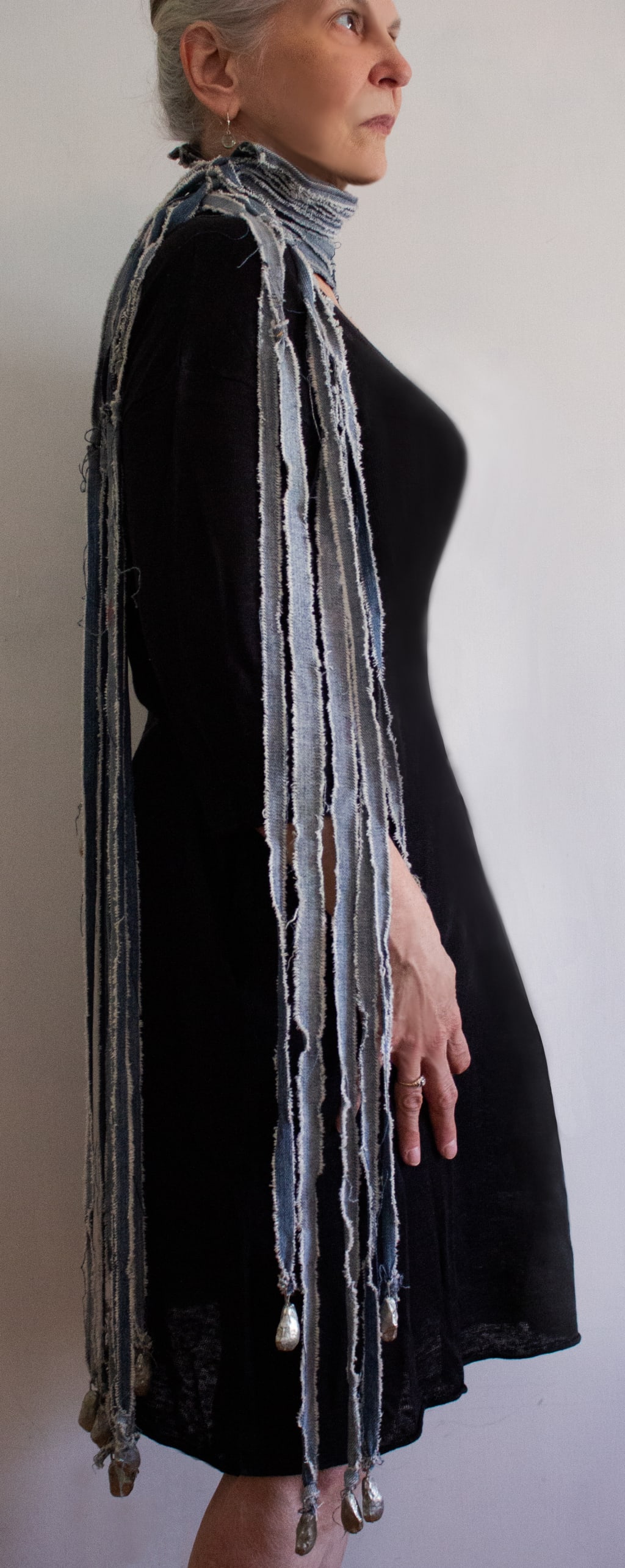
Professor Gralnick’s pieces operate as art beyond the aesthetic value of the work, speaking both to the history of craft and to issues that relate to the formation of contemporary life. It is work such as this that inspired me to pursue making art about social issues as well as more conceptually based work. Pieces such as Blue Collar (image above), were inspired from having her as well as Professor Rath as instructors. Blue Collar is made from repurposed blue jeans turned into a choker with pewter weights attached to the ends that literally choke the wearer to symbolism the weight of work and financial constraints that yank those in the working class down from excelling in society. It is intended to symbolize the cycle of continually striving to pull oneself up into better paying work and feeling the weight of one’s financial background dragging at one, literally choking one, as one attempts to move up out of the lower income. The cycle starts by not having enough money to participate in the social hobbies, activities, outings, and other leisure activities and networking events as those in wealthy upper class, thereby struggling to make friends and acquaintances that could recommend one for well paying positions. In order to gain the money for basics of life and these social activities one must have a job, but without having the friends and a social network to gain recommendations for well-paying jobs, one gets stuck taking low paying work and ending up with a network of similarly low-income persons, then, because of the number of hours that one must put in at these low paying jobs to make ends meet, one fails to have sufficient time, energy, and financial resources to participate in social activities that might introduce one to those who could help one in securing better work. Thereby it becomes a continuous cycle in which one works, but no matter how much one works and saves financially, the class discriminations from social networks, educational institutions, living situations, and one’s financial resources persist in creating barriers towards upper mobility to those from lower income backgrounds.
It is a continuous and oppressing cycle of life that chokes one from birth and feels like a never-ending weight that forces one to fight three times as hard as the privileged for the same positions. For everything that a wealthy person does to gain a position, a poor person does more, from more time into the very work that one creates so that it is better and therefore likely to get one hired without knowing anyone at the company to recommend one to more hours worked at a job. More time is spent doing something menial and perhaps even demeaning for a low wage, then attempting to socialize with people who have more resources at their deposal after long shifts at work and hours spent studying, hoping that no one notices that one bought the least expensive item on the menu. This cycle is draining, and one feels at points hopeless as though the very life and desire for life is being choked out of one by the sheer weight of being born into a lower income life.
This cycle of oppression was something that I experienced acutely as an undergraduate student in a program for low-income individuals. While there were many goods aspects to the program, there were also downsides as it lacked academic advisors and career advisors for the students in it. Additionally, students in this program had work-study jobs included as a part of our financial aid packages, meaning that we worked at low-wage jobs for fifteen hours a week. These jobs meant that when more privileged students were doing their schoolwork, we were at our work-study jobs, hence leading us to come in to school later in the evening to fulfill our academic requirements, while these more privileged students went out to social events and networked with other people. The divide between myself and these more privileged individuals was emphasized to myself and one of my fellow low-income students one evening, when arriving into the studio late to complete our assignments, we received criticism from a fellow privileged classmate who stated that our work would be better if we started it earlier in the day. Her ignorance to the notion that we couldn’t have started it earlier even though we would have liked to do so because we had to be at work, demonstrated to me the complete lack of understanding of our lives. While she complained about not receiving any scholarships and her father having to pay for everything, we looked on in amazement, discussing after she had left how she was completely out of touch with real life, and not at all in need of scholarships at all if her family was wealthy enough to pay for not only her tuition but also her living expenses in one of the most expensive private dormitories at the school.
This fellow student’s complete and utter inability to understand that people work because they need the money to pay for school and life, despite the time that it takes away from their studies and ability to build social networks to further their careers was astounding. It stands out to me to this day as a personal manifestation of the discrimination, arrogance, and blaming of the poor for their own circumstances that so many privileged individuals engage in. Without ever having struggled themselves, they make assumptions about those from low-income backgrounds, such as that we are lazy or bad students because we are forced to do our schoolwork after working at our paying jobs, tired from hours at a work-study job and with far less time to complete the work than those who come from backgrounds of privilege. It forms a critical part of the cycle of oppression and discrimination against people from lower-income backgrounds that creates the choker and weights dragging us down, and the feeling that despite proclamations that we live in a free society where anyone can pull themselves up by their boot straps, we are developing through wage depression and discrimination a distinctly classist society verging on a cast society. That the promises of upward mobility are often hollow and illusionary, as more and more people seem to rely on social networks, family connections, and friends to get their jobs, not educational qualifications and talent.
It is professors like Lisa Gralnick that give me hope and inspiration to continue to persevere against these invisible barriers of class and income discrimination. That someone without family in the arts and thereby a leg up in the field can become one of the most renown goldsmiths and Chair of the Art Metals Department at prominent university. Her support and encouragement of my work throughout my studies at the University of Wisconsin – Madison, allowed me to continue to aspire and believe that it is possible for me to do more with my life and that upward mobility is possible, if extremely difficult. To never give up pursuing my goals and aspirations, to use my education and my degree to move up and out from poverty and life as a lower-income person. To never stop pursuing my career goals and working to make them come true for myself, no matter how many times I have not succeeded. That if one can at first melt one’s project and fail completely at the assignment, then redo it as many times as it takes to get it perfect and achieve a top grade, then one should be able to do the same in the pursuit of one’s career. This value that persistence and continuing pushing oneself to do one’s best will lead to ultimate success inspires me always.
About the Creator
Keep reading
More stories from writers in Motivation and other communities.
Corrosion Resistance That Endures: The Strength of Hot-Dip Galvanized Steel
Steel remains essential to infrastructure, manufacturing, and development across the nation. However, corrosion constantly threatens its durability and performance. When steel comes into contact with moisture and oxygen, rust begins to form and slowly spreads. Over time, this process weakens structures and increases safety risks. Therefore, engineers and asset owners seek protection methods that deliver long-term reliability. Hot-dip galvanizing provides a proven answer to this ongoing challenge.
By Frontier Galvanizinga day ago in Motivation
How to Succeed at the Benson Directory®
Congratulations and welcome to the Benson Directory® employee #22391! As our newest call handler, you will have the privilege of speaking with dozens of unique and interesting people on a daily basis as well as the opportunity to earn bonuses for high performance. Contained within this handbook you will find a set of ease to follow instructions designed to help you settle in to your new role and begin paving the way to success.
By S. A. Crawforda day ago in Fiction
The Devil's Cut
“Comrade, finally you’re awake.” The voice was smooth, sensual. A flickering incandescent bar was all that lit the white, sterile room. All Vladimir remembered was everything going black. He tried to move his arms and found them strapped to the gurney.
By Matthew J. Fromm4 days ago in Fiction




Comments
There are no comments for this story
Be the first to respond and start the conversation.