
"Imran Khan: The Rise, Reign, and Reckoning of a Political Icon"
From cricket stardom to the corridors of power, the turbulent political journey of Imran Khan reshaped Pakistan’s destiny—and divided a nation.
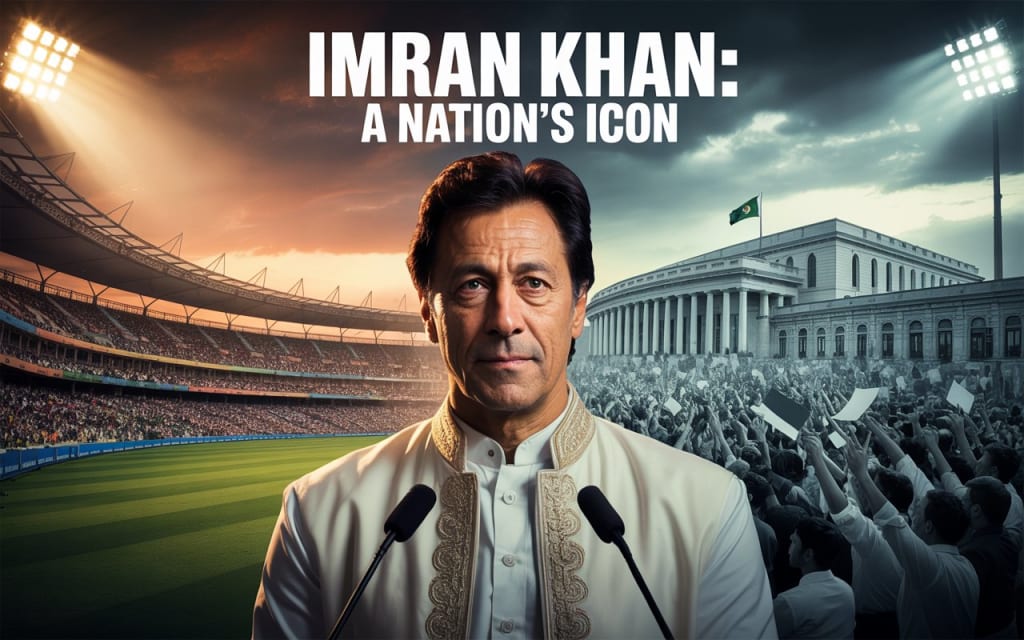
Imran Khan’s story is unlike any other in Pakistan’s modern history—a tale of fame, ambition, transformation, and controversy. From being a cricketing legend to becoming one of the most polarizing figures in Pakistani politics, his life reflects both the hopes and frustrations of a nation longing for change.
Born in 1952 into a well-off Pashtun family in Lahore, Imran Khan was educated at elite institutions, including Aitchison College, the Royal Grammar School in England, and later Oxford University. It was during his years in England that Khan’s cricketing career began to shine. He rose to fame as a world-class all-rounder, eventually leading the Pakistan national cricket team to its only Cricket World Cup victory in 1992. That moment, when he lifted the trophy at the Melbourne Cricket Ground, forever etched his name in the hearts of Pakistanis.
But Khan's ambitions didn’t end on the cricket field. After retiring from the sport, he turned to philanthropy, building the Shaukat Khanum Memorial Cancer Hospital in Lahore in honor of his mother. His success in rallying public donations for the hospital revealed a growing charisma beyond sport—a sign that he might soon set his sights even higher.
In 1996, Imran Khan officially entered the political arena by founding his own party, Pakistan Tehreek-e-Insaf (PTI), meaning "Movement for Justice." At first, the party was a fringe player, struggling to win seats and often mocked by political elites. For nearly two decades, Khan remained on the periphery of power. But his message—centered on anti-corruption, Islamic values, and national pride—slowly began to resonate with Pakistan’s burgeoning middle class and disillusioned youth.
By 2011, PTI’s momentum began to surge. Massive rallies in Lahore and Karachi demonstrated that Khan had tapped into a vein of public anger toward dynastic politics and systemic corruption. The 2013 general elections marked a significant breakthrough for PTI, securing a governing role in Khyber Pakhtunkhwa province. However, it was the 2018 general election that truly catapulted Khan to the top. With the backing of key institutions and a promise of a "Naya Pakistan" (New Pakistan), Khan became the 22nd Prime Minister of Pakistan.
His rise to power was hailed as a new chapter. He pledged to create 10 million jobs, build 5 million homes, and hold corrupt leaders accountable. Khan’s charisma, oratory, and international stature gave him an edge rarely seen in Pakistani leaders. His speeches at the United Nations and his handling of the 2019 India-Pakistan border tensions won him praise at home and abroad.
Yet, governing proved far more difficult than campaigning. His government struggled with economic instability, rising inflation, and accusations of political repression. Relations with opposition parties soured, and criticism grew over his handling of press freedom and judicial independence. Meanwhile, his once-warm relationship with the military—the country's most powerful institution—began to fracture.
In April 2022, Imran Khan faced a no-confidence vote in parliament and was removed from office. His ousting triggered mass protests and a new phase of confrontation with state institutions. Khan claimed a foreign conspiracy—backed by the United States and aided by local rivals—had led to his removal. Though evidence for the claim remained elusive, it energized his supporters and deepened the polarization in Pakistan.
The following year saw legal troubles mount for Khan, including charges of corruption and terrorism-related allegations. He was arrested multiple times, sparking widespread unrest. Social media became the battleground for his supporters and detractors, and his persona—once that of a national hero—became a lightning rod in an increasingly divided society.
Despite the controversies, Imran Khan’s influence remains undeniable. He reshaped Pakistan’s political discourse, mobilized a new generation of voters, and challenged the dominance of traditional parties. Whether viewed as a reformer betrayed by the system or a populist who overpromised and underdelivered, Khan’s legacy is already cemented as one of the most consequential in Pakistan’s history.
As of now, Khan remains a symbol—of hope to millions, of disruption to others, and of how deeply personal and emotional Pakistani politics has become. His rise, reign, and reckoning continue to define an era.
About the Creator
Keep reading
More stories from writers in Motivation and other communities.
One Hard Thing
Stop me if you’ve heard this one before: You have the number, you know your schedule- you’ve even picked out the perfect day and time to make this appointment. Shoot, you’ve even picked out alternative days and times just in case their schedules can’t accommodate you!
By Taylor Rigsby6 days ago in Motivation
The Psychology of Packaging: Why Shape and Texture Matter
It’s a fascinating reality that many customers can choose a product (over a thousand others) before they even truly know what it is. Within the first few seconds, our brains form an initial judgment of a product. And guess what? It is based solely on visual cues. Yes, the product packaging.
By Andy Roya day ago in Motivation




Comments
There are no comments for this story
Be the first to respond and start the conversation.