
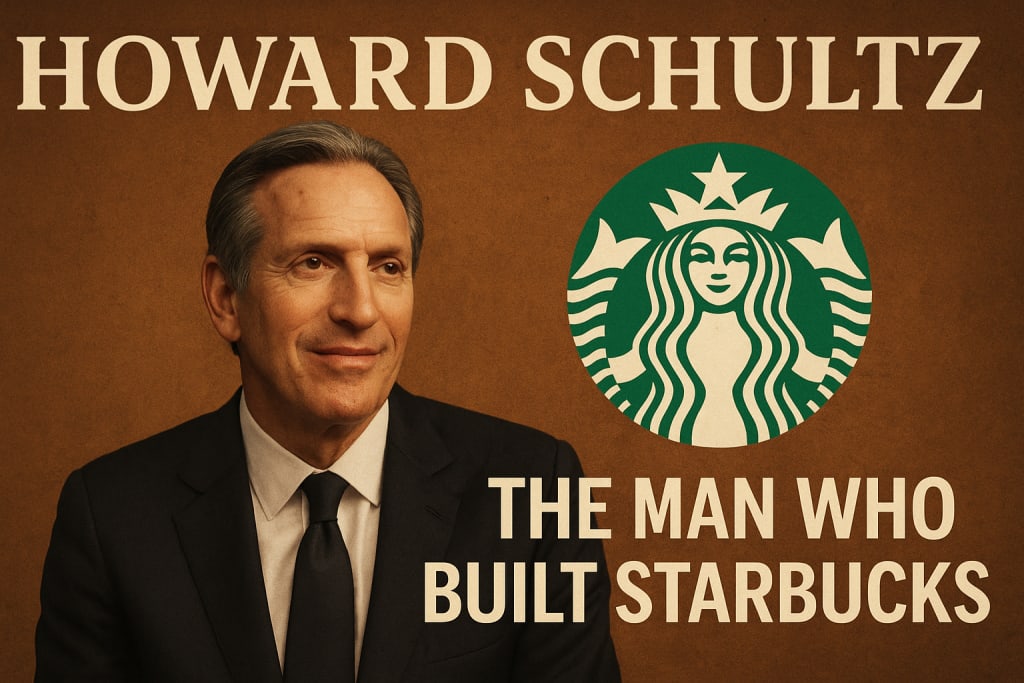
⭐ Howard Schultz: The Boy Who Refused to Stay Poor — The Untold Motivational Story of the Man Who Built Starbucks
SUCCESS STORY

The Day Everything Changed
The world knows Howard Schultz as the billionaire behind Starbucks — the man who transformed a tiny Seattle coffee store into a global symbol of culture, ambition, youth, and dreams.
But few know the moment that changed him forever.
He was seven years old, living in a cramped low-income apartment in the Bronx. One winter afternoon, Howard ran down the hallway laughing, chasing a small rubber ball. He pushed open the door to their apartment —
and froze.
His father, Fred Schultz, lay on the floor, his leg badly broken, unable to stand.
He had slipped on ice while delivering diapers — one of the last jobs he could find.
He had no health insurance. No savings. No stability.
No employer who cared.
Howard watched his proud, hardworking father break into tears of pain, frustration, and humiliation.
In that moment, little Howard felt something rise in his chest — anger mixed with helplessness.
He made himself a promise:
“One day, I will build a company where people are taken care of. No one will feel like my father did.”
He had no idea this promise would one day reshape global business culture.
Growing Up Invisible
Howard grew up in a world where nobody expected anything from him.
He wasn’t the top of his class.
He wasn’t the charming one.
He wasn’t the star athlete.
He was the kid who wore the same shoes for years, the kid who learned how to hide poverty behind humor, the kid who spent afternoons on the rooftop dreaming about a different life.
His father drifted from job to job. His mother stretched every dollar.
Their apartment was so small that privacy didn’t exist; dreams barely fit.
But Howard had one weapon:
ambition that refused to die.
He started selling newspapers.
Then he learned to hustle small jobs.
Then he discovered sports — and his raw competitive fire took over.
He became a quarterback, the only path he saw to escape.
His talent got him a football scholarship at Northern Michigan University — the miracle that lifted him out of poverty.
For the first time, he breathed air that wasn’t thick with fear.
The Moment of Realization: “Nobody Will Save Me.”
His scholarship lasted only because he fought for it every year.
He worked multiple jobs.
He washed dishes.
He stretched money as if it were rubber.
University wasn’t easy, but he learned something crucial:
He was all he had. Nobody was coming. He had to build his own life.
After graduating, he took sales jobs — the kind that require charm, courage, and a thick skin.
Within three years, he became the top salesman at a Swedish housewares company.
He wasn’t rich.
But he was no longer invisible.
The Trip That Changed Everything
In 1981, Schultz visited a small coffee bean shop in Seattle called:
Starbucks Coffee Company
At that time, Starbucks didn’t sell drinks.
They sold beans, grinders, and passion.
Howard walked in expecting nothing — and walked out obsessed.
The aroma, the culture, the craftsmanship…
He felt something electric.
He approached the owners repeatedly:
“Please hire me.”
They said no.
But Howard was a storm — unstoppable.
A year later, they gave in.
He became the Director of Marketing.
Then came the moment that would transform global coffee culture.
Italy: The Birthplace of a Revolution
Howard visited Milan for a trade show.
He stepped inside a small espresso bar —
and froze.
There was warmth. Community. Laughter.
Baristas knew customers by name.
People weren’t drinking coffee; they were sharing life.
He visited 200 cafés in one week.
It ignited something in him:
“This is what Starbucks should become — not a store, but a third place between work and home.”
When he returned to Seattle, he pitched the idea:
“Let’s sell coffee by the cup. Let’s bring the Italian café culture to America.”
The founders said:
“No. We don’t want to be in the restaurant business.”
Howard felt crushed — but not defeated.
So he did the unthinkable:
He left Starbucks.
The Struggle Before the Miracle
Howard launched his own café, Il Giornale, but raising money was torture.
Investors saw him as a kid with big eyes and no power.
He heard:
“No.”
“No.”
“No.”
“No.”
“No.”
214 times.
One investor even said to his face:
“You don’t look like someone who can build a business.”
Howard felt that seven-year-old boy inside him burning again — the memory of his father on the floor, broken and abandoned.
He kept going.
Finally — 25 investors said yes.
Il Giornale opened.
It was loud. Crowded. Alive.
A dream with steam and espresso.
Then came destiny:
Starbucks went up for sale.
Howard moved fast — raised $3.8 million — and bought the entire company.
The kid from the poor Bronx apartment now owned Starbucks.
Building an Empire: Pain, Sacrifice, Vision
Schultz built Starbucks on one core belief:
“People are not expenses.
They are assets.”
He offered healthcare — even for part-time workers.
He created stock options — calling employees “partners.”
Every financial advisor told him it was stupid.
He didn’t care.
His goal wasn’t just profit —
it was dignity.
Starbucks exploded —
from 4 stores
to 100
to 1,000
to 30,000+ across the world.
But success is never smooth.
The Collapse and the Comeback
In the 2000s, Starbucks grew too fast.
Quality faded.
Customers complained.
Stock plummeted.
Howard returned as CEO — not for ego, but to save what he built.
His first move shocked everyone:
He shut down every Starbucks in America for a day to retrain baristas.
Wall Street mocked him.
The media laughed.
But Howard knew something others didn’t:
You cannot scale a company
if you cannot scale its soul.
Within months, Starbucks rose again.
The Legacy of the Boy from the Bronx
Howard Schultz didn’t build Starbucks by being lucky.
He built it because:
He saw his father broken.
He saw what happens when companies do not care.
And he swore he would not repeat that cruelty.
He proved that poverty does not define destiny.
He proved that dreams born in small apartments can shape the world.
He proved that one promise — made by a seven-year-old — can evolve into a global empire.
Today, Starbucks is worth more than the GDP of countries.
It employs hundreds of thousands.
And its culture of benefits changed corporate America forever.
Not because of coffee.
But because of compassion.
About the Creator
Frank Massey
Tech, AI, and social media writer with a passion for storytelling. I turn complex trends into engaging, relatable content. Exploring the future, one story at a time
Keep reading
More stories from Frank Massey and writers in Motivation and other communities.
SUNDAR PICHAI – THE MAN WHO TURNED SILENCE INTO POWER
The Rise From a One-Room Apartment to the Nerve Center of The Internet Sundar Pichai’s story does not begin with Silicon Valley, billion-dollar valuations, or Google boardrooms. It begins with silence. The kind of silence that exists in a home where money is tight, electricity fails often, and dreams feel like they belong to someone richer.
By Frank Massey 2 months ago in Motivation
“The Selflessness of Hatim Tai”
In pre-Islamic Arabia, where evils were everywhere, there were still some good people. Among them was Hatim. Numerous stories have been told about Hatim. Even if we set aside the exaggerations in these stories, the truth remains that Hatim’s generosity is proverbial. In Islam, the generosity of Hazrat Uthman (RA) is exemplary, and countless incidents about him are well known.
By Sudais Zakwan7 days ago in Motivation
Miss Persephone's Manual to a Seemingly Ordinary Life
Miss Persephone was found at the dining table, her blue eyes swollen, her tears arriving and retreating like the tides of the ocean. Earlier that day, her family had visited her in the retirement home where she had lived for eight years. It was her eightieth birthday.
By Imola Tóth5 days ago in Fiction



Comments
There are no comments for this story
Be the first to respond and start the conversation.