
How will we feed Earth’s rising population? Ask the Dutch.
The Netherlands’ hyper-efficient food system is both a triumph and a cautionary tale.


Part of Against Doomerism from The Highlight, Vox’s home for ambitious stories that explain our world.
An hour north of Amsterdam, some of the world’s largest seed conglomerates — the first step in a long journey that brings food from the farm to our plates — occupy what the industry calls “Seed Valley.” It’s a play on Northern California’s famous tech hub, but there is no actual valley here — the Netherlands is notoriously flat — and there are no Google buses or towering redwood trees. Instead, in this quiet, rural pocket, rows of pristine greenhouses stand beside small experimental farm plots and low-slung office buildings, all without a ping-pong table in sight. While touring a few seed companies there last month, I couldn’t even order an Uber.
Despite their differences, both regions share the belief that the best way to overcome humanity’s pressing challenges is through innovation. In California, it’s software and semiconductors, but in the Netherlands, it’s something even more elemental: improved fruit and vegetable seeds that can produce more food per acre for a growing population while withstanding ever-evolving threats to agriculture. And just as Silicon Valley has put its stamp on the global tech sector, Seed Valley has done the same for farming: Wageningen University and Research (WUR), an hour southeast of Amsterdam, is the nucleus of the country’s agricultural sector and is widely considered the world leader in agricultural science.
Going back nearly 80 years, anxieties over food security have driven the tiny Netherlands to become a global leader in agriculture despite having just half the land area of South Carolina. After a horrific famine during World War II killed more than 20,000 Dutch, the government heavily invested in its agricultural sector through subsidies, rural infrastructure, and industrialization. Two decades ago, it pledged to grow twice as much food with half as many resources, a goal it has already far exceeded. Today, the Netherlands produces 6 percent of Europe’s food with only 1 percent of the continent’s farmland.
Gerthon Van de Bunt, a senior plant breeder with the seed company Pop Vriend, is one of countless scientists in Seed Valley tinkering away to further boost agricultural output. When I met him in the company’s greenhouse complex, he showed me a few trays of small green bean plants he had infected with anthracnose, a fungal disease that’s killing green beans around the world.
Several days after infection, some plants looked perfectly healthy, while others were shriveled and discolored. After I’d spent hours poring over news articles and academic papers trying to better understand plant breeding, this small experiment made its power unmistakably clear. Plant the wrong seed and it could fall prey to disease, ruining an entire crop and wreaking economic and environmental damage, while newer varieties, bred through years of painstaking experimentation by scientists — many of them in Seed Valley — can make all the difference.
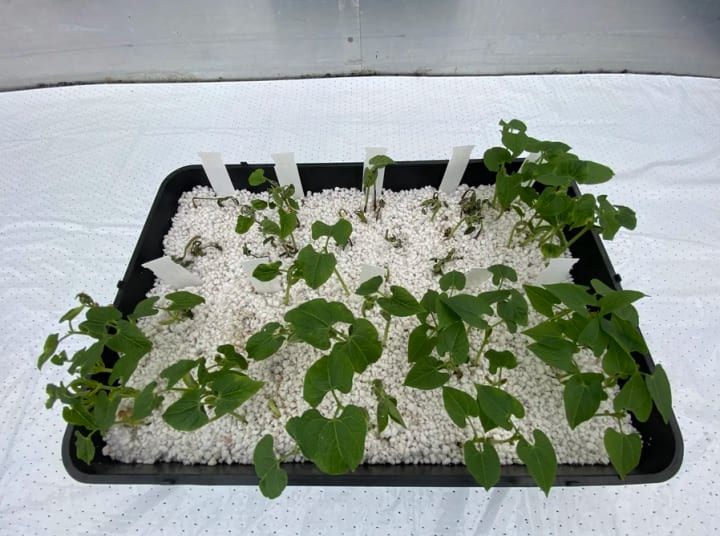
Van de Bunt will go on to breed those resistant varieties with ones that meet all the other desired green bean traits, such as color, size, texture, and yield. But before his anthracnose-resistant beans can make it to supermarket shelves, it’ll take six or seven years of testing in Pop Vriend’s climate-controlled greenhouses and in the field. Years ago, Van de Bunt developed a heat-tolerant variety of green beans this way, making them better able to tolerate rising temperatures that one year had killed as much as 80 to 90 percent of the harvest for some farmers in the southeastern US.
Thousands of such small improvements to food production add up, helping us grow more food on less land and feed a population that’s more than doubled in the past 50 years. We’ve largely been winning the race to feed humanity, but it’s a race that will only get tougher. Countless more innovations will be critical to feed the nearly 10 billion people projected to be alive in 2050, all against the backdrop of a changing and worsening climate.
In part because of its unique role in the global food system, the Netherlands in recent years has also become an emblem of ascendant debates over the future of food. After decades of doggedly chasing efficiency, many Dutch politicians and agriculture experts are now questioning the ills of the intensive farming style that drives that efficiency, calling for drastic changes in how the Dutch eat and farm in order to reduce pollution, improve biodiversity, and meet climate targets.
In the effort to stake out a middle ground between intensification and environmental conservation, I continually heard an updated version of their 20-year slogan throughout my trip: “Grow twice as much food with half as many resources — sustainably.”
Silicon Valley, but for seeds
Rapid world population growth over the past century has repeatedly fueled fears of mass starvation. But that hasn’t come to pass, in part because fertility levels began to decline sharply beginning in the mid-1960s, but also because advancements in agricultural technology, like the spread of tractors, synthetic fertilizers, and more sophisticated plant breeding, helped us squeeze more food out of less land.
To take one example, if the yields of staple crops like wheat, corn, and rice remained frozen where they were in 1961, we would have had to deforest an additional area of land close to the combined size of the US and India to provide the world with enough food. That would have been catastrophic for global biodiversity.
Much of that growth in yield is attributed to the Green Revolution, a US-led agricultural shift from the 1960s to ’80s to adopt synthetic fertilizers, pesticides, better irrigation, and hardier, higher-yield seeds in the Global South (Latin America, Africa, and Asia). The revolution spread harmful pollutants around the globe, but it also led to a dramatic reduction in death rates and immense economic growth, helping lift millions out of extreme poverty and hunger. No revolution is fought without casualties, but in the case of the Green Revolution, the benefits far outweighed the costs.
About the Creator
Mark Xavier
typing...
Keep reading
More stories from Mark Xavier and writers in Motivation and other communities.
THE MOST IMPORTANT QUESTION OF YOUR LIFE
Everybody wants what feels good. Everyone wants to live a carefree, happy and easy life, to fall in love and have amazing sex and relationships, to look perfect and make money, and be popular and well-respected and admired and a total baller to the point that people part like the Red Sea when you walk into the room.
By Mark Xavier3 years ago in Motivation
You're Going to Feel the Pain Either Way. Choose Which One.
The question was never "how do I avoid discomfort?" The question is "which discomfort am I choosing?" Because there are only two options, and you're picking one of them every single day - whether you're conscious of it or not.
By Destiny S. Harris7 days ago in Motivation
Parallel Protests
I haven't written for quite some time, but I have A LOT of thoughts about yesterday's protest rally against our government's involvement and complicity in America's war on Iran, on the harbourside of my home city Bristol, and I need to put them somewhere. My gorgeous girlfriend is always a loving and listening ear and sharing it all with her will always be a healthy and happy way of processing the mental and emotional weight, but getting it straight in my brain to share means writing it all down in straight lines, so, here we are and thanks for being here.
By Steph Cole6 days ago in The Swamp



Comments
There are no comments for this story
Be the first to respond and start the conversation.