
How One Book Ignited a City's Transformation
The Light of Pages

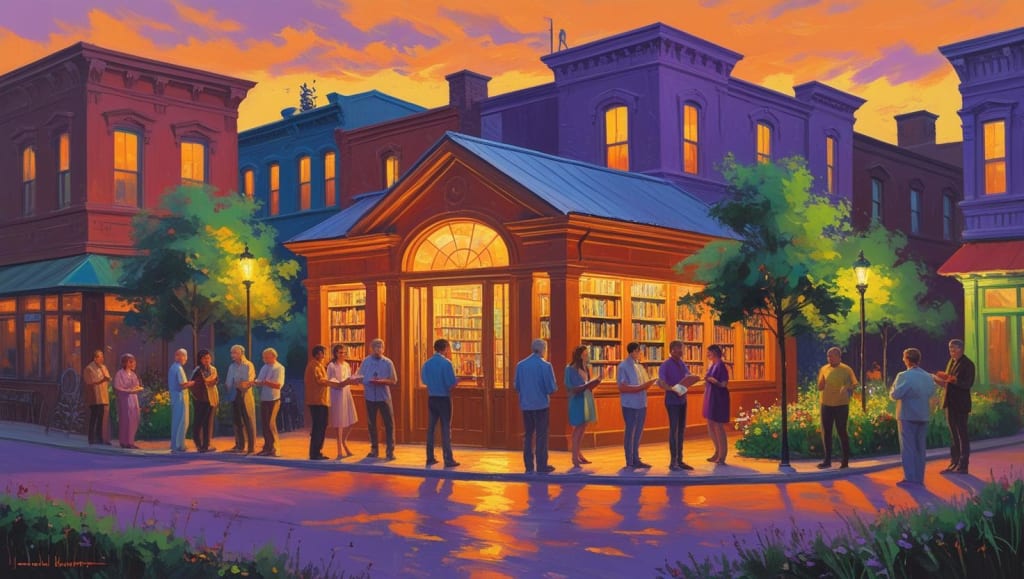
The Light of Pages
How One Book Ignited a City's Transformation
In the heart of Crestwood, a city draped in the gray monotony of routine, where smokestacks puffed dreams into ash and the hum of daily life drowned out hope, a single book flickered like a candle in the dark. Its pages, worn and dog-eared, held no magic spells or grand prophecies, yet they carried a power far greater: the ability to awaken minds, stir hearts, and reshape lives. This is the story of how one book, passed from hand to hand, transformed not just a single soul but an entire community, proving that the quiet act of reading can spark a revolution of thought and action.
Crestwood was not a place that invited dreamers. Its streets, lined with sagging rowhouses and cracked sidewalks, bore the weight of forgotten aspirations. The city’s library, a squat brick building tucked between a laundromat and a pawnshop, was more a relic than a refuge. Its shelves sagged under dusty tomes, and its fluorescent lights buzzed like trapped flies. Most residents passed it without a glance, their lives consumed by the grind of factory shifts or the endless scroll of screens. Books, to them, were luxuries for those with time to spare, and time was a currency Crestwood could ill afford.
But books, as Clara Evans would come to learn, are not mere luxuries. They are keys to locked doors, lanterns in uncharted caves. Clara, a thirty-two-year-old barista at the corner diner, lived a life as predictable as the orders she served: black coffee for Mr. Jenkins, two sugars for Mrs. Lyle. Her days blurred into a haze of steam and small talk, her nights spent in a cramped apartment where the television’s glow was her only companion. She wasn’t unhappy, not exactly, but she felt the weight of something missing—a hunger she couldn’t name.
One rainy afternoon, as Clara wiped down the diner’s counter, a customer left behind a book. It was a slim volume, its cover faded to a soft green, with the title The Art of Seeing embossed in gold. Curious, she slipped it into her apron pocket, intending to return it the next day. But that evening, as rain tapped her window, she opened it. The words inside were unlike anything she’d read before—not a story, but a meditation on observation, curiosity, and the hidden beauty in ordinary things. “To see the world clearly,” the author wrote, “is to understand its possibilities.”
Clara read late into the night, her television silent for the first time in years. The book wasn’t long, but its ideas were vast. It spoke of mindfulness, of finding meaning in the mundane, of asking questions that pierce the surface of life. For Clara, who had long accepted her world as fixed and unyielding, these words were a revelation. She began to notice things: the way sunlight fractured through her coffee pot, the rhythm of footsteps on the diner’s linoleum floor, the stories etched in the tired eyes of her customers. Reading had cracked open her world, and she couldn’t unsee its new colors.
The next morning, Clara brought the book to work, hoping to find its owner. No one claimed it, but she found herself talking about it to anyone who’d listen. “It’s like it rewrote how I see everything,” she told Mr. Jenkins, who raised an eyebrow but nodded politely. She left it on the counter, and by the end of her shift, a teenage girl named Mia, who often stopped by for a milkshake, had picked it up. Mia, a quiet high schooler with dreams of escaping Crestwood, devoured the book in two days. She returned it to Clara with wide eyes. “It’s like it’s telling me I can be more than this place,” she said.
Mia, inspired, began to carry the book everywhere, reading passages aloud to her friends at school. One friend, Jamal, a budding artist who sketched in the margins of his notebooks, was struck by the book’s call to see beauty in the overlooked. He started painting murals on the blank walls of abandoned lots—vibrant scenes of Crestwood’s people, its history, its potential. The murals caught the eye of passersby, who stopped to stare, to talk, to wonder. For the first time, Crestwood’s residents began to see their city not as a dead end, but as a canvas.
The book’s journey didn’t stop there. Jamal lent it to his history teacher, Ms. Rivera, who found in its pages a spark for her own stagnant career. She redesigned her lessons, encouraging her students to question the past, not just memorize it. Her classroom became a hub of debate and discovery, where students like Mia began to see history as a living thing, shaped by choices and ripe with lessons for their own lives. Ms. Rivera, in turn, passed the book to her neighbor, Mr. Patel, who ran a struggling corner store.
Mr. Patel, whose days were a blur of inventory and dwindling sales, read the book during slow hours. Its words about finding purpose in the everyday prompted him to rethink his business. He began hosting community nights at his store—free coffee and conversation, where neighbors shared stories and ideas. The book made its way from hand to hand, each reader finding something new: a librarian who revived story hours, a factory worker who started a book club, a retiree who began writing poetry after decades of silence.
As the book circulated, Crestwood began to change. The library, once a ghost town, buzzed with new visitors. People who hadn’t read in years dusted off old novels or picked up new ones, inspired by the conversations sparked by The Art of Seeing. Small acts of transformation multiplied: a community garden sprouted in an empty lot, a youth center opened in a shuttered warehouse, and the city council, pressured by newly engaged residents, invested in public spaces. The murals, the discussions, the renewed library—all traced back to a single book that taught people to look, to question, to act.
Clara, at the heart of it all, marveled at the ripple effect. She’d never imagined that a forgotten book could do so much. She began reading more, each book a new lens on the world. She enrolled in night classes, dreaming of becoming a teacher. Mia, meanwhile, won a scholarship to an art school, her confidence bolstered by the book’s encouragement to see her potential. Jamal’s murals became a local attraction, drawing visitors from beyond Crestwood. The city, once a place of resignation, hummed with possibility.
The power of reading, Clara realized, wasn’t just in the knowledge it imparted, but in the way it connected people. A book could be a mirror, reflecting one’s own thoughts; a window, revealing new perspectives; or a bridge, linking strangers through shared ideas. In Crestwood, The Art of Seeing had been all three. It taught people to see their city not as it was, but as it could be. It gave them the courage to ask, “What if?” and the tools to answer.
Years later, Crestwood was unrecognizable. The library had expanded, its shelves brimming with books donated by residents. The streets, once gray, bloomed with color—murals, gardens, and new storefronts. People greeted each other by name, their conversations laced with ideas and plans. Clara, now a teacher, stood in her classroom, holding a copy of The Art of Seeing. She read a passage to her students, her voice steady and warm: “To see the world clearly is to understand its possibilities.”
One of her students, a shy boy named Eli, raised his hand. “Ms. Evans,” he said, “can I borrow that book?” Clara smiled and handed it to him, knowing that the cycle would continue. In Crestwood, a single book had ignited a revolution—not with fire, but with light.
About the Creator
Shohel Rana
As a professional article writer for Vocal Media, I craft engaging, high-quality content tailored to diverse audiences. My expertise ensures well-researched, compelling articles that inform, inspire, and captivate readers effectively.
Keep reading
More stories from Shohel Rana and writers in Motivation and other communities.
The Book That Rebuilt a Valley
The Book That Rebuilt a Valley A Saga of Words and Redemption In the shadow of the jagged peaks of Thornvale, a valley where the soil was as hard as the lives of its people, lived Amara, a young woman with weathered hands and a heart bruised by loss. The village of Ashwick, nestled in this unforgiving land, was a place of quiet despair. Once fertile fields had turned to dust, the river had dwindled to a trickle, and most families survived on meager harvests and dwindling hope. Books were a rarity here—relics of a time when the valley thrived, now gathering dust in a crumbling schoolhouse. Amara, who spent her days tending barren plots, had little use for them. Her world was survival, not stories.
By Shohel Rana8 months ago in Motivation
Why We Compare Ourselves to Others
Have you ever scrolled through social media and suddenly felt like everyone else is doing better than you? Someone got a new job, someone started a business, someone is traveling, and another person seems to have the perfect life.
By Being Inquisitive6 days ago in Motivation


Comments
There are no comments for this story
Be the first to respond and start the conversation.