
How a Single Book Rewrote a City’s Story
The Whisper of Words


The Whisper of Words
How a Single Book Rewrote a City’s Story
In the shadow of Ironvale’s towering smokestacks, where the air carried the tang of steel and the streets echoed with the clatter of machinery, books were a rare and fleeting luxury. The city, a gritty sprawl of factories and faded dreams, moved to the rhythm of work, not wonder. Yet, within this unyielding landscape, a single book—its pages yellowed, its spine cracked—became a quiet catalyst, proving that the act of reading could ignite minds, mend hearts, and transform a community. This is the story of how one book’s whisper grew into a chorus that changed Ironvale forever.
Ironvale was a city built on labor, its people bound to the grind of mills and assembly lines. The library, a crumbling relic on the edge of town, was more a mausoleum than a haven, its shelves sparsely stocked, its windows clouded with grime. Most residents saw reading as a pastime for the idle, a distraction from the practical demands of life. Their days were measured in paychecks and shift changes, their nights spent under the flicker of screens or the weight of exhaustion. In Ironvale, hope was a word rarely spoken, let alone felt.
Lila Harper, a twenty-nine-year-old mechanic at the city’s largest steel plant, knew this rhythm well. Her life was a cycle of grease-stained overalls, clanging tools, and solitary evenings in a small apartment above a noisy tavern. Lila wasn’t unhappy, but she carried a quiet ache, a sense that life held more than the hum of machinery. She’d never been a reader—school had been a blur of rote lessons, and books felt like artifacts from someone else’s world. But one chilly autumn evening, as she sorted through a box of her late father’s belongings, she found a book: The Map of Moments, a worn paperback with a cover depicting a winding path through a starry sky.
Curiosity nudged her to open it. The book wasn’t a novel, but a collection of essays on finding meaning in small, fleeting moments—on noticing the world’s hidden patterns and possibilities. “Every life is a map,” one passage read, “and every choice a path to somewhere new.” Lila read by the dim light of her bedside lamp, the tavern’s noise fading as the words drew her in. The book spoke of presence, of seeing the extraordinary in the ordinary, of daring to imagine beyond the confines of routine. For Lila, whose days felt like a single, unchanging road, these ideas were a revelation.
She finished the book in three nights, each page stirring something dormant within her. She began to notice the world differently: the way sparks danced in the factory’s forge, the fleeting smiles of her coworkers, the rhythm of rain on her window. Reading had awakened her to the beauty in her own life, and she felt a spark of possibility she hadn’t known she craved. The next day, she brought The Map of Moments to the factory, leaving it in the break room with a note: “Read this. It might change how you see things.”
By the end of the week, the book had found its way to Javier, a forklift operator with a knack for storytelling. Javier, who’d grown up weaving tales for his younger siblings, was captivated by the book’s call to find meaning in the everyday. He began sharing its ideas during lunch breaks, spinning stories of Ironvale’s people—its workers, its dreamers, its unsung heroes. His coworkers, usually silent over their sandwiches, leaned in, their faces softening as they listened. Javier lent the book to his cousin, Sofia, a single mother who worked nights at a diner.
Sofia, whose life was a juggling act of bills and childcare, read the book in stolen moments between shifts. Its words about finding purpose in small acts gave her a new lens on her struggles. She started a journal, scribbling thoughts about her days, her dreams, her daughter’s laughter. The act of writing, inspired by the book, became a lifeline, helping her see her life as a story worth telling. Sofia passed the book to her neighbor, Mr. Chen, a retired librarian who’d long given up on Ironvale’s literary spirit.
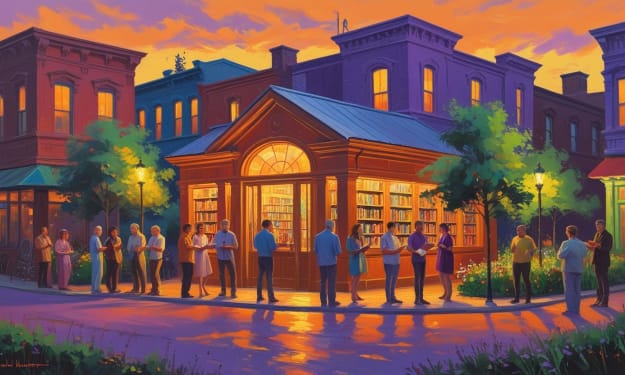
Mr. Chen, stirred by the book’s quiet wisdom, decided to revive the library. He began with small steps: cleaning the windows, organizing the shelves, and hosting a reading circle. He shared The Map of Moments with the handful of attendees, and soon, the circle grew. People who’d never set foot in the library—factory workers, teenagers, shopkeepers—came to listen, to share, to read. The book’s ideas took root, encouraging them to see their lives as maps they could redraw. One reader, a shy teenager named Aisha, was inspired to start a community art project, painting the library’s exterior with scenes of Ironvale’s past and potential.
The library’s transformation caught the city’s attention. Aisha’s murals drew crowds, sparking conversations among strangers. The reading circle expanded, and people began donating books, turning the library into a vibrant hub. Javier, inspired by the book’s emphasis on connection, organized storytelling nights at a local park, where residents shared tales of their lives, their hopes, their city. Sofia’s journal entries, read aloud at one of these nights, moved listeners to tears and applause, inspiring others to write their own stories.
As The Map of Moments passed from hand to hand, Ironvale began to change. A group of factory workers, inspired by the book’s call to action, formed a cooperative to improve working conditions. Aisha’s art project grew into a city-wide initiative, with murals and sculptures popping up in empty lots. The library became a beacon, hosting workshops, book drives, and community forums. Even the city council, nudged by a newly engaged populace, allocated funds to renovate public spaces, including a park where children now played under the shade of newly planted trees.
Lila, watching it all unfold, felt a quiet pride. She’d never imagined that a book found in a dusty box could ripple so far. She began reading voraciously, each book opening new horizons. She enrolled in an engineering program, dreaming of designing machines that served people, not just profits. Javier published a collection of his stories, dedicating it to the book that had inspired him. Sofia, empowered by her writing, started a blog that gained a following beyond Ironvale, her words touching readers across the country.
The power of reading, Lila realized, lay in its ability to transform not just individuals, but entire communities. A book could be a seed, planted in one mind and sprouting in others. It could be a mirror, reflecting one’s own potential; a compass, pointing to new paths; or a bridge, connecting people through shared ideas. In Ironvale, The Map of Moments had been all these things, teaching its people to see their city as a place of possibility, not limitation.
Years later, Ironvale was a different place. The library stood proud, its shelves overflowing with books and its rooms alive with voices. The streets, once gray and silent, buzzed with color and conversation—murals, markets, community gardens. People greeted each other with warmth, their lives intertwined by the stories they’d shared. Lila, now an engineer, stood in the library’s reading room, holding a copy of The Map of Moments. She read a passage to a group of children: “Every life is a map, and every choice a path to somewhere new.”
A girl in the front row, her eyes bright with curiosity, raised her hand. “Can I read that book next?” she asked. Lila smiled and handed it to her, knowing the whisper of its words would carry on. In Ironvale, one book had sparked a revolution—not with a shout, but with a quiet, persistent light.
About the Creator
Shohel Rana
As a professional article writer for Vocal Media, I craft engaging, high-quality content tailored to diverse audiences. My expertise ensures well-researched, compelling articles that inform, inspire, and captivate readers effectively.
Keep reading
More stories from Shohel Rana and writers in Motivation and other communities.
How One Book Ignited a City's Transformation
The Light of Pages How One Book Ignited a City's Transformation In the heart of Crestwood, a city draped in the gray monotony of routine, where smokestacks puffed dreams into ash and the hum of daily life drowned out hope, a single book flickered like a candle in the dark. Its pages, worn and dog-eared, held no magic spells or grand prophecies, yet they carried a power far greater: the ability to awaken minds, stir hearts, and reshape lives. This is the story of how one book, passed from hand to hand, transformed not just a single soul but an entire community, proving that the quiet act of reading can spark a revolution of thought and action.
By Shohel Rana8 months ago in Motivation
The Joy Of Sharing
Sharing Your Facebook Friend's Vocal Stories Yesterday I got a Facebook notification that my name had been mentioned, so I went to check up on it and was shocked in the most beautiful way by what was said about me as Lena Beana shared one of my stories. It was one of my fiction stories that you can read here:
By Mike Singleton 💜 Mikeydred 6 days ago in Motivation
The Light in the Library Window
On a quiet street in a small town stood an old library that most people had forgotten. The building was small and worn, its brick walls faded by years of wind and rain. The wooden door creaked loudly whenever someone pushed it open, and the tall windows were often covered with a thin layer of dust.
By Waleed khan6 days ago in Motivation


Comments
There are no comments for this story
Be the first to respond and start the conversation.