
Flesh vs. Spirit
The Human Struggle for Wholeness

Flesh vs. Spirit: The Human Struggle for Wholeness
The tension between flesh and spirit is a profound and perennial theme in the human experience, often symbolizing the inner conflict between our lower instincts and our higher calling. It is a central narrative in religious scriptures, philosophical discourses, and the daily moral decisions that shape our lives. To understand this dynamic is to engage deeply with what it means to be human.
1. Understanding the Flesh
The term flesh (from the Greek word sarx in the New Testament) encompasses more than just the physical body. It refers to the natural human condition when disconnected from divine guidance or moral purpose. The flesh is driven by desire: the craving for pleasure, power, control, recognition, and security. It is impulsive and reactive, often resistant to constraint or correction.
While the flesh is not inherently evil—it was created good—it is susceptible to corruption. Left unchecked, it can dominate the soul, leading to self-centeredness, addiction, envy, wrath, and a host of other destructive patterns. The flesh desires ease, comfort, and satisfaction, often at the expense of what is true, noble, or eternal.
2. The Nature of the Spirit
The spirit represents the part of us that connects to God, truth, and the deeper moral law written on our hearts. In many religious traditions, particularly Christianity, the spirit is the seat of the image of God in humanity. It longs for meaning, purity, communion, and transcendence. The spirit seeks what is eternal, rather than what is fleeting. It desires to love, to give, to grow, and to serve.
Unlike the flesh, which is reactive, the spirit is responsive. It listens, discerns, and acts according to a higher wisdom. In Christian theology, the spirit is not self-generated but is made alive through the work of the Holy Spirit. The spiritual life, therefore, is not merely about moral striving but about divine transformation.
3. The Inner Battle
One of the most vivid descriptions of this inner battle comes from the Apostle Paul, who writes:
“For the flesh desires what is contrary to the Spirit, and the Spirit what is contrary to the flesh. They are in conflict with each other...” (Galatians 5:17, NIV)
This internal division is familiar to anyone who has wrestled with temptation, guilt, or the difficulty of doing what they know is right. A person may genuinely want to be patient, yet find themselves exploding in anger. They may desire purity but find themselves lured by lust. The flesh and the spirit are not merely abstract categories; they are felt realities in our daily lives.
This battle can be exhausting, but it is also essential. It reveals that we are not machines nor beasts, but moral agents capable of choosing between good and evil, between immediate gratification and lasting peace.
4. The Role of Discipline and Grace
Victory in the conflict between flesh and spirit is not achieved through willpower alone. While discipline is important—fasting, prayer, study, accountability—it is ultimately grace that empowers transformation. In the Christian view, the Spirit of God dwells within believers, enabling them to live a new kind of life:
“It is no longer I who live, but Christ who lives in me.” (Galatians 2:20)
This is not a denial of the body or of human desires, but their rightful ordering. The flesh is not annihilated but sanctified. Desires are not suppressed, but purified. The spiritual life is not about becoming less human, but about becoming more fully human—free, integrated, and whole.
5. Implications for Modern Life
In a culture saturated with distractions, consumerism, and the pursuit of pleasure, the voice of the flesh is amplified. Marketing constantly appeals to appetite, ego, and fear. Instant gratification is only a click away. Meanwhile, the spirit is often drowned out—neglected, ignored, or dismissed.
Yet the hunger for something more remains. People long for peace, purpose, and authenticity. They feel the tension between what they do and who they want to be. The ancient conflict between flesh and spirit is playing out now in a digital age, where the stakes are no less eternal.
To choose the spirit today is to resist the noise and choose silence, to refuse the impulse and practice patience, to ignore the demand for more and embrace simplicity, to turn away from self and toward others.
6. Toward Integration and Wholeness
Ultimately, the goal is not a divided self but an integrated one. Flesh and spirit are not meant to be enemies but harmonized under the rule of love and truth. In Christian spirituality, this is the work of sanctification—a lifelong process of becoming whole, where the body becomes a servant of the soul, and the soul a servant of God.
As we grow in spiritual maturity, the flesh becomes less dominant, and the spirit becomes more attuned to its source. We begin to see with new eyes, love with a deeper heart, and live with greater integrity.
Conclusion
The struggle between flesh and spirit is not a curse but a calling. It is the battleground of transformation, the space where God meets us, and where we are invited to rise above the transient and embrace the eternal. To walk by the spirit is to walk in freedom—not the freedom to do whatever we want, but the freedom to become who we are truly meant to be.
About the Creator
Keep reading
More stories from Oluwatosin Adesoba and writers in Motivation and other communities.
Avoidance of Difficult Conversations
Avoidance of Difficult Conversations Difficult conversations are those that involve sensitive topics, conflicting viewpoints, emotional reactions, or uncomfortable truths. These discussions often require courage, empathy, and clear communication to navigate successfully. However, many people instinctively avoid such conversations because of the discomfort they bring. Understanding why avoidance happens, its effects, and how to overcome it is key to maintaining healthy, transparent, and productive relationships.
By Oluwatosin Adesoba8 months ago in Motivation
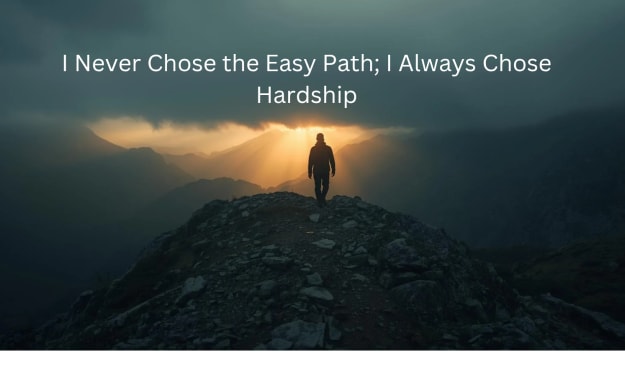
I Never Chose the Easy Path; I Always Chose Hardship
From the earliest memories I can recall, life presented me with two roads. One was smooth, inviting, and well-trodden—a path that promised comfort, approval, and ease. The other was rough, rocky, and uncertain—a path of struggle, obstacles, and lessons that demanded effort, patience, and resilience. I never chose the smooth road. I never took shortcuts. Not because I was fearless, but because something deep inside refused to let me live a life that wasn’t earned. The easy path whispered promises of fleeting satisfaction, fleeting success, and fleeting recognition. It was tempting. Many around me chose it, and I often wondered if I was foolish for ignoring it. But I learned early that true growth is rarely convenient. The easiest choice often leads to emptiness, to regret, to a quiet knowing that you could have been more than you allowed yourself to be. Hardship became my teacher long before success ever noticed me. The lessons it offered were harsh, uncompromising, and often lonely. There were days when choosing the hard path felt like choosing isolation. While others were celebrated for small accomplishments, supported by friends and family, I walked in silence, with doubt as my companion. Progress was invisible to the world. Failures were frequent and relentless. Many nights, I returned home tired, my heart heavy, my mind questioning why I even bothered. Yet even in that silence, I was being shaped. I was learning the value of persistence, of dedication, and of refusing to give up on myself. The hard path forced honesty. It refused to allow excuses. It stripped away illusions and pretenses. I was left face-to-face with my limits, my fears, and my own humanity. On this path, I discovered strengths I never knew I had: patience I had never cultivated, resilience I had doubted, and self-respect that grew every time I stood up instead of walking away. These were not lessons that could be taught in comfort. They were only learned in struggle, in challenge, and in the quiet persistence of refusing to quit when no one was watching. I remember one time vividly. I had a goal that seemed impossible—one that required me to sacrifice comfort, leisure, and social approval. The easy path was right there: a way to avoid the challenge, to be “okay,” to follow what others had done before me. Many advised me to take it. “It’s safer,” they said. “It’s simpler,” they said. But I could feel, deep inside, that taking the easy way would leave me empty. I chose the hard path. The journey was grueling. Every step felt like pushing against gravity. But with each challenge, I gained more than I ever would have on the easy road. I gained endurance, confidence, and an understanding that real achievement is never handed—it is earned. Strength, I realized, isn’t loud. It doesn’t announce itself. It grows quietly, in the moments no one sees—the early mornings, the long nights, the repeated failures, the times you push forward when giving up would be understandable. Resilience is not simply surviving; it is deliberately choosing to continue, to stand again, to pursue the path that tests you the most. It is knowing that walking away is easier but will never lead to the person you are capable of becoming. I have walked many hard roads in life. Each one was different, yet the lessons were the same: comfort cannot teach endurance, shortcuts cannot teach discipline, and fleeting success cannot teach respect. Every struggle, no matter how small, adds to your character. Every failure is a mirror that shows you who you really are. And every choice to face hardship instead of fleeing builds a foundation that lasts long after temporary victories fade. There were times when I felt truly alone. People around me often misunderstood my choices. Friends, family, colleagues—they all questioned why I refused the easy way, why I worked harder, why I pushed myself beyond what seemed necessary. They didn’t see the growth happening quietly inside me. They didn’t see the small victories, the lessons learned, the resilience being forged. But eventually, the results spoke for themselves—not in a loud announcement, but in the quiet confidence and self-respect that I had built from the inside out. Life, I have learned, rewards those who endure hardship. Not always immediately. Not always visibly. But it rewards those who persist, who face struggle head-on, and who refuse to settle for anything less than becoming their fullest selves. Success that comes without effort is temporary; strength and self-respect are eternal. Hardship tests us, but it also teaches us. It shows us the depth of our own courage, the strength of our will, and the power of refusing to surrender. The lessons of the hard path are subtle, often invisible, and always lasting. I learned that failing is not shameful; failing is a necessary step toward mastery. I learned that enduring pain, even when no one notices, builds a type of strength that comfort never can. I learned that the more difficult the path, the deeper the reward—not measured in wealth or fame, but in character, wisdom, and self-respect. Every choice to embrace struggle instead of avoiding it shaped me. Every sacrifice, every extra hour, every moment of doubt faced instead of ignored, added to the foundation of the person I am today. My life was not easy. It was messy, unpredictable, and often overwhelming. But it was authentic. It was mine. And through hardship, I became resilient. I became someone who can face challenges without fear because I have faced them before. I became someone who respects themselves because I have honored my own effort. I became someone capable of growth because I refused to choose comfort over character. I often reflect on the people around me who chose the easy path. Many of them achieved quick victories, immediate recognition, and temporary peace. But over time, I noticed something important: the victories were shallow, the peace fleeting, and the growth minimal. They lacked the depth of resilience, the quiet power of self-respect, and the profound satisfaction that comes from knowing you endured, you learned, and you became someone stronger. Choosing hardship is not glamorous. It is not celebrated in real-time. It is often lonely, exhausting, and demanding. But it is transformative. It shapes your mind, your heart, and your spirit in ways comfort never can. It teaches discipline, patience, humility, and courage. It makes failure meaningful, effort valuable, and success earned. The hard path is where true people are made—people who understand that life’s challenges are not punishments, but opportunities. Opportunities to become better, stronger, wiser, and more capable. I never chose the easy path. I always chose the harder road, the one that tested me, the one that demanded effort, and the one that required me to face myself honestly. I walked through fear, doubt, exhaustion, and setbacks. I fell, and I got up. I failed, and I tried again. I cried, I questioned, I endured. And through it all, I became someone I could respect, someone who knew the value of persistence, someone who understood that hardship is not the enemy—it is the greatest teacher. Today, I measure success differently. I do not measure it by comfort, convenience, or ease. I measure it by growth, resilience, and the depth of self-respect I have cultivated. I measure it by how I faced challenges I could not ignore, how I embraced struggles that seemed unbearable, and how I refused to take shortcuts at the cost of my own becoming. I never chose the easy path. I chose the one that made me resilient. I chose the one that taught me self-respect. I chose the one that allowed me to become the person I am today. And if I had the choice again, I would choose the hard path every single time. Because the road of struggle is not only a journey—it is the making of a human being.writing...
By Ihtisham Ulhaqabout 17 hours ago in Motivation



Comments
There are no comments for this story
Be the first to respond and start the conversation.