

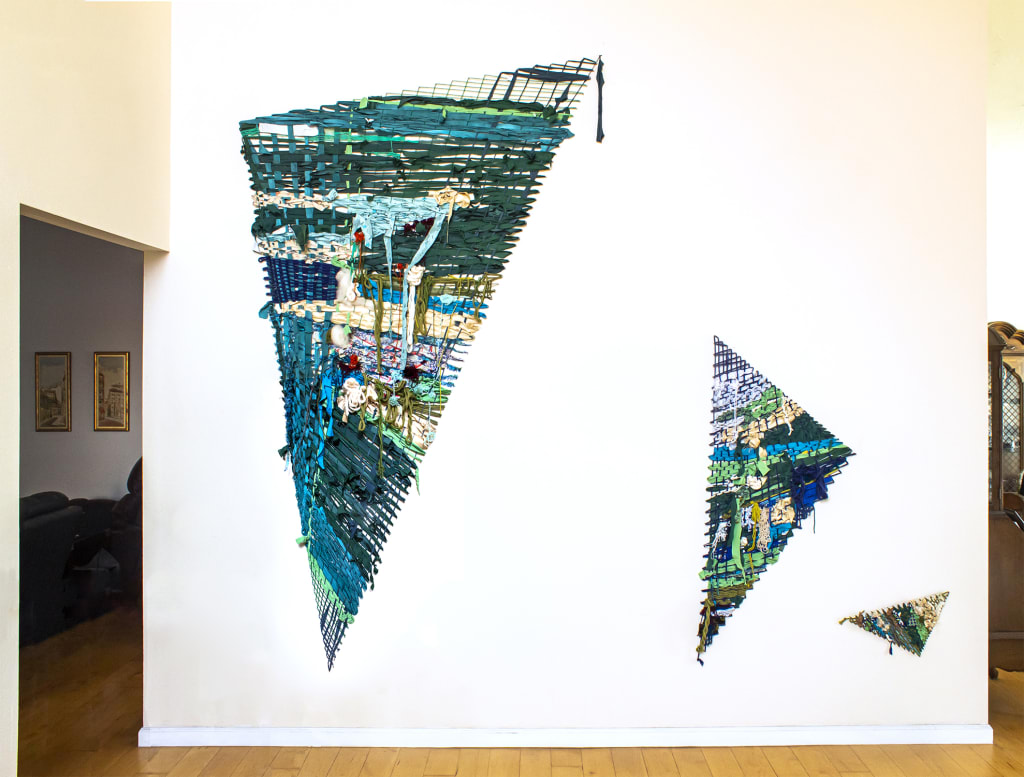
2021. Inch by inch, I’m stripping my clothes. I’m baring all these raw, dangling parts clipped with my pair of Fiskars. Sliced fibers crudely stick out from the ends of the continuous thread I’m making. Before I reach the end of one side, I pivot to keep going and head in the opposite direction. The pieces that once wrapped around my body are now flattening and getting eaten by my machine. My hands are the drivers, steering back and forth until nothing is left but a large ball of giant thread. And it’s beautiful—all these colorful balls of cloth, ready to be woven into abstracted wall art. Crimson, vermillion, mustard yellow, disco gold, cobalt blue, kelly green, creamy white. Luscious tones unwind and drop to the floor as I loop, twist, pull, and thread the fiber into my latest creation. I weave directly on the wall using the nails I’ve pounded into triangular and circular contours to hold tension. Hours flash by in a blitz. Each day I get to create, time scurries along like a scattering lizard chased by the sound of crunching footsteps. When I finish, I view an array of floating shapes, playfully tumbling across the surface, with bits of fabric jutting intermittently across each form, a button here, a tag there. Contrasting textures and colors become blocks of meditation for my eyes. Perpetual delight.
2008. My eyes search excitedly, scanning the house. I don’t even know what precisely it is I’m looking for. Up, back, round. Dusty corners in a chest of blankets. A hallway shelf. A forgotten tablecloth is laid folded in a pile of hardly-used linens. I pull it out gently. What would it be like to crochet from lace? Can you do that? Back at school I’m still cutting away, adding to the heaps of shredded fabric. My professor comes along and suggests finding some better scissors. What do you mean better? These are fabric scissors, I think. She pulls out her spring-loaded pair and demonstrates. I take the handles and give it a whirl. Whoa. Ok. This is smooth. I cut my way through the mounds like a knife slicing tepid butter. At the end of class, I slowly walk Professor Harris’s scissors to her working table. I drop the handles delicately. Outside, I scramble down the infinite flights of stairs climbing down the cliff’s edge that props up the art department. Finally in the parking lot, I throw my bag into my car, start the engine, and drive straight to the fabric store to get my own spring-loaded scissors. Back in my studio I now have masses of thrift store clothes waiting impatiently to be trimmed into giant balls of thread for my fiber art experiments. My first creation is a crocheted tool belt to hold my scissors and a ball of thread. It looks awesome and fits snugly on my hips.
2016. Capitalist development has always been unsustainable because of its human impact!—I shout Silvia Federici’s words into the small but potent gathering of art patrons. Behind me a 13 by 14 foot wall is slathered with my crocheted, up-cycled fabric hanging, It’s Immaterial, Products of Invisible Labor. I step over jumbled streams of once-used-clothing, hangers, and plastic bags that spill out onto the floor, bring the re-sewn pieces of pant leg back to my mother, who begins sewing on the machine again. Hands tap hangers with long knitting and crochet needles and more hangers, while a mom sits on the concrete floor with her children rhythmically shaking jars of buttons. Scissors snip, snip, snip, adding to the makeshift orchestra of noise I direct with fiber accoutrements as instruments. We continue the crescendo for a few ecstatic minutes, and then I conduct each section to rest. Fine. Awestruck, jubilant cheering ensues.
2021. The door opens and Mom lugs in her cooler and bags of fabric balls. Her grip loosens and the bags plummet to the floor. Clunk. It was really hard to cut through the denim! She rubs her hands. Mom, you really need to get scissors like mine—it’s easier to cut, I tell her for the hundredth time. I get my scissors and show her what they look like. She’s been helping me cut fabrics for the last few years whenever I have a large project to undertake. Currently, my large project is making art as a full-time mother. My mom says she ponders my future creations while cutting fabrics for me, often glancing up at the giant green triangles I wove onto her 20 ft. high entryway. Thread interweaves our lives together as we partake in this new tradition, much like my Dutch grandmother’s knitting connected the different generations before and after her, even while painfully separated by an ocean. I still have slippers, sweaters, hats, and scarves from Grandma Flikkema. Memories transform into materials I dissect and recombine during this art process. She opens one of the bags—it’s full of fabric balls made from my three-year-old’s outgrown clothes. I feel a sense of déjà vu wash over me. I remember a dream from a few months ago. In it my mom gave me my childhood clothes, shoes, and belongings she saved and wrapped as presents for Mariet and I thanked her through tears. Mom texts later that day: I’m at JoAnn’s Fabrics and I got a scissor. Me: Oh cool! Picture? Mom: (picture of spring-loaded Fiskars) (then another picture of her cutting some old jeans). I swell with pride and happiness.
2020. The tactile experience of touching the fabrics leads to an intimate, thoughtful meditation when I reflect on the history of a garment. Who wore or used this? Where were they going or what were they doing when they used it? When I cut into the weave of a mass-produced textile, I feel like I am cutting through space and time and spiritually touching the fabric’s origins and its inheritors by touching and reversing the same material that traversed their hands and bodies. I can see the trail of events in a backward dream that plays out the repetition of creation versus destruction: raw material, processing, fabrication, commercialization, sale, change of hands to new ownership in a completely different world, the body sweat and oils that rub onto the fabric’s surface; the roughness, smoothness, or silkiness of the texture which help lead my hands in twisting, looping, or pulling the fiber. The somatic journey of cloth leads to a cycle of birth, death, and rebirth.
2011. Delirious joy. I have succeeded. The long journey of my masters in fine art is closing. Professors come toward me smiling to shake my hand and congratulate me—a stark contrast from the moment of defeat two years prior. What a distinct turn—I remember professors quickly passing me with eyes averted. I had opened the heavy gallery doors and my advisor and fibers professor were quietly arguing. We’re still talking! Ms. Harris put her hand up to signal. I backed away nervously, closing the door. And now an inversion of events. I walk confidently out of the gallery doors. My advisor hands me my written thesis. I open the book and it’s signed. I stare in disbelief. I have done it. Four years of challenges, triumphs, surprises, failures—not passing my advancement included—are now behind me and my unknown future awaits. I once received criticism that I was doing too much crochet and now have just completed an entire series of sculptures 100% crocheted, aided by my trusty tools that fit in my back pocket.
2023. Peering out the window, I view layered brick in rows of gabled Dutch Baroque houses lining the canal. Northern light gracefully illuminates the room. The muted sounds of the city begin to awaken the space while the aroma of sweet poffertjes (Dutch mini pancakes) teases my nose. Lekker! (Yum!) Lacy curtains create fanciful patterns in shadows along the cushioned furniture. Thoughts spark as I gaze into the intricate curtain motifs on the pale blue sofa. I recall the windmills and flowers adorning the lacy curtains of my childhood bedroom, half shading the window. I remember myself amazed, opening the tiny drawers of historical lace samples catalogued at the Victoria and Albert Museum in London. I see the lace of my wedding dress, cascading over my curves while swaying in Dominic’s arms to Bill Withers’ Make a Smile For Me. My grandmother’s post-war wedding dress was laceless, but she carried a floral bouquet with dangling tendrils of ribbon and greenery. Looking again at the curtains, I run my fingers over the undulations. The texture evokes a vision of silhouettes of voluminous excess woven in variations of white. Assuredly, I go to a chair and push it across the length of the floor arriving beneath the window. Up I go, reaching and releasing the fabric with abandon. Back to my suitcase, I slide my hand into the inner lining, pulling out my faithful Fiskars, spring-loaded. Disengaging the orange safety, I relax my fingers around the handles and start to carve the frilly drape. Hours later ivory crumbs are all that remain along the table’s edge. My latest bundles metamorphose into a grandiose fiber installation in my mind’s eye, subtly glimmering like a Vermeer pearl. I fix the art to the walls and allow it to flow out the window wildly into the piercing air, greeting the passerby, local merchant, student, punk, banker, baker, mother and child. Down below my husband and child stare, then jump and shout with their arms reaching skyward. Bicyclists stop to look. They turn their heads up and we wave to one another. They ring their soft bells again and again. We’re free and happy and spreading joy to all who dare to stop and share this moment of wonderment.
About the Creator
Dia Bassett
I make art with unrefined fiber techniques--loose weaves and unruly crochet loops. Continuous thread that I cut using discarded textiles from friends, family, and self becomes fiber installations that reference play, motherhood, and memory.
Keep reading
More stories from writers in Motivation and other communities.
One Hard Thing
Stop me if you’ve heard this one before: You have the number, you know your schedule- you’ve even picked out the perfect day and time to make this appointment. Shoot, you’ve even picked out alternative days and times just in case their schedules can’t accommodate you!
By Taylor Rigsby8 days ago in Motivation
Time to change your life.
Is it even possible for you to change your life? A lot of people, more than there should be, are unhappy with their lives. But what are they doing about it? Usually nothing. People talk about how shitty their lives are and want change, but are they not taking the actions to change?
By Jen Phillips2 days ago in Humans



Comments
There are no comments for this story
Be the first to respond and start the conversation.