
Channel your Anger the Gandhian Way
Reacting to anger is like driving a car whose brakes are out and the steering wheel has stopped responding. You are certainly going to crash. But if you can steer the car well, if you can regulate its speed, the same power of the engine will take you to your destination.
“When anger arises, think of the consequences,” said the Chinese philosopher Confucius. Well, if only we could think properly when we get angry, we wouldn’t be angry in the first place, would we? When anger arises, thinking is the first thing that shuts down. Anger is blind, unreasonable, destructive. We only realize its negative impact on us when we are no longer angry. We feel foolish, guilty and ashamed that we were angry and had no control over ourselves
So why do we get angry? Does anger have any use for us? Yes, it does. Anger is a defense mechanism that nature has built inside us that has saved our lives since the very beginning. With anger we feel a surge of energy inside us; really powerful, uncontrollable, short-lived enegry which induces a ‘flight or fight’ response. This was a life saving mechanism when we lived in forests for millennia surrounded by predators and other existential threats. For most of our human and pre-human lives, staying alive was a challenge every day. We needed that temporary surge of energy which anger provides to fight for our survival, or run away from the danger.
In today’s life, however, most of us don’t feel the existential threat on a daily basis, and yet we get angry quite often because it lies deep inside us. The mechanism which saved our lives for millenia gets triggered when we feel threatened. Anger gives us power when we feel powerless. It is the power of the powerless. But in the absence of the real life threatening cause, the emotion which has been quite helpful in saving our lives, has now the opposite effect.
So what can we do about it? Can we control our anger? Can we choose not to be angry? I think we can. But instead of using the word ‘control’, I would prefer to use ‘channel’. Anger is power, anger is energy. Uncontrolled energy is destructive, but if you could regulate and channel that energy, it can be quite useful.
What Gandhi did
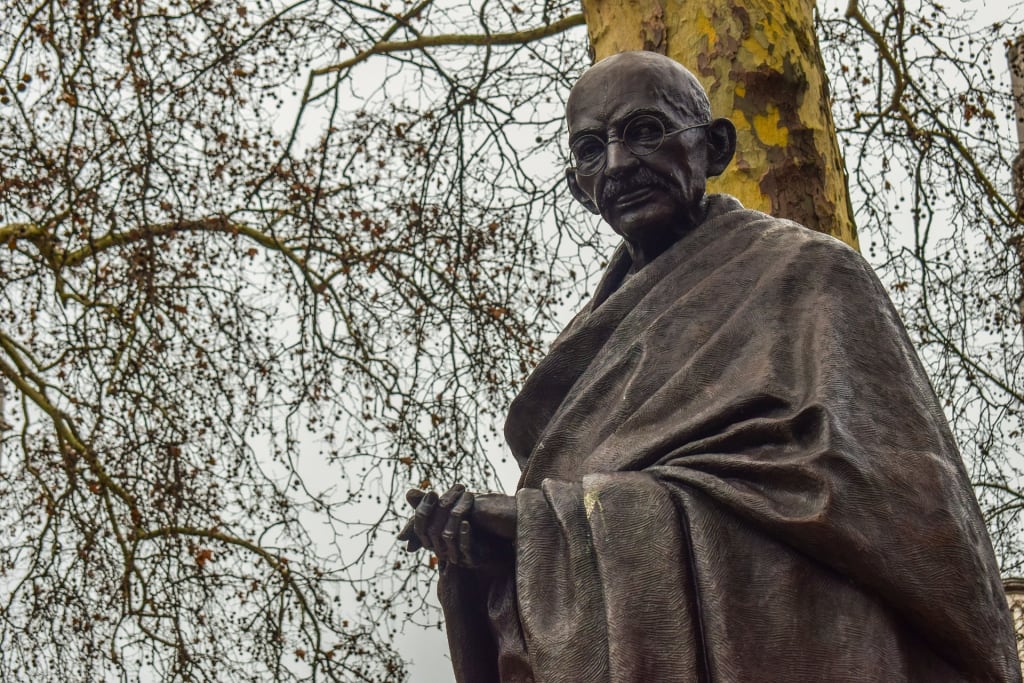
The best example that I can think of on how to channel the power of anger is Gandhi. Gandhi, the advocate of nonviolent resistance, did not start his career as a political leader. He was trained as a lawyer in London and, like any ambitious young man, wanted to have a prestigious, successful career. He was invited to represent a client in South Africa. So, there he was, traveling first-class in a train. A white man entered his compartment and was shocked to see a “person of color” traveling first-class. Gandhi, being new in South Africa, didn’t know that a brown/black man could not travel first-class, nor could he be a lawyer. He was asked to move to the third class but he refused. So he was thrown out at the next train station. (You can watch this episode beautifully portrayed on the screen by Ben Kingsley here.)
Gandhi seethed with anger at injustice meted out to him. He sat at the station at night thinking what to do about it. Should he just forget about the whole thing and move on with life? But he could not. He was too outraged not to do anything about it. So he decided, right there at the station, shivering with cold and anger, that he would strike at the root of this injustice and unfairness. And, as we know, the rest is history. He challenged the British Empire, the mightiest empire the world had ever seen. And he didn’t only win in his country, India, but inspired people all over the world to stand up against injustice through nonviolent resistance.
Gandhi could have acted differently. He could have thrown punches at people who threw him out of the train. He could have tried to destroy the property as many do when they feel the sense of injustice. He could have screamed, cursed, kicked things around as many would do in this situation. But he didn’t do any of those things. He just sat and thought. Instead of reacting to events which made him angry, he chose to respond, and that made all the difference.
Reaction and response
What is the difference between reaction and response? Well, if we can boil it down to one sentence, it is this. Reaction is unconscious response and response is conscious reaction. What do I mean by that? When you react to things, you are not really in control of your actions. Reaction is instinctive, unmeditated, unconscious, whereas your response to things is thought out, premeditated and conscious.
Reacting to anger is like driving a car whose brakes are out and the steering wheel has stopped responding. You are certainly going to crash. But if you can steer the car well, if you can regulate its speed, the same power of the engine will take you to your destination.
So how do you convert your reaction to response? I am going to tell you the technique which I use and which has been working quite well. Although I do still get angry and react to it at times, I think I’m much better than before at channeling it into something positive.
Time gap between emotion and response
The key is to break the chain. When anger arises in you, your reaction to it is instant and simultaneous. There is no time for your reasoning faculty to intervene. You need to create a time gap between the arising of anger and your reaction to it. Just delay the response. If you manage to do that, you will see magic start happening.
You will have a few options to choose from. Someone on the street yells at you. Are you going to punch him, yell back at him? Or are you just going to smile instead? Or ask him nicely why he is yelling? Or are you just going to avoid the confrontation and walk away? You have all these options and even more when you delay the reaction and allow your reasoning to intervene. How empowering is that! Instead of reacting uncontrollably, being at the mercy of your instinct, you are now the master of your action just by allowing space between the emotion and reaction.
But it is easier said than done. For anything worthwhile in life, it is going to need some practice. What I did when I started on this path was that I told myself that when I get angry I would count to ten before I do anything. Of course at first I failed miserably. But after some time I gradually started having more and more control over my actions. I am still on that path, and I hope that I will do better in the future. And If I can do it, so can anyone.
About the Creator
Keep reading
More stories from Ashutosh and writers in Motivation and other communities.
One Hard Thing
Stop me if you’ve heard this one before: You have the number, you know your schedule- you’ve even picked out the perfect day and time to make this appointment. Shoot, you’ve even picked out alternative days and times just in case their schedules can’t accommodate you!
By Taylor Rigsby4 days ago in Motivation
🅼🅸🅳🅽🅸🅶🅷🆃 🆂🅽🅰🅲🅺🆂
"It's 10 in Tuscon! We all know what that means... It's Time for Midnight Snacks with your man, Gerald Gee! Ready to spend the night together? Me too! I'm full of snacks and can't wait to regurgitate them all back into your hungry ears. Crack a brew! Pop some corn! Anything to get ready for one hell of a show where the talk maybe cheap but the words cut deep...
By Lamar Wiggins7 days ago in Fiction




Comments
There are no comments for this story
Be the first to respond and start the conversation.