
Book Review: Reclaiming Your Community By Majora Carter
You Don’t Have to Move Out Of Your Neighborhood To Live In a Better One

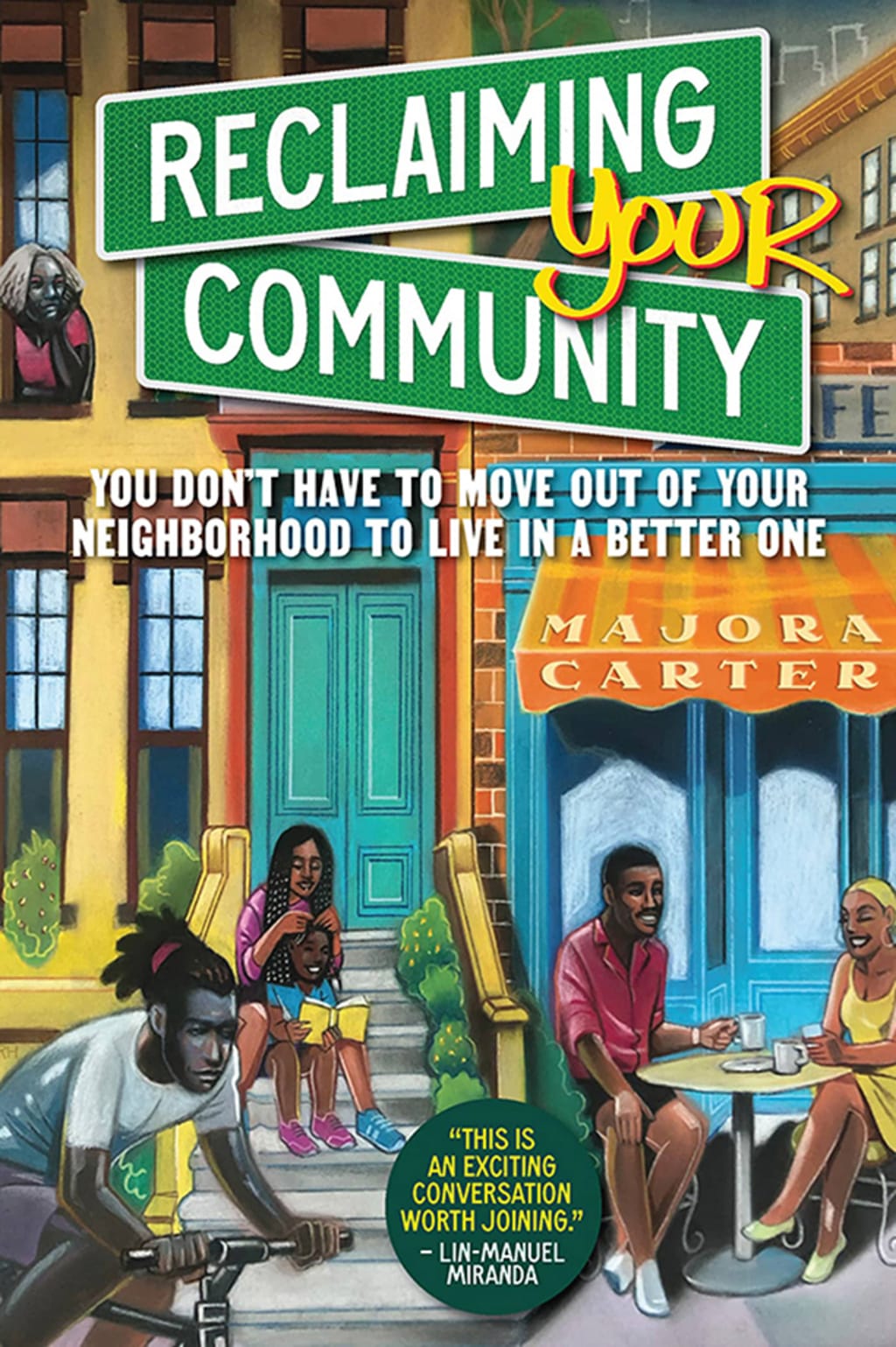
Bronx, N.Y-based real estate developer, and urban revitalization strategy consultant Majora Carter is responsible for creating a number of development programs, technology inclusion, policies, and job training in her Hunt’s Point neighborhood. In her new book Reclaiming Your Community: You Don’t Have to Move Out Of Your Neighborhood To Live In a Better One, she encourages you to rethink investing in your community. Challenging the notion that “success” is achieved by how far you move away from your neighborhood.
The Neighborhood
Reclaiming Your Community: You Don’t Have to Move Out Of Your Neighborhood To Live In a Better One, is a book you should read in 2022!
I grew up in the same neighborhood as Majora and found out many years later that she was the reason for some of the positive changes I saw in Hunt’s Point. She opens her book describing what it was like growing up in the south Bronx, sharing personal moments from her childhood during the mid-1970s into the1980’s.
The Bronx at the time wasn’t much to look at, you were surrounded by burned-out abandoned buildings and as Majora put it where squatters and sometimes drug dealers could be found.
As I read Reclaiming Your Community: You Don’t Have to Move Out Of Your Neighborhood To Live In a Better One, I recalled my own childhood on Spofford Ave. Raised across the street from the notorious Spofford Juvenile Center. I spent many days watching young kids be escorted into the detention center in handcuffs, wondering if and when they would be released. Families lined up outside for visiting hours and watching the young juveniles play basketball in the yard from my fire escape window.
While there have been improvements in the Bronx since my time as a kid, it still remains to be the poorest congressional district in the nation.
Brain Drain & Low-Status Communities
Majora does an excellent job of encouraging you to look at your surroundings differently.
Besides feeling elated that I had finally read a book that I could relate to, I enjoyed Majora’s introduction to the terms “brain drain”, “low-status communities”, and a few others. Majora first heard the term “low-status” from Danah Boyd a researcher and the founder of Data & Society Research Institute on a panel at the “Fast Company” event in April 2015. “Brain drain” is explained as training the most talented and smartest kids in a community and convincing them to move out of their neighborhood. The belief was that their personal success would be determined by it.
In Reclaiming Your Community: You Don’t Have to Move Out Of Your Neighborhood To Live In a Better One, Majora defines low-status communities as
the places where it is widely agreed that the schools are worse the air is more polluted the parks are few and less well maintained. The health statistics are not good. And the elected officials and nonprofit industrial complex readily acknowledge that these disparities exist but seem unable to address them with any effectiveness.
In layman’s terms low-status communities are the communities filled with health clinics, fast-food chain restaurants, check cashing places, community centers, and pawn shops.
In a series of surveys and focus groups, Majora found out that people living in low-status communities want the same things people not living in the hood want. To feel safe, have accessibility to bars, restaurants, parks, and housing that matches your income. Not the pharmacies, community centers, and homeless shelters put in place to help or revive the community.
In order to improve the “low-status” communities we live in, we have to stop running out of them; change our mindsets, and create the tools and resources needed in our communities. Majora has faced many challenges in order to revive her community. People in her community protested the opening of The Boogie Down Grind Cafe, she was called a sell-out and everything but a child of God.
Hey! How about we talk? Human to human. I get the feeling that you and your friends have some misunderstanding about who I am and what I do. You can talk to me, instead of about me. I'm right here.
This is my favorite quote in the book. It was a reminder that change doesn’t have to be scary– we need to open the channels of communication and understanding so that fear doesn’t push you to handle things in ways you typically wouldn’t.
Majora Isn’t The Only Example
Queens, N.Y- based rap icon Jay-Z and the late Los Angeles- based rapper and entrepreneur Nipsey Hussle are real-life examples of individuals investing back into their communities. Young Dolph a Memphis, Tenn rapper was also investing back into his community.
It’s important for us to see examples like this because it empowers communities to do more and hopefully break free from competing amongst each other and learn to work together better. At least I hope to see black and brown communities finally unify for the greater good of the future. We have to remember that everything that is done today affects the generation following behind.
In Closing
Where we come from shapes who we are. We don’t have to move out of our communities to have a better life. Is the work easy not at all, but if we don’t start valuing ourselves and make the changes that we need to have successful black and brown communities who will? If we aren’t willing to take a stand then how mad can you really be when our white counterparts make the changes for us.
Feel empowered by reading In Reclaiming Your Community: You Don’t Have to Move Out Of Your Neighborhood To Live In a Better One by Majora Carter. If you’re not sure how to start the conversation no worries because Majora leaves you with discussion questions at the end of the book. This is just a small piece of a much larger conversation.
If you thought this was helpful subscribe for more content or show your support with a small tip.
About the Creator
Mrz. PG
My superpower is in the silver lining.
Let me show you how to see through a different lens.
Keep reading
More stories from Mrz. PG and writers in Motivation and other communities.
Miss Persephone's Manual to a Seemingly Ordinary Life
Miss Persephone was found at the dining table, her blue eyes swollen, her tears arriving and retreating like the tides of the ocean. Earlier that day, her family had visited her in the retirement home where she had lived for eight years. It was her eightieth birthday.
By Imola Tóth3 days ago in Fiction



Comments
There are no comments for this story
Be the first to respond and start the conversation.