
Becoming Smart Is Easy, Actually!
The Smart Path: Practical Strategies for Effective Learning and Knowledge Retention


You want to be smart, and most people tell you that it takes 12 years of school, 4 years of college, and 6 years of graduate school to become smart. However, the reality is that you end up homeless—this isn't even a joke. On the plus side, though, when you post on Reddit about how hard it is to get a job, you can do it in perfect English. As you can see from the title, becoming smart is actually very easy, even if you believe that your genetics make you stupid
When individuals like you and me express our desire to become smarter, it encompasses many different things. We want to acquire practical skills, preferably ones that generate income; we want to be adept at problem-solving with the hope of earning money; we want to improve our geds and learn challenging subjects in order to increase our income and impress others; and finally, we want to sound intelligent in conversation—just enough so that others respect us but not so much that we come across as nerds. The issue is that most advice on the Internet is so ambiguous and philosophical that even if it were to be effective, only Oprah and Socrates could actually follow it.
Instead, if you seek for precise guidance that you can put into practice immediately, you will receive the following: consume blueberries since they are a brain food. IQ testing, black coffee, exercise, and more sleep listen to classical music; these things sound good, but eventually you have to learn things. In addition, some geniuses have been known to spend their entire day at a desk and only get two to four hours of sleep each day. So what can you do to actually become smarter than copying and pasting the same six brainteasers from a wikiHow article that were inspired by a quote that was spray-painted on a wall of a New York subway car?
The most important thing is to read. Depending on what kind of reading you choose, fiction can help you learn to read more quickly and improve your vocabulary. It can also make you feel like you have friends if you read a lot of dialogue. However, most people stick to non-fiction, which is actually the key to being able to casually bring up interesting facts in conversation. For instance, just by reading this book, you can come across to anyone as someone who is knowledgeable about history. The secret is to avoid being overly nosy about it—it's amazing how we descended from chimpanzees, after all.
This is considered polite by the standards of a YouTube comment section in real life, but actually evolution is nonlinear, and multiple human-like species once inhabited Earth simultaneously, none of which could even be remotely considered as chimpanzees. Now that we're talking, let's redo that conversation about how humans evolved from chimpanzees. It's crazy, right? I was reading the other day, and apparently humans and chimpanzees. I always thought we evolved from them, but I guess we just evolved side by side
You may sound like you touch grass and be knowledgeable at the same time. The secret is to impart your knowledge without making others think you're stupid. In this way, people will learn from you and see you as intelligent and deserving. Now, where do you locate these books? It's actually very simple. You don't have to read the five books that everyone recommends you read; instead, choose a subject you'd want to learn more about, like cleaning. Google books on cleaning; this one appears to be well-written.
These books are usually expensive, but if you are unintentionally browsing this website, you might accidentally search for the book's title. If that happens, you might click on the first link, which then, oh no, unintentionally downloaded a file, which you opened with the appropriate ebook viewer. Now that you have the book, you will also discover that, in addition to learning many practical skills, you can also pick up interesting facts to share in conversations. There are ten things you should know before you learn a skill. First, if you don't practice a skill, your brain will consider it worthless and you will forget it as well.
We could probably simply go on since, as the saying goes, "you only need to know 20% of the knowledge to master 80% of the skill." This is known as the learning curve. It shows how your talent improves with time, and you can see that even with modest initial effort, you may make significant progress. However, consistent practice is required. Though not everyone has two cars lying around to practice on, you can still practice it by just imagining the moment when you'll need to know how to jump start a car and putting yourself in the situation. For example, imagine you're reading a book about cars and then you see this diagram of how to jump start a dead car with a good car. Ideally, you'll read about it and then go practice it. Find a video and visualize the entire procedure as though it were your automobile. By doing so, you've persuaded your brain to apply all that knowledge.
This is basically how the entire school system works: you learn a piece of information, and because it will be like 15 years before you actually use it, your teacher creates an imaginary situation where that information is useful that is a test. Now that you know it, you'll remember it, while the person who just looked at the diagram and tried to memorize it still won't know what to do if they ever had to jump start a car. This is how you get smart by using everything you learn.
an exam with questions on that precise piece of information; if you answer it incorrectly, you fail or, in the case of cheating, you go to prison. This is typically sufficient to force your brain to at least try to recall the material; the only issue is that after the test, your brain decides it is no longer relevant, so you forget it. Some people believe that studying in intervals, mind mapping, spatial repetition, and repetition will help them learn more quickly and achieve higher marks.
However, if you don't have any practice questions, doing them will actually help you get the most out of your learning since they mimic the real-world scenario in which you'll need to apply what you've learned. create your own, and persuade yourself that the stakes are high. For example, imagine that you're dangling off a cliff by one arm, and someone is trying to pull you up. Then, if you can name every component of a human cell, that person will only be able to help you if you can learn information and make it appear useful to your brain.
This is the reason textbooks are the S tier format for learning as much as possible quickly; they include only material and a ton of practice problems; if you need assistance, you must turn to the appendix's pages. There is no filler, no handholding, and no distractions. Textbooks aren't meant for casual learners since viewing a YouTube video on a subject is more enjoyable and less likely to result in forgetting everything an hour later.
About the Creator
Mariam Fathalrahman
Whether you’re a nature lover, a history buff, or simply someone who enjoys a good read, there’s something here for you, diving into topics as diverse as the mysteries of Earth and nature. Join me, and let’s explore the world together.
Keep reading
More stories from Mariam Fathalrahman and writers in Motivation and other communities.
Not Feeling Successful? Here’s Why
Does diligence matter? No matter what your field, you've undoubtedly heard that you can succeed if you just work hard and put in the hours. The 10,000-hour rule for becoming an expert at something has been promoted for years, and many people are convinced that giving it their all will pay off. But what if I told you that was all wrong? Sierra 6 from The Gray Man, the world's most proficient CIA agent, gave me the inspiration for this project. It made me wonder: Does someone become the greatest at what they do, like being a top CIA agent, by skill acquired via hard effort or inherent aptitude, or is there another aspect at work?
By Mariam Fathalrahman2 years ago in Motivation
30 Days Talking to Strangers in Amsterdam — Day 17 Ended My Panic Attacks
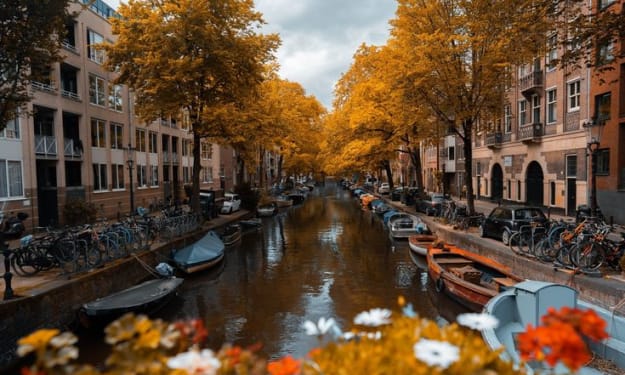
The Stranger Who Answered Back How talking to one stranger every single day for 30 days in Amsterdam quietly ended my panic attacks I used to think Amsterdam was the loneliest city on earth. You know the feeling — you’re surrounded by 900,000 people, bikes whizzing past, trams dinging, canal water lapping at your feet… and still feel completely invisible. My panic attacks had gotten so bad by January 2026 that I’d started avoiding the tram altogether. Heart racing at red lights, palms sweating in the rain, convinced everyone could see I was one deep breath away from falling apart. So on February 1st I made a stupid promise to myself: talk to one stranger every single day for 30 days. No small talk rules. No “nice weather” cop-outs. One real sentence. One genuine question. Nothing more. I had no idea that promise would save my life. The Awkward First Ten Days Day 1 was humiliating. I stood at the Albert Cuyp Market like a statue until a woman in a bright yellow raincoat picked up the last bunch of tulips. “Those are beautiful,” I blurted. She smiled, said “They’re for my mother’s grave,” and walked away. I wanted to disappear into the cobblestones. Day 3: A guy locking his bike near the Rijksmuseum. I asked how his day was going. He answered in perfect English, “Tired, man. My wife left yesterday.” I froze. He laughed at my face and said, “Relax, it’s been two years. You’re the first person who’s asked in months.” By day 8 I was getting braver. A barista at my usual spot on De Pijp told me her dream of opening a cat café in Portugal. On day 10 an old lady on the 12 tram scolded me for not offering my seat — then spent the next six stops telling me about her husband who died in 1998 and how she still sets the table for two. Every conversation felt like jumping off a cliff. My chest still tightened. My voice still shook. But something tiny was shifting. I was no longer invisible to the city — and the city was no longer invisible to me. The Day Everything Changed Day 17. A grey Thursday. I was exhausted, rain pouring sideways, and seriously considering quitting the whole stupid experiment. I ducked into Vondelpark under a big oak tree near the rose garden. There he was — sitting on a wet bench in a wool coat that had seen better decades. Silver hair, bright blue eyes, holding a small thermos like it was the only warm thing left in the world. I sat. Heart hammering. Then I did what I’d been doing for seventeen days straight. “Excuse me… do you mind if I ask what you’re drinking?” He looked at me for a long moment, like he was deciding whether I was worth the words. Then he smiled — the kind of smile that reaches the eyes first. “Turkish coffee,” he said in a thick Dutch accent. “My wife taught me. She died eleven years ago today.” I swallowed. “I’m so sorry.” He waved it away gently. “Don’t be. She would have liked you. You’re the first person in months who’s looked me in the eye instead of at their phone.” We talked for forty-three minutes. His name was Hendrik. He’d been a ship captain on the IJ for thirty-seven years. Lost his wife to cancer. Raised two daughters who now live in Australia. And then he said the sentence that cracked my entire life open: “You know what I learned after she was gone? Panic is just the mind trying to live tomorrow today. The only thing you can control is this moment — and whether you’re brave enough to share it with someone.” He tapped my knee. “You’re scared right now. I can see it in your shoulders. But you still sat down and asked an old man about his coffee. That’s how you win against the fear, jongen. One small yes at a time.” I cried on the tram home. Not pretty tears — ugly, snotty, shoulder-shaking ones. For the first time in two years, the tightness in my chest wasn’t panic. It was relief. The Last Thirteen Days & What Actually Changed The rest of the month felt different. I stopped forcing conversations and started enjoying them. A Syrian refugee who bakes the best pistachio baklava near Nieuwmarkt. A teenage girl practicing guitar by the canals who let me record her song. A stressed-out delivery cyclist who ended up inviting me for a beer after his shift. My panic attacks didn’t vanish overnight — but they lost their power. When the racing heart came, I heard Hendrik’s voice: This moment. Share it. So I would turn to whoever was nearest and ask one small question. Every single time, the fear shrank. By day 30 I wasn’t the same person who started. I smiled at strangers without thinking. I slept through the night. I even took the tram during rush hour without counting exits. What I Wish I’d Known Sooner Talking to strangers didn’t fix me. It reminded me I was never broken — just disconnected. In a city as beautiful and busy as Amsterdam, it’s ridiculously easy to feel alone. We all walk around wearing invisible headphones. But when you take them off for thirty days and actually see people, something magical happens. You realise every single person is carrying their own quiet storm — and most of them are desperate for someone to notice. Hendrik was right. The panic wasn’t in my chest. It was in the story that I had to do life alone. Your Turn I’m not saying you have to talk to a stranger every day for a month (though… why not?). Start smaller. Next time you’re waiting for coffee, on the tram, or sitting on a bench in Vondelpark — look up. Smile. Ask one real question. You might just meet the stranger who answers back. And who knows? They might be carrying exactly the words you’ve been waiting your whole life to hear.
By Shoaib Afridia day ago in Motivation



Comments
There are no comments for this story
Be the first to respond and start the conversation.