
Barack Obama: A Journey from the Classroom to the White House
How a Teacher from Chicago Became the 44th President of the United States and Inspired a Generation

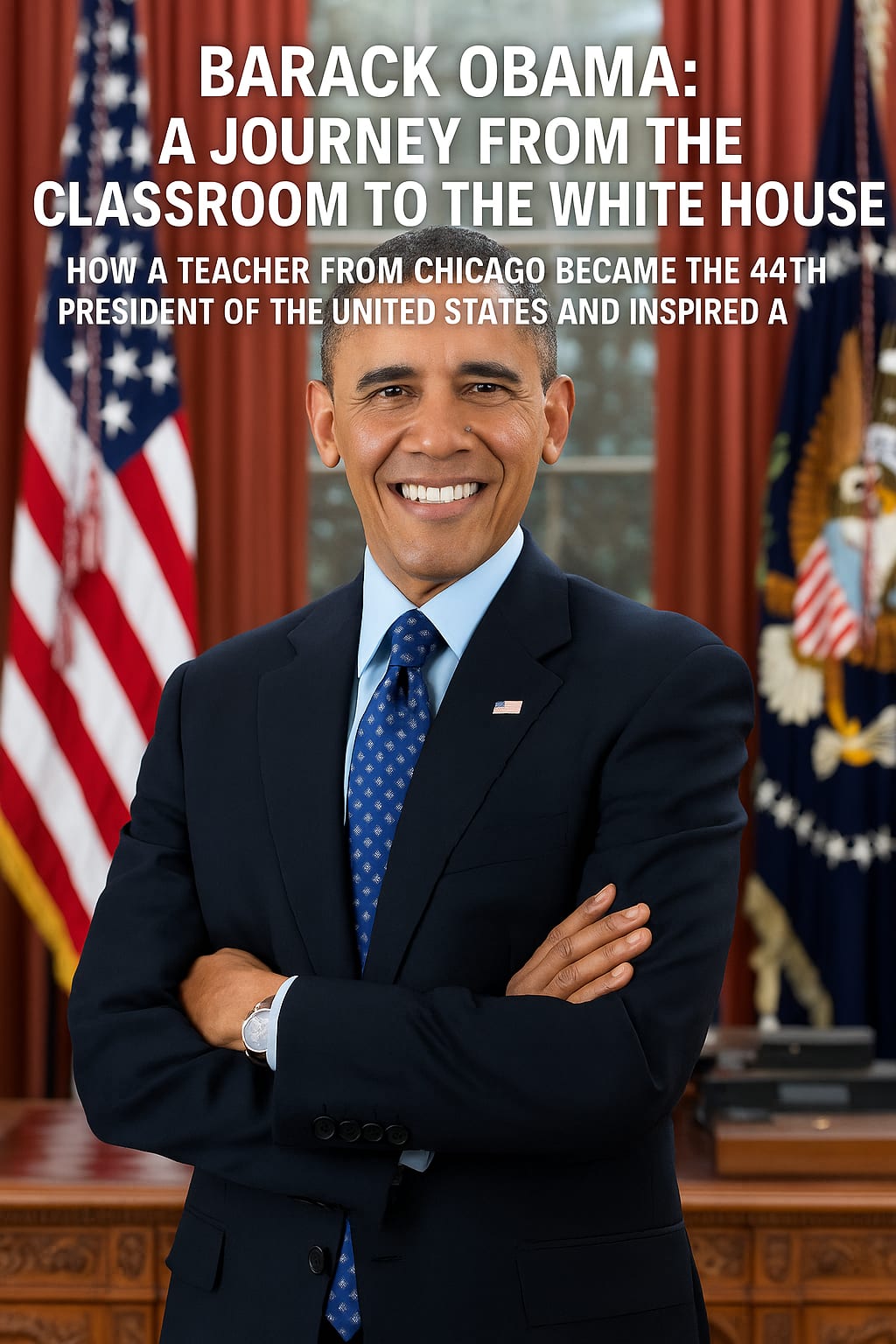
Barack Hussein Obama II, the 44th President of the United States, is a symbol of hope, resilience, and change. Born on August 4, 1961, in Honolulu, Hawaii, Obama’s life story is a powerful blend of intellectual rigor, community service, and political determination. Before stepping into the White House, Obama was not only a lawyer and a community organizer but also a teacher—roles that deeply influenced his approach to leadership.
Early Life and Education
Obama’s diverse background played a significant role in shaping his worldview. His father, Barack Obama Sr., was a Kenyan economist, and his mother, Ann Dunham, was an American anthropologist from Kansas. Raised by his mother and grandparents, Obama experienced life in both the United States and Indonesia. These early years made him deeply aware of cultural differences and the importance of inclusion.
Obama attended Occidental College in Los Angeles before transferring to Columbia University in New York City, where he graduated with a degree in Political Science in 1983. After working briefly in New York, he moved to Chicago, where he became a community organizer on the city’s South Side—a turning point in his life.
Becoming a Teacher and Leader
In 1988, Obama enrolled at Harvard Law School, where he made history by becoming the first African American president of the prestigious Harvard Law Review. After earning his law degree, he returned to Chicago and worked at a civil rights law firm while also teaching constitutional law at the University of Chicago Law School. As a lecturer, Obama was known for his clarity, calm demeanor, and thoughtful insights. His time as a teacher was not just about academics—it reflected his desire to engage people in critical conversations and civic responsibility.
Entry into Politics
Obama entered politics in 1996 when he was elected to the Illinois State Senate. His speeches, rooted in logic, empathy, and a deep understanding of American society, gained him a loyal following. In 2004, he won a U.S. Senate seat, rising to national fame after delivering the keynote address at the Democratic National Convention. His message of unity and hope resonated across the country.
The Road to the Presidency
In 2008, Obama launched his campaign for the presidency. With his message of “Yes We Can,” he energized millions of voters, particularly the youth and marginalized communities. He made history in November 2008 by becoming the first African American President of the United States. He was re-elected in 2012 for a second term.
As president, Obama introduced significant reforms, including the Affordable Care Act (commonly known as Obamacare), the Dodd-Frank Act to regulate Wall Street, and various environmental policies. He also ordered the military operation that resulted in the death of Osama bin Laden in 2011. His calm leadership during the global financial crisis and his push for equality and diplomacy earned him the Nobel Peace Prize in 2009.
Real and Inspiring Life Stories
Obama’s life is filled with inspiring stories. One such moment occurred during his early days in Chicago, when he worked tirelessly to help unemployed steelworkers and their families regain hope. Despite facing rejection and skepticism, he knocked on doors, listened to their concerns, and built trust—laying the foundation for his future in public service.
Another remarkable story comes from his presidency. During the 2015 Charleston church shooting, Obama visited the grieving families of the victims. Instead of offering just a standard condolence, he led the congregation in singing “Amazing Grace,” moving millions around the world with his genuine empathy and moral courage.
Life After the Presidency
After leaving the White House in 2017, Obama continued his public service through the Obama Foundation, focusing on leadership development, civic engagement, and education. He and his wife, Michelle Obama, have authored bestselling books and launched media projects aimed at inspiring future generations.
Conclusion
Barack Obama’s journey from a teacher and community organizer to the highest office in the world is a story of dedication, vision, and belief in change. His biography is not just a political timeline but a testament to the power of education, dialogue, and hope. Obama remains a global icon whose legacy continues to inspire people to dream bigger, serve others, and believe in the power of unity.
One particularly heartwarming story from Obama's presidency was during a school visit when he asked a group of students what they wanted to be in the future. The students shared dreams of becoming doctors, teachers, and astronauts. Then one curious student asked him, 'What about you? What do you want to be in the future?' Obama smiled warmly and replied, 'I want to be the President of the United States.' This simple yet profound exchange reflected not only his ambition but also his belief in setting big goals and staying true to them.
Another powerful example of Obama’s thoughtful leadership occurred before his historic speech in Berlin in 2008. Although there is no official record of him sending a special team months in advance, it is widely known that Obama and his advisors prepared deeply for the moment. Understanding the historical weight of speaking near the Brandenburg Gate—a site connected to both the Cold War and the reunification of Germany—Obama made sure his 10-minute speech acknowledged shared democratic values, unity, and global cooperation. His preparation and delivery not only impressed the German crowd but also sent a signal of responsible and respectful diplomacy.
About the Creator
Keep reading
More stories from SK Prince and writers in Motivation and other communities.
How to Build Real Confidence
How a quiet boy found his courage and real confidence In a small village near the hills lived a boy named Arman. He was quiet, kind, and smart, but he never believed in himself. At school, he stayed in the back of the class. He never raised his hand, even when he knew the answer. When other kids played or spoke loudly, Arman stayed silent. He often thought, I am not strong like them. I cannot do what they do.
By SK Prince 9 months ago in Motivation



Comments
There are no comments for this story
Be the first to respond and start the conversation.