
Act Like Nothing Bothers You - Napoleon Hill
Mastering Emotional Control, Detachment, and Inner Power to Live Unshaken in a World of Chaos

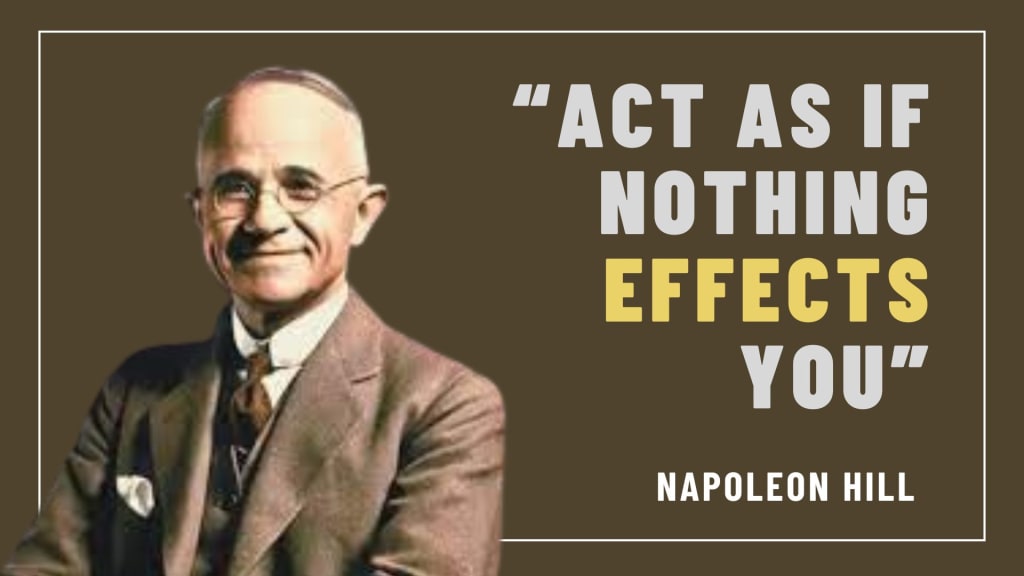
Acting as though nothing bothers you is a profoundly liberating principle taught by Napoleon Hill’s wisdom in a world that demands our attention, reaction, and emotional investment on a constant basis. This is an invitation to emotional mastery — to take charge of your responses and, consequently, your life — rather than a call for apathy or indifference to life. By cultivating a mindset where external chaos no longer controls internal peace, individuals can step into a new realm of power, purpose, and peace.
The “Nothing Bothers Me” Mindset
The foundation of this philosophy is built on one simple, yet revolutionary idea: emotional detachment is power. Life, by its very nature, is filled with interruptions — people’s opinions, unexpected problems, daily stressors. Those who master themselves rise above the cacophony, while the majority let these factors disturb their tranquility.
Imagine being able to walk through a storm and stay dry — not because the storm doesn’t exist, but rather because you’ve constructed an internal shelter that will keep you safe. That’s the core of Hill’s thinking. What distinguishes the strong from the weak is the capacity to handle chaos without allowing it to disturb your inner serenity.
Mastery begins with detachment — training yourself not to tie your emotions to every external event. This mindset doesn’t require fewer problems. Instead, it demands better control. By responding rather than reacting, you create a psychological buffer between yourself and the world.
Cultivating Control Over Emotions
Contrary to popular belief, emotional detachment isn’t suppression. It’s awareness and control. It’s about deciding when and how your emotions influence your behavior, not about suppressing them.
Imagine being publicly insulted. The typical person will take offense, retaliate, or even argue. But the master will remain calm, smile, and leave. They deprive the attacker of their power in the process. When your silence speaks louder than any answer, that’s true strength.
Failures and setbacks are another battlefield where emotional detachment reigns supreme. Where most people crumble, ruminate, or stall their progress, emotionally detached individuals analyze failure as data. They adapt and keep moving forward. Their sense of identity isn’t tied to momentary defeats.
This control doesn’t come overnight. It is built through intentional practices — pausing before reacting, reflecting before speaking, and constantly asking: Is this worth my energy? With each conscious choice, the mind is trained to rise above impulses.
Visualization: Becoming the Person Who is Unbothered
Visualization is a powerful technique Hill emphasizes. It’s about seeing yourself as the person you want to be until that image becomes your reality. If you constantly imagine yourself as someone who cannot be shaken by insults, failures, or opinions, you’ll start to live that truth.
Visualize yourself walking calmly through challenges, remaining unaffected by distractions. Over time, this mental rehearsal conditions your brain to replicate the same behavior in reality. You begin to live out the very mindset you’ve trained yourself to adopt.
Mindful Indifference: A Superpower
Carefully caring is the goal of mindful indifference, not not caring at all. It’s about realizing that not every circumstance is worthy of your emotional commitment. In five years, most of the things that irritate us now will be moot. However, we give them the authority to control our emotions and behavior.
You establish a filter for what merits your attention by refocusing your attention on what really matters — your development, your values, and your purpose. What distinguishes the strong from the easily influenced is this change from emotional reactivity to strategic response.
The world becomes simpler when you stop trying to control everything and instead master the art of selective engagement. You don’t need to fight every battle or prove every point. You conserve your energy for what’s meaningful and let the rest pass by like background noise.
Stop Seeking Approval
Seeking approval is one of the greatest forms of self-betrayal. It places your value in the hands of others, making you emotionally dependent on their opinions. According to Hill’s philosophy, this is a trap — a thief of personal power.
No one’s opinion of you should outweigh your own. Magnetic, influential people are not those begging for validation — they are those who walk their path confidently, with flaws and all, because their self-worth isn’t up for negotiation.
Releasing the need to be liked by everyone is liberating. The truth is, no matter what you do, someone will criticize you. Some will misunderstand you. Others simply won’t care. So why chase validation? Why compromise your values to earn approval that may never come?
Self-validation is the source of true power. The applause stops mattering when you celebrate your own development and value. You no longer let other people’s expectations dictate your words or deeds; instead, you live boldly, authentically, and with purpose.
Responding to Criticism Like a master
Criticism is unavoidable. However, Hill teaches that your strength is determined by how you respond to criticism.
Criticism can be classified as either constructive or destructive. Experience and concern are the sources of constructive criticism, which aids in your personal development. Conversely, destructive criticism is the result of ignorance, jealousy, or insecurity.
It is your responsibility to use reason, not emotion, to filter criticism. Question: Is this feedback helpful? Is this person credible enough to pass judgment on me? Otherwise, go on. You shouldn’t pay attention to every voice.
Think of a sculptor. While creating a masterpiece, many stop to watch — some admire, some scoff. But the sculptor does not abandon his work due to criticism. He continues, guided by his vision. In a similar vein, you should follow your objectives rather than the chatter around you.
You demonstrate to the world that your confidence is independent of recognition or immunity from criticism by maintaining your composure in the face of it. Due to its internal construction, it is unbreakable.
Putting Emotional Resilience into Practice
In the end, Hill’s lessons promote the growth of emotional resilience, or the capacity to maintain composure under pressure.
Emotionally resilient people don’t make snap decisions. They take deliberate action. They control their emotions rather than repressing them. Even when provoked, misinterpreted, or faced with adversity, they maintain their groundedness.
This isn’t about being emotionless. It’s about becoming emotionally sovereign — ruling your own state of mind rather than being ruled by it. And from this inner sovereignty comes true, lasting confidence.
The Unshakable Self
Those who master this mindset become rare individuals. They carry a presence that commands respect — not through words, but through behavior. They become enigmas — untouchable, unshaken, and deeply respected not because they conform, but because they don’t.
When everyone is reacting, they are observing. When everyone is panicking, they are planning. When everyone is chasing approval, they are walking in purpose.
This kind of self-possession transforms not only how others perceive you — but how you perceive yourself. It frees you from needing to win arguments, from being liked, from over-analyzing every mistake. You begin to operate from clarity, peace, and unwavering confidence.
Choose Yourself, Own Your Power
In a world screaming for attention, the real power lies in stillness. In being unaffected. In holding your ground while others seek applause. Napoleon Hill’s timeless advice invites us to do just that — to rise above pettiness, distraction, and drama by choosing emotional mastery over emotional reaction.
When you stop being a puppet to your emotions and reactions, you reclaim your power. You learn that not everything deserves your energy. You start choosing peace over pride, purpose over noise, and growth over reaction.
So next time life throws chaos your way, pause. Breathe. Ask yourself: Does this deserve my energy? Most of the time, the answer will be no.
And in that pause, you’ll find power. In that breath, you’ll find clarity. In that choice, you’ll find freedom.
Master this mindset — and you master your life.
About the Creator
Mohammed Askee
An Enthusiastic and Energetic Content Writer, able to think topics out of the box and provide quality content and provide quality articles. Preferring the topics which are odds, movie-material and so-on.
Keep reading
More stories from Mohammed Askee and writers in Motivation and other communities.
How I Plan to Retire by 40
Okay, so I know this sounds completely insane, but I recently stumbled upon this video on ET Money’s YouTube channel titled “How To RETIRE EARLY In Your 40s Using The F.I.R.E. METHOD?” and… my brain is still processing. Like, is it actually possible to stop working forever while you’re still young enough to backpack across Europe or binge-watch Netflix guilt-free at 40? Turns out — it is.
By Mohammed Askee11 months ago in Motivation
Do Dog Lovers Understand The Language of Barking?
Listening to Ammara and Jasset talking while they were enjoying lunch. “I am not sleeping at your house anymore,” Jasset said, biting into her chicken breast sandwich after taking a long sip of her strawberry iced tea.
By Annelise Lords 2 days ago in Motivation
Thief In The Night
To the thief in the night that took and replicated what once was mine: Honestly, I feel kind of bad for you. It’s funny, because we hardly know each other. I only know of you through the magazines you’ve written and the broadcasts you have televised in the past — as well as through the public mentions of you from your show business connections there.
By Snarky Lisa8 days ago in Humans




Comments
There are no comments for this story
Be the first to respond and start the conversation.