
11-Year-Old Girl Discovers Ichthyotitan severnensis, the Largest-Ever Marine Reptile
Meet the 11-year-old girl whose fossil-hunting adventure led to the discovery of Ichthyotitan severnensis—a prehistoric giant that may be the largest marine reptile ever known to science.

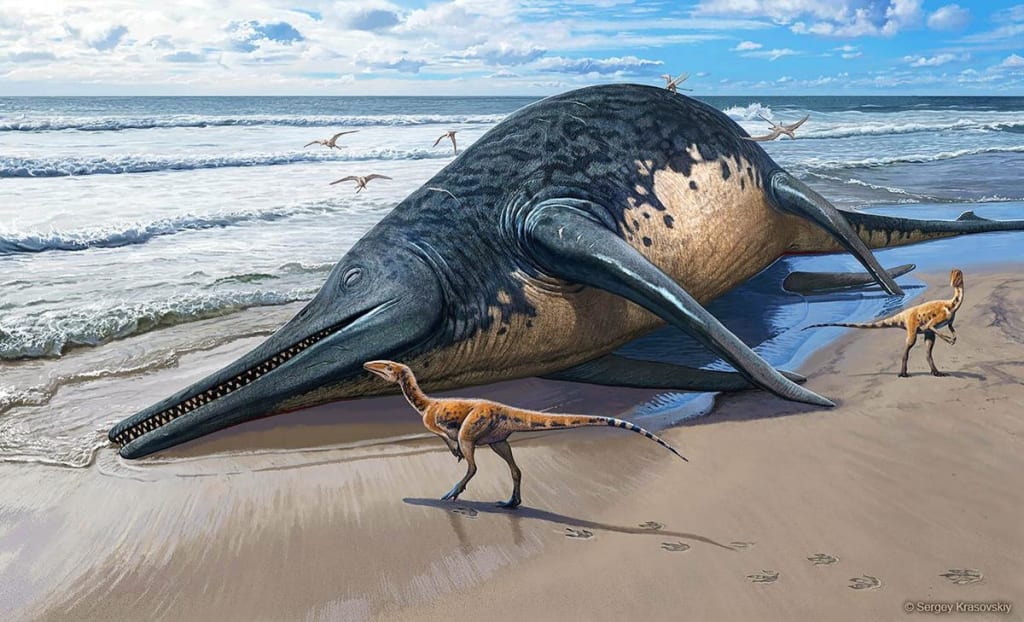
In a discovery that has captivated paleontologists and science enthusiasts alike, an 11-year-old girl from Somerset, England, has helped uncover a fossil belonging to the largest marine reptile ever found—*Ichthyotitan severnensis*. This remarkable find not only adds a new chapter to our understanding of prehistoric marine life but also proves that curiosity and exploration know no age limits.
A Discovery That Began with Curiosity
In May 2020, Ruby Reynolds and her father, Justin Reynolds, set out for a fossil-hunting expedition on the rocky shores of Blue Anchor in Somerset, England. What began as a casual outing quickly turned into a historic scientific breakthrough. Justin found a curious bone fragment on the muddy flats, and shortly afterward, Ruby discovered a much larger piece nearby.
Realizing the significance of the bones, the Reynolds family contacted Dr. Dean Lomax, a paleontologist affiliated with the University of Bristol and the University of Manchester. Dr. Lomax is a leading authority on ichthyosaurs—marine reptiles that roamed the oceans over 200 million years ago—and his expertise would soon confirm that Ruby's discovery was far from ordinary.
A Familiar Fossil from the Past
Upon examining the bones, Dr. Lomax noticed a striking resemblance to another fossil found in 2016 by fossil collector Paul de la Salle. That specimen had also been recovered from the same region near the Bristol Channel. At the time, the jawbone fragment measured over 6.5 feet (2 meters) long but was considered an isolated find.
With the Reynolds family’s discovery, scientists had the missing puzzle piece they needed. Over the next few years, a team of experts—including Dr. Lomax and Dr. Mark Evans from the British Antarctic Survey—conducted multiple field trips and further analysis. Their conclusion was groundbreaking: the fossils belonged to a new species, now named *Ichthyotitan severnensis*, which translates to “giant fish lizard from the Severn.”
The Largest Marine Reptile to Ever Live
So how big was *Ichthyotitan severnensis*? According to the scientific study published in *PLOS ONE*, the creature’s lower jawbone alone spans more than 2 meters. Based on comparisons with known ichthyosaurs like *Shonisaurus*, scientists estimate that *Ichthyotitan* may have reached lengths of up to 82 feet (25 meters). That makes it longer than a modern blue whale and the largest marine reptile ever discovered.
Ichthyosaurs were fast-swimming predators that dominated prehistoric oceans during the Mesozoic Era, especially in the Late Triassic and Early Jurassic periods. Despite their fish-like appearance, ichthyosaurs were reptiles, more closely related to modern-day lizards than to fish or whales. Their streamlined bodies, large eyes, and powerful tails made them perfectly adapted for life in the deep sea.
A Glimpse Into Prehistoric Oceans
*Ichthyotitan severnensis* lived around 202 million years ago, just before a mass extinction event that wiped out over 75% of life on Earth at the end of the Triassic period. This extinction paved the way for the rise of the dinosaurs on land and may have contributed to the eventual decline of ichthyosaurs in the oceans.
What makes this discovery even more significant is the evolutionary parallel it presents. After ichthyosaurs went extinct approximately 94 million years ago, the role of top marine predator remained unfilled until whales evolved to occupy that niche around 50 million years ago. This phenomenon, known as convergent evolution, shows how unrelated species can develop similar traits and ecological roles due to comparable environmental pressures.
A Family Legacy in Paleontology
Dr. Lomax praised the Reynolds family for their incredible contribution to science, calling it one of the most exciting fossil discoveries in recent memory. He also pointed out that Ruby’s name will forever be linked with the discovery of this ancient giant, an achievement few can claim regardless of age.
“To think that Ruby Reynolds, an 11-year-old girl, helped uncover this magnificent piece of natural history is just awe-inspiring,” Lomax said. “It demonstrates the importance of amateur fossil hunters and the potential impact they can have on scientific research.”
Ruby’s discovery has already inspired a new generation of young fossil hunters and has been widely reported across international news outlets. It serves as a shining example of how scientific curiosity, when nurtured, can lead to incredible achievements—no matter your age or background.
Conservation and Continued Exploration
The fossil-rich coastline of Somerset, especially the areas surrounding the Bristol Channel, has proven once again to be a treasure trove for paleontologists. These coastal mudflats and cliffs are subject to constant erosion, often revealing fossils hidden for hundreds of millions of years. Scientists believe more jawbone fragments from *Ichthyotitan* could be found in the future, which may help them reconstruct a more complete skeleton.
In light of this discovery, conservation efforts to protect fossil-rich coastal zones have gained renewed importance. Paleontologists are urging for more awareness and responsible fossil hunting practices to preserve these vital areas for scientific study.
Final Thoughts
The story of *Ichthyotitan severnensis* is a perfect blend of science, history, and human curiosity. Thanks to the keen eyes of a young girl and her father, the world now knows about the largest marine reptile to ever swim Earth’s oceans. The discovery highlights the ongoing importance of fossil exploration and serves as a powerful reminder that groundbreaking scientific discoveries can come from anyone—young or old.
Whether you're a seasoned paleontologist or a child with a fossil-hunting kit, one thing is certain: the next big discovery might just be waiting beneath your feet.
About the Creator
Tech Horizons
Exploring the future of technology, AI, gadgets, and innovations shaping tomorrow. Stay updated with Tech Horizons!
Keep reading
More stories from Tech Horizons and writers in Motivation and other communities.
Crypto Market Rally: Dogecoin, Solana, and Ethereum Surge as Bitcoin Hits Monthly High
The cryptocurrency market has sprung back to life this week, offering a much-needed jolt of optimism for investors. On April 22, 2025, major cryptocurrencies including Dogecoin (DOGE), Solana (SOL), and Ethereum (ETH) witnessed strong price rallies as Bitcoin (BTC) hit a new monthly high. This surge comes amid improving investor sentiment and whispers of progress in global economic relations, particularly between the U.S. and China.
By Tech Horizons9 months ago in Motivation
The Long Game of Becoming
Introduction: Why the Second Chapter Matters Motivation is often portrayed as a sudden spark—a lightning strike that changes everything in an instant. In reality, meaningful change rarely begins with fireworks. It begins quietly, often invisibly, in moments that feel too small to matter. This second chapter is written for those moments.
By Chilam Wongabout 6 hours ago in Motivation
Wild Card Weekend Recap: What Happens Now?
I think I figured out why I love Wild Card Weekend so much. It's because it's the first playoff anything of the calendar year. The NFL season starts in the fall, and once upon a time, the champion was crowned either on or slightly before New Year's. The evolution of the NFL schedule has resulted in the playoffs starting just into the New Year, and currently, the final week of the season falls on the first weekend of the New Year, with Wild Card Weekend coming a week after that. So yes, chronologically, the NFL's Wild Card Weekend serves as the first playoff anything of the calendar year.
By Clyde E. Dawkins6 days ago in Unbalanced




Comments
There are no comments for this story
Be the first to respond and start the conversation.