
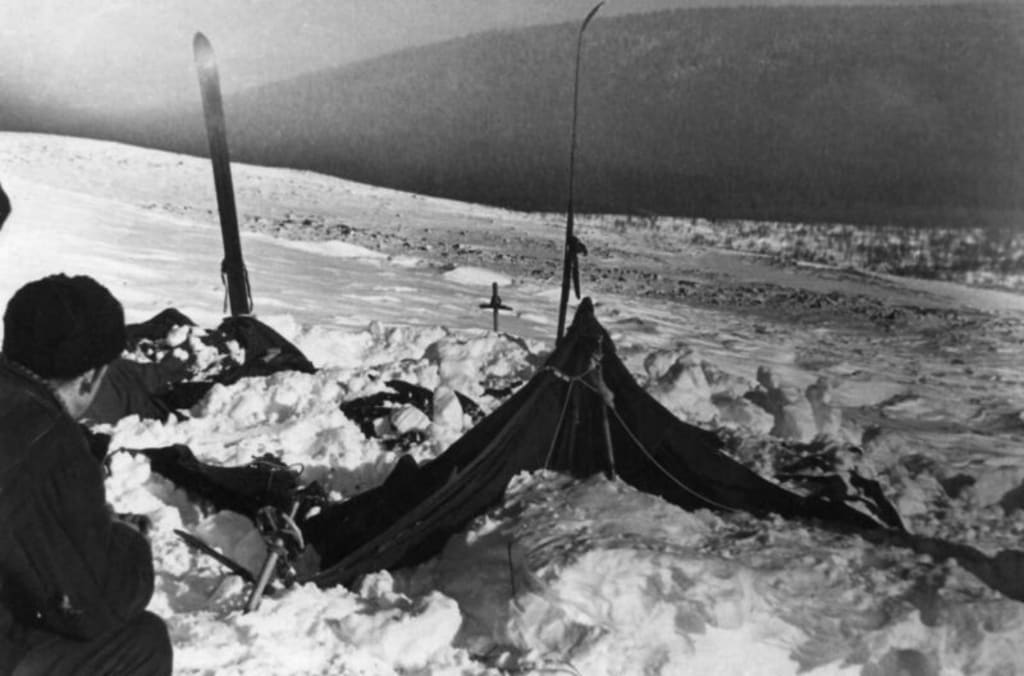
In February 1959, a group of experienced Russian hikers ventured into the remote Ural Mountains in Western Siberia for an advanced winter trek. However, this trip would be their last, and the mystery of their disappearance would captivate the world for decades to come.
On the night they vanished, the hikers were captured in a photograph digging a platform in the deep snow to pitch their tent along the slope of Kholat Syakhl, which translates to Dead Mountain in the language of the indigenous Mansi people. Little did they know that hours later, they would abandon their tent and all their equipment in the darkness, leaving behind a half-destroyed shelter cut open from the inside.
Weeks later, a search party found the tent, but the group's frozen bodies were discovered 1,500 meters away. Most of them were found barefoot and wearing only their sleeping clothes. It appeared as though they had been driven out of the tent so urgently that they had no time to put on the heavy winter gear necessary to survive the harsh conditions outside.
The investigation into the Dyatlov Pass incident, named after the group's leader, 23-year-old Igor Dyatlov, yielded baffling findings. While some of the hikers died from hypothermia, others suffered severe internal injuries that were difficult to explain. The bodies were found in three groups, and footprints leading away from the tent vanished after about 500 meters. The first two bodies were discovered under a cedar tree downslope from the tent, while three more were found in a straight line, seemingly attempting to return to the shelter. The last four bodies were located two months later, buried under four meters of snow in a ravine, with three of them showing signs of severe internal trauma comparable to the impact of a bomb blast.
Numerous theories have emerged over the years, ranging from alien encounters to government cover-ups, but they all attempt to address the same fundamental question: What drove the hikers to leave their tent in such a perilous situation? Among the myriad of theories, two stand out as the most plausible explanations.
The first theory proposes that a delayed slab avalanche, a rare type of avalanche triggered by cutting the slope to pitch the tent, might have impacted the group. According to this theory, the strong winds brought additional snow on top of the tent, leading to progressive accumulation and eventual failure of a weak layer, resulting in an avalanche that struck the tent and hikers. The traumatic injuries suffered by some of the hikers could be attributed to being trapped under the snow slab, forcing them to cut their way out of the tent and seek shelter near the tree line.
The second theory involves a katabatic wind, a powerful "falling wind" that can quickly gain speed under the force of gravity and create hurricane-like conditions without warning. In this scenario, a sudden and violent katabatic wind struck the tent, placing it at risk of being torn apart. Faced with temperatures around -30 degrees Celsius, the hikers would have had to evacuate the tent immediately. Putting on their frozen equipment in such conditions would have been a time-consuming task, leaving them severely underdressed and vulnerable to the extreme cold.
The injuries suffered by some hikers could have occurred in a collapsed snow den in the ravine where their bodies were found. The heavy snow collapsing over them could have caused the compressed chests, and the injuries might even be post-mortem due to months of decomposition under the crushing snowpack.
Both theories have compelling evidence to support them, and they could even complement each other. For instance, the slab avalanche theory relies on katabatic wind for snow transfer, while the katabatic theory explains the collapsed snow den under a heavy slab.
Despite the plausible explanations presented by these two theories, the enigmatic behavior of the hikers after the incident remains a mystery. Since there were no survivors to provide insight into their actions, trying to understand why they did what they did raises more questions than answers.
The Dyatlov Pass incident continues to be one of the most enduring mysteries of the 20th century. While numerous theories have been proposed and debunked over the years, the truth behind what transpired that freezing February night in 1959 remains elusive. The story of these brave hikers and the circumstances surrounding their untimely demise will continue to intrigue and haunt generations to come.
About the Creator
Keep reading
More stories from Saleel Khetle and writers in Men and other communities.
Effiel Tower Sold
This has to be one of the best cons of all times The tale of the man who ingeniously sold the iconic Eiffel Tower not once but twice is one of the most captivating stories of all time, yet surprisingly, it hasn't been adapted into a movie yet. Victor Lustig, a master scammer, had a long and impressive life of crime, but his Eiffel Tower scheme is what everyone wants to hear about.
By Saleel Khetle2 years ago in Criminal
Why You're Getting Friendzoned (And How to Fix It)
Getting stuck in the friendzone happens to countless guys who wonder why their romantic interest sees them as "just a friend." For men who keep finding themselves in this frustrating situation, understanding the real reasons behind getting friendzoned is the first step toward changing the pattern.
By LaMarion Zieglerabout 14 hours ago in Men




Comments
There are no comments for this story
Be the first to respond and start the conversation.