
The Last Secret
How My Dying Mother-in-Law's Confession Shattered and Saved My Marriage
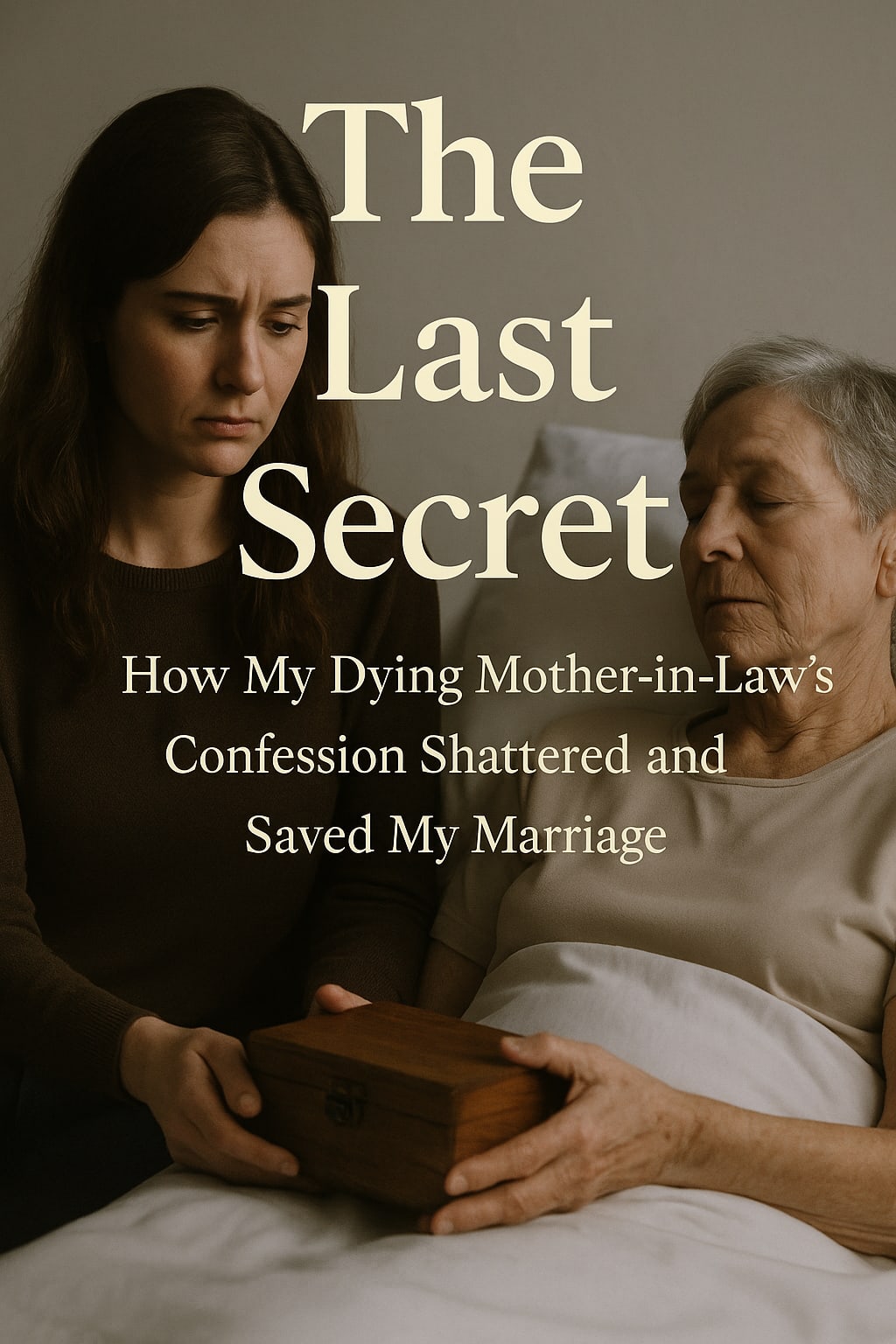
My relationship with my mother-in-law, Helen, had always been complicated. From the moment I met her, she sized me up like a hawk watching prey. “You’re not what I imagined,” she once said during a tense family dinner. My husband, Daniel, would brush off her comments, telling me she was just “traditional” and “hard to please.” I believed him, or at least I wanted to.
Helen was a proud woman. Her house was always spotless, her lipstick never smudged, and her judgment sharp as knives. She never fully accepted me, and I, in return, never really let her in. But things changed dramatically the year she got sick.
It started with forgetfulness. Then came the hospital visits. Cancer, they said. Aggressive and terminal. She deteriorated quickly. The woman who once stood tall with a sharp tongue now lay frail and soft-spoken in a hospice bed.
Daniel visited every day. I came twice a week. I brought flowers, read to her when she had the strength, and watched the softening in her eyes when she looked at me. It was like she was trying to say something but couldn’t quite find the right time.
One rainy afternoon, I found myself alone with her. Daniel had gone to the cafeteria to grab coffee. The room was quiet except for the sound of rain tapping the window. Helen turned her head toward me and whispered, “There’s something you need to know before I go.”
I froze. Her voice, though weak, was urgent.
“What is it?” I asked, leaning closer.
She struggled to lift her hand, pointing to a small wooden box on her bedside table. “Take it. Don’t open it here. Do it when you’re alone.”
I hesitated but nodded. Her hand fell back to her side, and her breathing slowed. That night, she passed away.
At home, after the funeral, I found the box still tucked in my bag. I opened it. Inside was a bundle of letters tied with a blue ribbon and a photograph—an old, slightly faded picture of a young woman holding a baby. On the back, in neat handwriting, it said: Daniel – 1984.
But the woman wasn’t Helen.
Confused, I read the first letter. It was addressed to Daniel, written by a woman named Margaret.
My sweet boy,
I’ve loved you every day since I held you in my arms. I never wanted to give you up. Helen and Richard promised they’d raise you with love and stability. I wasn’t ready, and they were. But I never stopped thinking about you. I hope someday you’ll understand.
My hands trembled. Letter after letter revealed the truth: Helen was not Daniel’s biological mother. He had been adopted by Helen and her husband after Margaret, a young relative of Helen’s, couldn’t keep him. They had agreed to keep it a secret to protect “family reputation.”
I sat in stunned silence for hours. I couldn’t believe Helen had hidden something so monumental from Daniel his entire life. And yet, I understood her better in that moment than I ever had. Her protectiveness, her distance—it was all fear. She was afraid of losing him, of the truth undoing everything.
For days, I debated whether to tell Daniel. I read the letters again and again, searching for guidance in Margaret’s words. She never said she wanted to take Daniel back—only that she loved him, always had, and wanted him to know the truth if he ever questioned who he was.
Finally, I couldn’t carry the secret any longer.
We sat on the couch, and I handed him the box.
At first, he laughed, thinking it was some kind of sentimental token from Helen. But as he read the letters, his face changed. His expression shifted from confusion to disbelief to quiet devastation.
When he finally looked at me, his eyes were glassy. “She wasn’t my mom?”
I reached for his hand. “She was in every way that mattered. But… you had another mother, too.”
He didn’t speak for a long time. Then he whispered, “I always wondered why I felt like something didn’t quite add up. I look nothing like her. She never talked about when I was born.”
In the weeks that followed, Daniel was quiet. Distant. Processing. I gave him space, but I worried. Not just for him, but for us. Our foundation had cracked—what else might fall through?
Then, one night, he came into the room holding one of Margaret’s letters. “She lived in Oregon,” he said softly. “I looked her up. She died three years ago. But… she had other children. I have half-siblings.”
I sat up, heart pounding.
“She wrote that she’d always hoped I’d forgive her someday. And I think I do,” he said. “But I don’t know how to feel about Helen anymore. I loved her. I hate that she lied. But I understand why she did it.”
We talked for hours. About family. Identity. Secrets and love and grief. It wasn’t easy, but it brought us closer. Closer than we’d been in years.
Helen’s final words, her last act, had shaken the foundation of our lives—but they’d also unearthed a truth that reshaped our marriage. We learned that love isn’t always perfect, that family is sometimes forged in silence and sacrifice. And most of all, we learned that the truth—however painful—is better shared than hidden.
Because in the end, secrets don’t die with the dead. They wait in boxes, in letters, in old photographs, for the moment they’re finally ready to be set free.
About the Creator
Fazal Rahman
I’m Fazal Rahman—a storyteller at heart and book seller by trade. I create and share content that sparks curiosity, makes you think, and maybe even makes you smile. Find my books on Amazon and my thoughts right here on Vocal.
Keep reading
More stories from Fazal Rahman and writers in Marriage and other communities.
The Unspoken Truth About My Best Friend's Marriage That Left Me Speechless
I always thought Samantha had the kind of love people wrote novels about. She was the first of our group to get married—beautiful ceremony, candlelit vows, and a groom who looked at her like she was the only person in the world. Daniel was smart, successful, and charming in a way that made strangers believe in love at first sight.
By Fazal Rahman8 months ago in Marriage
Marriage 2.0: How Couples Are Rewriting Love in 2026
Marriage in 2026 no longer looks like it did a decade ago. The institution hasn’t disappeared, but it has evolved quietly, deeply, and intentionally. Today’s couples are not abandoning marriage; they are upgrading it. Welcome to Marriage 2.0, where love is no longer defined by roles, control, or silent sacrifice, but by awareness, partnership, and emotional maturity.
By Sathish Kumar 5 days ago in Marriage


Comments
There are no comments for this story
Be the first to respond and start the conversation.