
Where did all the fat that you desperately lose?
Fat to lose weight

As the main goal of most people's fitness, fat loss has always been a hot topic in the fitness circle, but have you ever thought about where all these lost fats ended up? Regarding this matter, you can’t expect that even for recognized professionals such as coaches, doctors, and nutritionists, only a very small percentage of people can answer correctly, so you might as well take the test after understanding the following knowledge points.
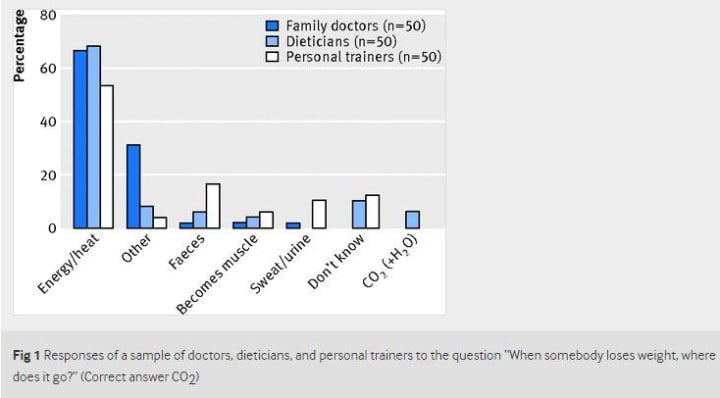
A survey searched 150 doctors, nutritionists, and personal trainers to ask them: When someone loses fat, where does the lost fat go? Some think it turns into muscles, and some think it increases with energy supply. It is consumed when it is converted into energy, and some think that it may be removed from the body with excrement, and some think it is sweating (these are also the answers that most ordinary people may give), only about 10% The answer is correct, and the correct answer is: They are mainly discharged from the body in the form of carbon dioxide through breathing.
In a paper "When somebody loses weight, where does the fat go?" published in the "British Medical Journal", by tracing the path of each atom, it was concluded that about 84 fats were consumed. % Will be exhaled in the form of carbon dioxide through the lungs, and 16% will be in the form of water in excretion, sweating, breathing and other body fluids.
You may be wondering how this wave of operations is derived. Let's first understand the process of fat decomposition.
Excess carbohydrates and protein intake by the human body will be converted into triglycerides and stored in fat cells. The fat we want to lose is actually these triglycerides. Triglycerides can be broken down into free fatty acids and glycerol. After being mobilized and transported, it will be sent to the blood, and then further transported to the mitochondria of muscle cells for oxidation and energy, and triglycerides are composed of oxygen, hydrogen and carbon.

Although energy may be generated in the process of fat decomposition, the process of chemical reaction is the process of recombining the atoms of each substance participating in the reaction to form other substances. The type of atoms before and after the reaction will not change, and the number will not increase. Subtract, the mass of the atom will not change. This is the law of conservation of mass that we have learned in middle school chemistry: any chemical reaction, the total mass before and after the reaction will not change, and the total mass of the substances participating in the reaction is equal to After the reaction, the total mass of each substance will neither increase nor decrease, but will only be transformed from one form to another, but not eliminated, so this is also known as the law of indestructibility of matter. Triglycerides and oxygen eventually become carbon dioxide and water, which are consistent in atomic species, so what we need to see next is whether the quality is consistent.
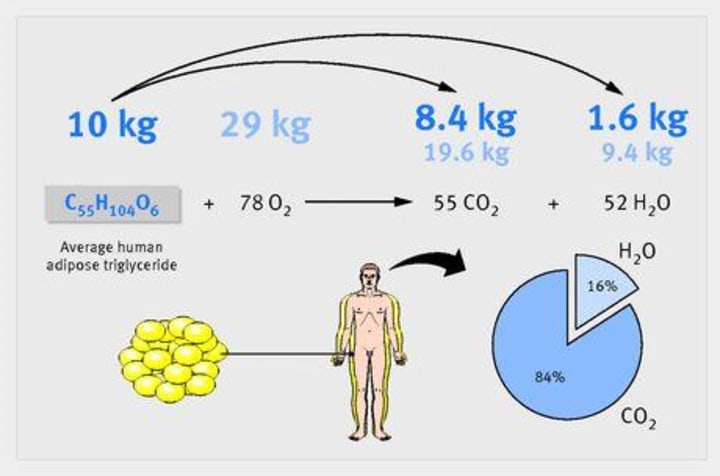
According to stoichiometric calculations, if you want to completely oxidize 10 kg of fat, you need to inhale 29 kg of oxygen, and 28 kg of carbon dioxide and 11 kg of water will be produced in this metabolic process, 10+29=28+11 . And if we track the final direction of the 10kg of fat, 8.4kg will exhale carbon dioxide through the lungs, and the remaining 1.6kg will become water. It is not just fat. In fact, almost all the nutrients we take in are exhaled through breathing. Carbohydrates and fats are basically converted into carbon dioxide and water, and a small part of protein is turned into urea and other solids. Excretion of urine is the same result.
Of course, this does not mean that you only need to breathe hard to consume fat. A more correct understanding should be that this is a process required for our lipolysis, but it is not the essential condition that leads to lipolysis, and it is caused when you deliberately quickly exhale. Hyperventilation may cause dizziness, palpitations and unconsciousness.
Knowing this basic chemical reaction process can help you to falsify many "fat-reducing recipes" with reason and evidence. You cannot apply various topical products or shock, massage, massage, or wear sweat suits, and wrap insurance. Membrane and other "physical methods" to break down your fat, to actively exercise, to control your diet, and then allow these lipids to be naturally decomposed for energy and excreted, is the truly scientific and reasonable way.
Perhaps most members can’t really figure out whether your professional is solid, whether you really know and believe that what you are saying is the correct content, but as a coach, it’s the last thing you should do to follow the sloppy professionally. The error that occurred. Recognize your shortcomings generously and actively work hard to improve your professional level within the scope of your ability. If you can do this, then I think even if you are not now, sooner or later you will become a real good coach.
And if you have such characteristics, and at the same time have good teamwork ability and professionalism, then you are very welcome to join, excellent growth opportunities and a group of outstanding partners are waiting for you!
The harsher the environment is, the more it can test whether we are truly loyal to the beliefs in our hearts and have the courage to create our own dreams. As long as we keep working hard to practice and do the right things, then one day we can use fitness to change everyone's life
About the Creator
Keep reading
More stories from writers in Longevity and other communities.
Day 4 of Quitting
If this is how sobriety feels, maybe it’s better to go through life a little buzzed… this, along with other hits like, I want to kill myself, I wish I was dead, and I’m going to throw myself off a bridge have been the only thoughts on rotation these past few days. I promise myself that if, in a month, I still feel like this (‘this’ meaning despondent, full of rage, and simultaneously numb) I can go back to smoking. Until mid-February though? Nicotine is off the table.
By sleepy drafts24 days ago in Longevity
The Peculiar Magic of a Winter Snowstorm
How the world transforms when snow blankets the landscape There is something undeniably magical about a winter snowstorm. As flakes begin to fall, the world seems to slow down. Streets, trees, and rooftops are covered in a soft, white layer that transforms familiar landscapes into scenes of quiet beauty. But beyond its aesthetic charm, a snowstorm is a fascinating blend of nature’s power, science, and subtle wonder.
By Fiaz Ahmed 7 days ago in Longevity
One Hard Thing
Stop me if you’ve heard this one before: You have the number, you know your schedule- you’ve even picked out the perfect day and time to make this appointment. Shoot, you’ve even picked out alternative days and times just in case their schedules can’t accommodate you!
By Taylor Rigsby5 days ago in Motivation


Comments
There are no comments for this story
Be the first to respond and start the conversation.