
When Pain Turns Inward: The Silent Crisis of Untreated Mental Illness
A young woman’s desperate act reminds us why mental health must be taken as seriously as physical health.

She was thirty-three years old — educated, quiet, and seemingly composed. But beneath her calm exterior, a war was raging. For months, she had been battling intrusive thoughts and deep emotional pain. Though she was under the supervision of a psychologist, she rarely followed the treatment plan and often refused to take her prescribed medications. Her family assumed she was fine. But she wasn’t.
When she finally walked into her therapist’s office one morning, her eyes were heavy with exhaustion and despair. She confessed that she no longer wanted to live, that the voices in her head were louder than her will to survive. Recognizing the danger, her psychologist immediately arranged for her to be admitted to a psychiatric unit. It was a necessary step — one that might have saved her life.
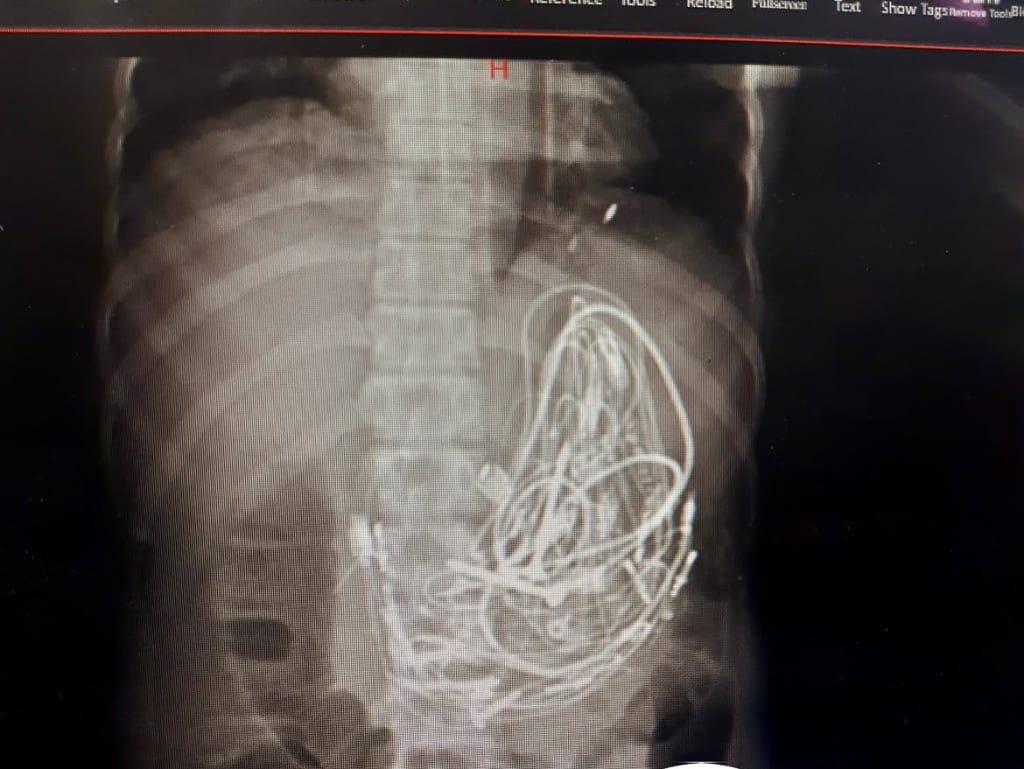
But just days after admission, she began complaining of severe abdominal pain and nausea. The nurses, concerned by her distress, informed the psychiatrist on duty, who ordered an urgent X-ray. What appeared on the scan shocked everyone — the woman had swallowed several foreign objects: a nail, a mobile phone charger cable, an earphone, and small metallic pieces.
She was rushed to surgery. The medical team worked quickly to remove the items before they could cause irreversible damage. As she lay on the operating table, her story became a mirror for a much larger issue — one that society often refuses to face.
Mental illness is not visible like a wound or a broken bone, yet it can destroy a person from the inside. The stigma surrounding psychiatric disorders still prevents many from seeking the help they need. Too often, people dismiss depression, anxiety, or psychosis as weakness, laziness, or attention-seeking. But these conditions are illnesses, not choices.
Ignoring mental suffering doesn’t make it disappear — it makes it worse. When left untreated, it grows quietly until it bursts, just as pressure inside a balloon eventually causes it to explode. The human mind is not made of steel that can be hammered into shape. It is fragile, sensitive, and deeply affected by emotion, trauma, and isolation.
This woman’s act of swallowing dangerous objects was not a cry for attention — it was a cry for help. Her body spoke the words her mouth couldn’t. Each object represented the invisible pain she carried. And while her case seems extreme, it is a reminder that many people live on the edge of the same despair every day — unseen, unheard, and untreated.
We must begin to treat mental health with the same urgency and compassion as physical illness. If someone breaks a leg, we rush them to the hospital without hesitation. But when someone says they are depressed, we tell them to “be strong” or “get over it.” This mindset must change.
Healing the mind requires patience, empathy, and understanding. It’s not always about pills — sometimes, what a person needs most is a listener, someone who will sit quietly, without judgment, and say, “I hear you.”
If you ever feel trapped inside your thoughts, please reach out. Talk to a psychologist, a counselor, or even a trusted friend. There is no shame in needing help. Seeking therapy does not make you weak; it means you are brave enough to face your pain.
Mental illness can be more dangerous than any physical disease because it kills silently. It erodes hope, isolates people from their loved ones, and convinces them that the world would be better without them. But there is always hope — recovery begins the moment you choose to speak up.
This woman survived her surgery, and with continued psychiatric support, she began to rebuild her life. Her story is not just about tragedy — it’s about awareness. It’s a call for us all to pay attention before it’s too late.
Mental health matters.
It always has, and it always will.
⸻
Tags:
#MentalHealthAwareness #Psychiatry #SuicidePrevention #Depression #Trauma #Healing #Health
About the Creator
Faeze Gholami
“Registered nurse and vocal educator — sharing medical insights with clarity, compassion, and care.”
Keep reading
More stories from Faeze Gholami and writers in Longevity and other communities.
The Girl Who Lost Weight Fast and Couldn’t Stop Drinking Water – Was It Just Exam Stress?
A 23-year-old woman with no prior medical history presented with a two-week history of severe thirst (polydipsia), increased urination (polyuria), and significant unexplained weight loss. Her family noticed her rapid weight loss and general fatigue but initially believed it was related to exam stress. On the day of her hospital visit, she experienced persistent nausea, repeated vomiting, abdominal pain, and severe dry mouth. When examined at the emergency department, she showed Kussmaul breathing, a fruity odor on her breath resembling acetone, and decreased alertness.
By Faeze Gholami3 months ago in Longevity
Day 4 of Quitting
If this is how sobriety feels, maybe it’s better to go through life a little buzzed… this, along with other hits like, I want to kill myself, I wish I was dead, and I’m going to throw myself off a bridge have been the only thoughts on rotation these past few days. I promise myself that if, in a month, I still feel like this (‘this’ meaning despondent, full of rage, and simultaneously numb) I can go back to smoking. Until mid-February though? Nicotine is off the table.
By sleepy drafts12 days ago in Longevity
Olivia Dean
In an age where music often feels rushed and overproduced, Olivia Dean stands out by doing something surprisingly simple: she sounds honest. Her voice carries warmth, restraint, and emotional clarity, making listeners feel understood rather than overwhelmed. Olivia Dean is not just another rising singer; she represents a return to music that values feeling over noise. Born and raised in London, Olivia Dean grew up surrounded by a mix of musical influences. From a young age, she was drawn to soul, pop, and jazz, genres that prioritize storytelling and emotion. This foundation shaped her artistic identity and continues to influence the way she writes and performs today. Rather than chasing trends, Dean focuses on timeless sounds and relatable experiences. What makes Olivia Dean special is not just her technical ability, but her emotional intelligence as an artist. Her songs often explore themes like self-worth, love, vulnerability, and growth. These are universal ideas, yet she presents them in a way that feels deeply personal. Listening to her music can feel like reading someone’s private journal—quiet, reflective, and sincere. One of her greatest strengths is her voice. It is soft without being weak, powerful without being aggressive. She knows when to hold back and when to lean in, allowing space for emotions to breathe. This control gives her music a calm confidence that resonates with listeners who are tired of constant intensity. Her vocals don’t demand attention; they invite it. Olivia Dean’s songwriting also deserves attention. Her lyrics are simple but thoughtful, avoiding dramatic exaggeration. She writes about real emotions in everyday language, which makes her songs easy to connect with. There is no need to decode hidden meanings or metaphors that feel forced. Instead, her words flow naturally, reflecting real conversations and feelings many people experience but struggle to express. Another important aspect of her artistry is authenticity. In interviews and performances, Dean comes across as grounded and self-aware. She openly talks about personal growth, creative struggles, and learning to trust herself. This honesty builds a strong connection with her audience, especially young listeners navigating similar emotions. She doesn’t present herself as perfect, and that makes her relatable. Her rise in the music industry has been steady rather than explosive, and that slow growth feels intentional. Olivia Dean has taken time to develop her sound, refine her message, and understand who she is as an artist. This patience shows in the quality of her work. Each release feels considered, not rushed, and that consistency builds long-term trust with her audience. Live performances further highlight her strength as a musician. On stage, she maintains the same warmth and control that define her recordings. There is no overacting or unnecessary spectacle. Instead, she focuses on connection—between herself, the music, and the audience. This creates an intimate atmosphere, even in larger venues, where listeners feel emotionally present rather than distracted. Olivia Dean’s influence extends beyond music alone. She represents a generation of artists who prioritize mental health, self-awareness, and balance. Her work encourages listeners to slow down, reflect, and accept themselves as they are. In a world driven by constant comparison and pressure, this message feels both refreshing and necessary. Fashion and visual presentation also play a subtle role in her identity. Dean’s style is elegant but understated, mirroring the tone of her music. She avoids excess and instead embraces simplicity, allowing her personality and voice to remain the focus. This alignment between sound, image, and message strengthens her overall artistic presence. As her career continues to grow, Olivia Dean remains a reminder that success does not have to be loud to be meaningful. Her journey shows that there is space in modern music for softness, reflection, and emotional honesty. She proves that artists can build strong connections without sacrificing integrity or authenticity. In the long run, Olivia Dean’s impact may not be measured by chart positions alone, but by the way her music stays with people. Her songs feel like companions during quiet moments—on late-night walks, early mornings, or times of personal change. That kind of connection is rare, and it is what gives her work lasting value. Olivia Dean is not trying to reinvent music. Instead, she is reminding us why it matters in the first place. Through her voice, her words, and her presence, she offers something increasingly rare: comfort, clarity, and genuine emotion. And in today’s fast-moving world, that might be her greatest strength.
By Saboor Brohi a day ago in Longevity




Comments
There are no comments for this story
Be the first to respond and start the conversation.