
WHAT IS ASTHMA,HOW ASTHMA AFFECTS THE RESPIRATORY SYSTEM?
HEALTH IS WEALTH

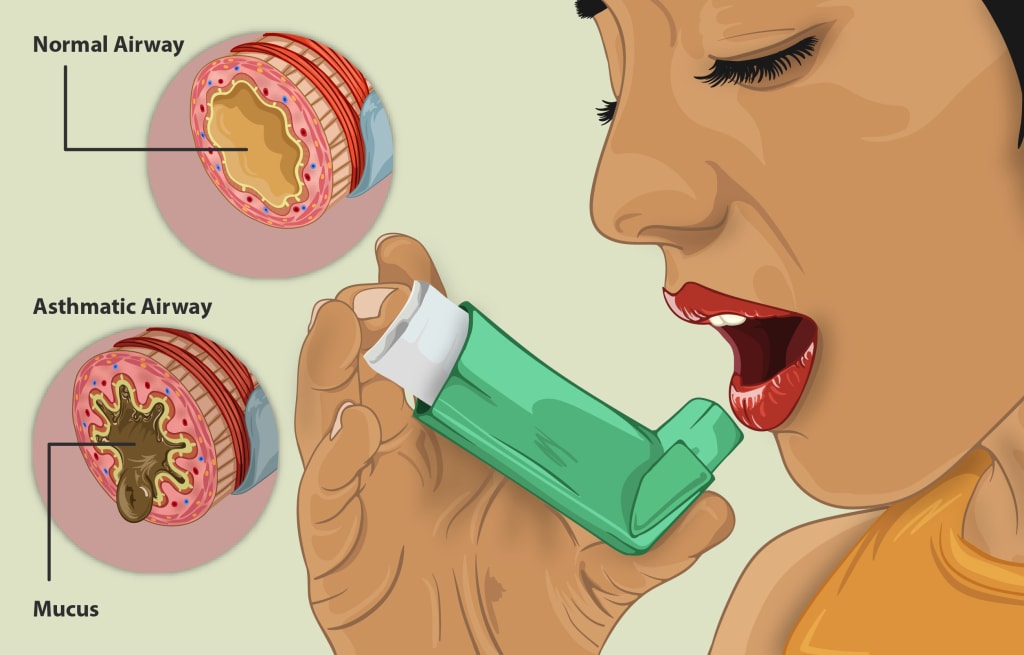
Asthma is a common lung disease in which the breathing tubes get narrowed temporarily during an acute attack, and it becomes difficult to breathe. A wheezing noise may be heard and breathing becomes rapid. Mild asthma may present with a dry cough alone. Sometimes there is phlegm, but it is often difficult to cough it out. Children tend to develop asthma between the ages of 2 to 8 yrs, but asthma may involve all ages. During an asthma attack, the muscle walls contract, and the inner walls of the airways swell and become inflamed. These changes cause narrowing of the airways, exacerbated by increased secretions from the mucous membranes, and can actually block small airways.
WHAT IS "ASTHMATIC" OR WHEEZY" BRONCHITIS? WHAT ASTHMA FEELS LIKE?
The old term "asthmatic bronchitis" has now been replaced by the term wheezy bronchitis'". It describes the child who develops a mild wheeze only during a chest infection (bronchitis). When the chest infection clears up, the wheezing will also disappear. These children probably have a very mild and transient form of asthma that is only triggered off by a chest infection.
WHAT IS ASTHMA DUE TO / WHERE ASTHMA OCCURS / WHERE ASTHMA CAME FROM?
lt is due to an allergy, but the precise factor that can trigger off an attack may differ from one person to another. Some children may develop an attack when the weather changes, eat oranges or come into contact with pollen or animal hair. Chest infection, exercise, and emotional factors may also precipitate an asthmatic attack.
DOES ASTHMA RUN IN FAMILIES?
Yes, many relatives of an asthmatic have asthma or some other form of allergy. However, the precise mode of inheritance is still not worked out.
WHAT IS THE TREATMENT OF ASTHMA?
Medicines that can widen the breathing tubes may be given either as tablets, syrup or inhaled. Generally, inhaled medicines act faster and may have fewer side effects. However, it may be more difficult to give inhaled medicines to small children. A beta-agon1st medicine is used for mild asthma, and usually, there is no need for hospital admission. Theophylline is added to the beta-agonist for moderately severe asthma. If there is no improvement, hospital admission must be considered. In very severe cases, admission to the hospital is critical, and asteroids may have to be used in addition to the above medicines.
SHOULD ANY PARTICULAR FOOD OR DRINK BE AVOIDED?
Certain foods and drinks may precipitate an attack on asthma. These might include oranges, milk, nuts, and eggs. Each child will differ in his range of allergies. If a particular food or drink can start an attack on asthma, then it is reasonable to exclude it.
SHOULD I STOP MY ASTHMATIC CHILD FROM SWIMMING OR DOING OTHER EXERCISES?
Physical exertion can precipitate an attack of asthma, but it is no reason to stop all exercises.The benefits of regular exercise are considerable. Rather than restrict physical activities, one should encourage them. To avoid starting off an attack, a beta-agonist can be given about half an hour before the exercise. Swimming is one of the best forms of exercise for an asthmatic, as it also promotes controlled breathing.
HOW CAN WE PREVENT FUTURE ASTHMATIC ATTACKS?
It is not always possible to avoid known factors that trigger an asthmatic attack. Furthermore, some children develop an attack with no obvious cause. Children who have frequent recurrent episodes may try one of the following medical measures to reduce the chances of future attacks. Abeta-agonist could be given on a long-term daily basis. Other medicines used can be used daily to prevent exacerbations. For the child with persistent asthma or severe recurrences, an inhaled steroid may be considered.
CAN ASTHMA BE CURED? CAN ASTHAMA GO AWAY?
There are currently no medicines that can cure asthma. Medicines can significantly alleviate the breathing difficulties experienced, and some medicines may even prevent most future attacks of asthma. While asthma cannot be cured by medical treatment, quite a large number of children will grow out their asthma by puberty. Unfortunately, develop some of these adolescents may develop asthma again later on in life.
About the Creator
DILIP CHANDRAN EDAPAYIL
Hi everyone, my name's Dilip. I love writing short stories,articles on education,social welfare,health'' and several other general subjects which have been published by newspappers and periodicals from time to time.
Keep reading
More stories from DILIP CHANDRAN EDAPAYIL and writers in Longevity and other communities.
Why our health is important
Thanks to errors of eating and drinking, and perennial anxiety that dogs present-day life; even the elementary life needs like 'sleep' are hardly met. Insomniacs pass difficult nights lying on bed awake. If by any chance they do catch a nap, the slightest of noise usurps it. And then once again there are desperate attempts to find sleep. But sleep, as if, plays truant.
By DILIP CHANDRAN EDAPAYIL4 years ago in Longevity
One Key Protein Could Be a Powerful New Target Against Malaria
Scientists have uncovered a major vulnerability in the parasite that causes malaria that could lead to a new class of treatments and interventions, offering hope against one of the world’s deadliest infectious diseases. The discovery centers on a crucial protein called Aurora‑related kinase 1 (ARK1), which researchers say is indispensable to the malaria parasite’s ability to grow and reproduce. Despite decades of progress in vaccine development and antimalarial drugs, malaria continues to kill hundreds of thousands of people each year, largely in sub‑Saharan Africa, with young children bearing the greatest burden. The need for new tools to combat the disease — especially ones that operate differently from existing drugs — is urgent. The newly identified protein may offer exactly that. A Parasite’s Weakness Revealed The malaria parasite, Plasmodium, undergoes a complex and unusual form of cell division that is very different from how human cells reproduce. ARK1 plays a central role in this process. The protein directs the assembly of a structure called the spindle apparatus, which ensures that the parasite’s genetic material is accurately split and distributed during cell division. In laboratory experiments, scientists used genetic tools to turn off ARK1 in Plasmodium organisms. The result was dramatic: without this protein, the parasites could no longer form spindles correctly, meaning they failed to replicate at all — either inside human red blood cells or within the mosquito vectors that spread malaria. This effectively stopped their life cycle. “This protein truly heralds a new beginning in our understanding of malaria cell biology,” said one researcher involved in the study. The finding was published in the scientific journal Nature Communications and represents a significant step forward in the fight against malaria. Why ARK1 Is Such a Promising Target There are two key reasons scientists are excited about ARK1 as a target: 1. Fundamental difference from human biology. Humans have their own versions of Aurora kinases — proteins involved in cell division — but the form used by malaria parasites is structurally different. This means it may be possible to design drugs that specifically inhibit ARK1 in the parasite without interfering with human cells, reducing the risk of harmful side effects. 2. Blocking transmission as well as infection. Most antimalarial drugs only affect the parasite once it has infected the human host. ARK1, however, is necessary both in the parasite’s human phase and in its reproductive stage inside mosquitoes. Targeting ARK1 could potentially disrupt the parasite’s life cycle in both hosts — a dual effect that would make new therapies more powerful than many existing options. A New Direction for Antimalarial Therapy Existing antimalarial drugs, such as artemisinin and its derivatives, often target metabolic processes within the parasite. Over time, however, resistance has emerged in some regions, reducing the effectiveness of these treatments. A drug targeting ARK1 could bypass these resistance mechanisms entirely, providing a novel mode of action. Researchers emphasize that this discovery does not immediately translate into a new medicine. Drug development is a complex, costly, and time‑consuming process that involves designing molecules that effectively inhibit ARK1, testing them in laboratory and animal models, and eventually conducting clinical trials in humans. Nevertheless, identifying ARK1 as an essential protein is a major scientific breakthrough that opens the door to these next stages of research. The Global Context Malaria remains one of the most persistent global health challenges. According to health authorities, there were an estimated hundreds of millions of malaria cases in recent years, with a significant number of deaths — particularly among young children in areas lacking access to prompt treatment and preventive measures. While tools like bed nets, insecticides, and vaccines have helped reduce the burden, malaria has proved adept at evading control strategies through adaptation and resistance. By identifying a previously underappreciated target like ARK1, scientists hope to stay ahead of the parasite’s evolutionary tricks. Future drugs that cripple the parasite’s ability to replicate could save countless lives and complement existing measures such as vaccines and vector control programs. Looking Ahead The discovery of ARK1’s critical role marks a promising chapter in antimalarial research. It underscores the value of fundamental biological studies in revealing “Achilles’ heels” within pathogens that can be exploited therapeutically. As researchers begin exploring molecules that can shut down this protein, the global health community may be on the cusp of a powerful new tool in the fight against one of humanity’s oldest foes.
By Fiaz Ahmed about 12 hours ago in Longevity




Comments
There are no comments for this story
Be the first to respond and start the conversation.