
United States Non-Invasive Prenatal Testing Market Size & Forecast 2025–2033
Rising Genetic Awareness, Insurance Coverage Expansion, and Sequencing Innovations Propel the U.S. NIPT Market into a New Growth Era

United States Non-Invasive Prenatal Testing Market Overview
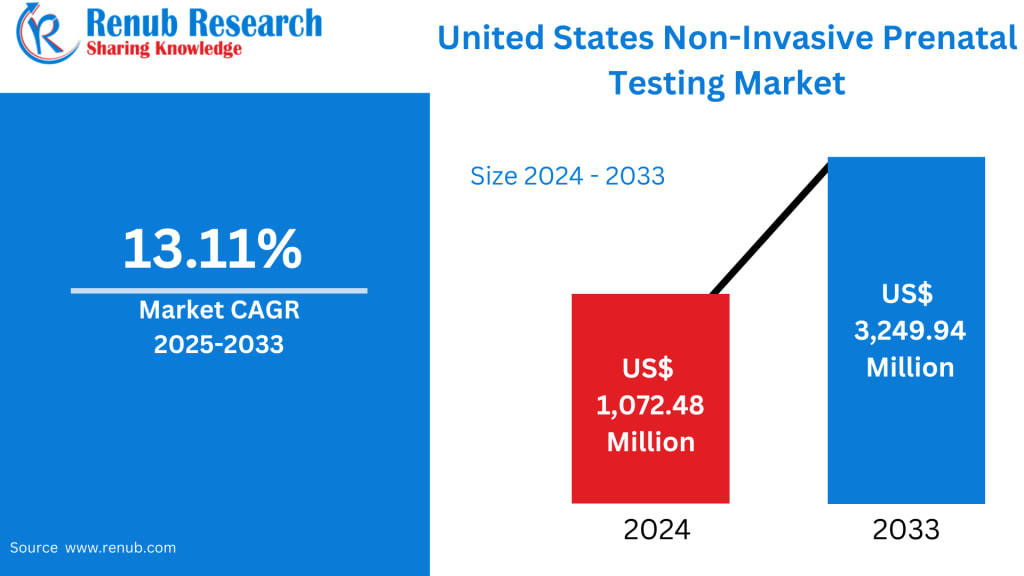
The United States non-invasive prenatal testing (NIPT) market is experiencing rapid transformation as advances in genomic science reshape prenatal care standards. According to Renub Research, the market is expected to reach US$ 3,249.94 million by 2033, growing from US$ 1,072.48 million in 2024, at a strong CAGR of 13.11% from 2025 to 2033.
Non-invasive prenatal testing has emerged as a preferred screening method for detecting chromosomal abnormalities early in pregnancy. Unlike traditional diagnostic procedures such as amniocentesis or chorionic villus sampling (CVS), NIPT requires only a simple maternal blood draw, significantly reducing risks to both the mother and fetus. By analyzing cell-free fetal DNA (cfDNA) circulating in maternal blood, NIPT delivers highly accurate results for conditions such as Down syndrome (Trisomy 21), Edwards syndrome (Trisomy 18), and Patau syndrome (Trisomy 13).
The U.S. market has benefited from strong clinical acceptance, increasing public awareness, favorable reimbursement policies, and continuous improvements in next-generation sequencing (NGS) and bioinformatics technologies. As prenatal care becomes more patient-centric and preventive in nature, NIPT is increasingly being positioned as a first-line screening tool for all pregnancies rather than a test reserved solely for high-risk cases.
Growing Acceptance of NIPT in U.S. Clinical Practice
One of the most significant shifts in the United States prenatal diagnostics landscape is the widespread acceptance of NIPT by healthcare professionals. Major medical bodies, including the American College of Obstetricians and Gynecologists (ACOG), now recommend NIPT as a first-line screening option for all pregnant women, regardless of age or risk status.
This recommendation reflects growing confidence in the test’s clinical accuracy and reliability. Early detection allows families and physicians to make informed medical decisions, plan interventions, and access appropriate counseling services. As a result, NIPT has become an integral part of routine prenatal care in hospitals, obstetrics clinics, and diagnostic laboratories across the country.
Down Syndrome Segment Dominates Market Demand
Among all applications, Down syndrome (Trisomy 21) continues to account for the largest share of the U.S. NIPT market. The condition remains the most common chromosomal abnormality diagnosed in the country.
According to data from the National Center on Birth Defects and Developmental Disabilities, approximately 6,000 babies are born with Down syndrome in the U.S. each year, representing roughly 1 in every 700 births. The rising average maternal age and growing awareness of prenatal screening options have further increased testing volumes.
Expectant parents increasingly prefer NIPT for Down syndrome screening because of its high sensitivity and low false-negative rates. Early diagnosis also enables families to prepare emotionally, financially, and medically, contributing to the sustained growth of this application segment throughout the forecast period.
Growth Drivers for the United States Non-Invasive Prenatal Testing Market
Improved Reimbursement Policies
Expanded insurance coverage has played a crucial role in accelerating NIPT adoption in the United States. Both Medicaid programs and private commercial insurers now reimburse NIPT for a broader patient population, significantly lowering out-of-pocket expenses for expectant mothers.
Previously, cost constraints limited NIPT access primarily to high-risk pregnancies. However, evolving reimbursement frameworks have democratized access, allowing more women to benefit from early and accurate genetic screening. As healthcare payers continue to recognize the long-term cost savings associated with early detection and reduced invasive procedures, reimbursement support for NIPT is expected to strengthen further.
Increased Awareness and Professional Recommendations
Public education campaigns, physician advocacy, and updated clinical guidelines have greatly increased awareness of NIPT’s advantages. Obstetricians now routinely discuss NIPT with patients during early prenatal visits, making it a standard option rather than a specialized test.
This cultural shift has normalized genetic screening as a proactive healthcare decision. Pregnant women today are more informed about chromosomal conditions and increasingly prioritize safe, non-invasive diagnostic options, driving consistent demand across the U.S. healthcare system.
Safety and Non-Invasive Nature
The non-invasive nature of NIPT remains one of its strongest selling points. Unlike invasive diagnostic tests, NIPT carries no risk of miscarriage, making it especially appealing to women concerned about pregnancy complications.
This safety profile has been a decisive factor in adoption, particularly among women with previous pregnancy losses, advanced maternal age, or heightened anxiety regarding invasive procedures. As safety continues to influence healthcare decision-making, NIPT’s role in prenatal care is expected to expand even further.
Challenges in the United States Non-Invasive Prenatal Testing Market
Regulatory Oversight and False Results
Despite its benefits, the NIPT market faces challenges related to regulatory oversight. Many NIPT assays are classified as laboratory-developed tests (LDTs) and do not undergo direct approval by the U.S. Food and Drug Administration (FDA).
While overall accuracy rates are high, false positives can occur, potentially leading to emotional distress and unnecessary follow-up procedures. The absence of standardized regulatory frameworks has raised concerns about consistency, test validation, and patient confidence. Addressing these regulatory gaps will be critical to sustaining long-term trust in NIPT technologies.
Ethical and Social Implications
The widespread adoption of NIPT also raises complex ethical and societal questions. Early detection of genetic abnormalities can influence decisions related to pregnancy continuation, prompting debates around selective termination and genetic discrimination.
Additionally, interpreting genetic results can be emotionally challenging for expectant parents, underscoring the need for comprehensive genetic counseling services. As NIPT becomes more advanced and capable of identifying a broader range of conditions, ethical considerations will remain a central topic in prenatal healthcare discussions.
United States Non-Invasive Prenatal Testing Market News
May 2024:
Natera, Inc., a global leader in cell-free DNA testing, launched a cfDNA-based fetal RhD test designed to address the critical shortage of Rho(D) immune globulin (RhIg) in the United States. The test enables clinicians to determine fetal RhD status as early as nine weeks of gestation using maternal blood samples.
This innovation supports more targeted use of RhIg treatments and incorporates advanced analysis of complex RhD-CE-D hybrid variants, reinforcing Natera’s leadership in prenatal genetic diagnostics.
United States Non-Invasive Prenatal Testing Market Segmentation
By Component
Instruments
Kits and Reagents
Services
By Application
Down Syndrome (Trisomy 21)
Edwards Syndrome (Trisomy 18)
Patau Syndrome (Trisomy 13)
Turner Syndrome
Other Applications
By End User
Hospitals
Diagnostic Laboratories
Competitive Landscape and Company Analysis
The U.S. NIPT market is moderately consolidated, with leading players focusing on technological innovation, test accuracy, expanded test menus, and strategic collaborations. Companies are investing heavily in sequencing platforms, AI-driven data interpretation, and physician education initiatives.
Key Companies Covered
Eurofins Scientific
F. Hoffmann-La Roche Ltd
Invitae Corporation
Illumina Inc.
Natera Inc.
Centogene NV
Qiagen
Each company is analyzed based on:
Business overview
Key leadership
Recent developments and strategies
Financial performance and market positioning
Final Thoughts
The United States non-invasive prenatal testing market is entering a decisive growth phase, supported by clinical validation, favorable reimbursement environments, and increasing patient awareness. With a projected market value exceeding US$ 3.24 billion by 2033, NIPT is set to redefine prenatal care standards across the country.
While regulatory and ethical challenges remain, continued innovation, transparent clinical practices, and expanded genetic counseling services will be key to addressing these concerns. As technology evolves and healthcare systems increasingly prioritize early, safe, and accurate diagnostics, NIPT will remain at the forefront of prenatal screening in the United States.
About the Creator
Renub Research
Renub Research is a Market Research and Consulting Company. We have more than 15 years of experience especially in international Business-to-Business Researches, Surveys and Consulting. Call Us : +1-478-202-3244
Keep reading
More stories from Renub Research and writers in Longevity and other communities.
UAE Non-Invasive Prenatal Testing Market Size & Forecast 2025–2033
UAE Non-Invasive Prenatal Testing Market Outlook The UAE Non-Invasive Prenatal Testing (NIPT) Market is witnessing strong and sustained growth as the country continues to modernize its healthcare infrastructure and prioritize maternal and fetal health. According to Renub Research, the UAE NIPT market is expected to reach US$ 64.46 million by 2033, rising from US$ 21.04 million in 2024, registering an impressive CAGR of 13.25% from 2025 to 2033.
By Renub Research24 days ago in Longevity
Day 4 of Quitting
If this is how sobriety feels, maybe it’s better to go through life a little buzzed… this, along with other hits like, I want to kill myself, I wish I was dead, and I’m going to throw myself off a bridge have been the only thoughts on rotation these past few days. I promise myself that if, in a month, I still feel like this (‘this’ meaning despondent, full of rage, and simultaneously numb) I can go back to smoking. Until mid-February though? Nicotine is off the table.
By sleepy drafts4 days ago in Longevity
North America Gas Chromatography Market Size and Forecast 2025–2033
Introduction: Precision at the Heart of Modern Industry Gas chromatography (GC) has long stood as one of the most reliable analytical techniques in modern science. From detecting trace contaminants in food and water to ensuring pharmaceutical purity and monitoring industrial emissions, GC systems operate behind the scenes of countless safety, compliance, and research processes. As North America intensifies its focus on regulatory oversight, advanced research, and sustainability, the relevance of gas chromatography continues to expand.
By Janine Root a day ago in Longevity
Center Stage with Gina C.
*** I'm keen to republish the interviews I did for my series with Vocal creators. It's been a few years and I thought it might be nice to revisit these wonderful conversations. I'll be releasing them one at a time for a few weeks/months.
By Heather Hubler5 days ago in Interview



Comments
There are no comments for this story
Be the first to respond and start the conversation.