
United States Dialysis Market Size & Forecast 2025–2033
Rising Renal Disease Burden, Home Dialysis Expansion, and Technology Innovation Shape the Future of Kidney Care in America

United States Dialysis Market Overview
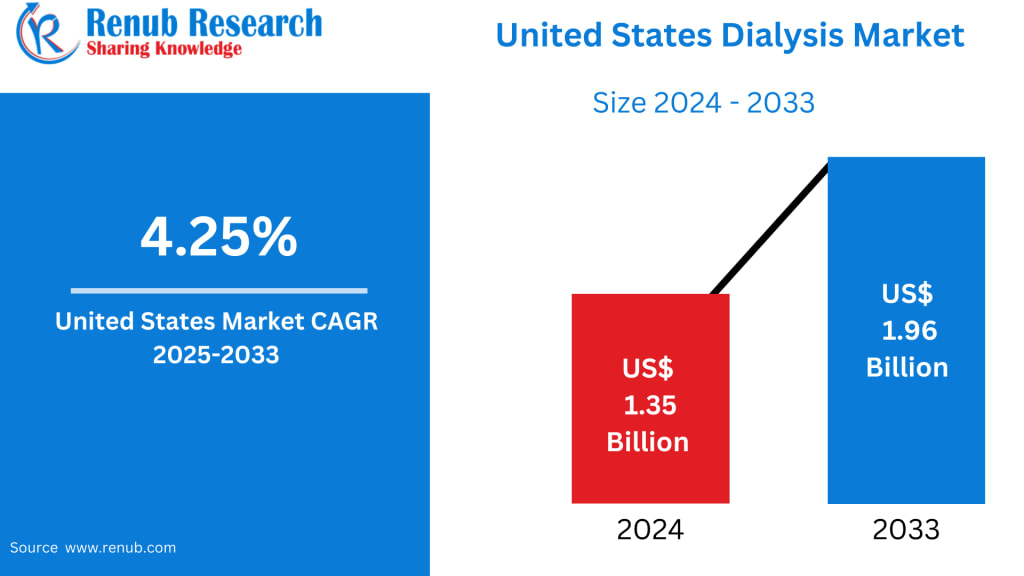
The United States Dialysis Market is entering a phase of sustained and resilient growth as the country grapples with a rising burden of kidney-related disorders and an aging population requiring long-term renal care. According to Renub Research, the market is projected to expand from US$ 1.35 Billion in 2024 to US$ 1.96 Billion by 2033, registering a Compound Annual Growth Rate (CAGR) of 4.25% during 2025–2033.
Dialysis remains a life-sustaining therapy for individuals whose kidneys are no longer able to adequately filter waste and excess fluids from the bloodstream. In the U.S., dialysis plays a critical role in managing chronic kidney disease (CKD) and end-stage renal disease (ESRD), conditions that are increasing due to diabetes, hypertension, obesity, and longer life expectancy.
With nearly half a million Americans dependent on dialysis, the sector has become an indispensable component of the national healthcare infrastructure, supported by Medicare reimbursement, private insurance coverage, and continuous innovation in medical technology.
United States Dialysis Market Outlook
Dialysis functions as an artificial replacement for kidney function, helping regulate electrolyte balance, remove toxins, and prevent fluid overload in patients with kidney failure. In the U.S., dialysis is most commonly used by ESRD patients who either await kidney transplantation or are not eligible for one.
There are two primary dialysis modalities:
Hemodialysis, which uses a machine and dialyzer to cleanse blood and is typically performed in specialized centers multiple times per week.
Peritoneal Dialysis, which relies on the abdominal lining to filter blood and is often performed at home, offering greater patient autonomy.
The U.S. dialysis ecosystem is supported by advanced clinical protocols, robust reimbursement frameworks led by Centers for Medicare & Medicaid Services, and extensive provider networks. As healthcare policy increasingly favors home-based and value-driven care, dialysis delivery models are rapidly evolving.
Key Growth Drivers in the United States Dialysis Market
Rising Incidence of Chronic Kidney Disease and ESRD
The most significant driver of dialysis demand in the United States is the steadily increasing prevalence of CKD and ESRD. Lifestyle-related conditions such as diabetes and hypertension are the leading causes of kidney failure. According to Centers for Disease Control and Prevention, more than 35 million U.S. adults—approximately 1 in 7—are affected by CKD, many of whom remain undiagnosed until advanced stages.
As kidney transplantation remains constrained by donor shortages, dialysis continues to be the primary long-term treatment for most patients. This expanding patient base ensures consistent demand for dialysis services, equipment, consumables, and trained healthcare professionals.
Advancements in Dialysis Technology and Equipment
Technological progress is transforming dialysis care across the United States. Modern hemodialysis machines now offer real-time monitoring, enhanced filtration efficiency, and patient-specific treatment customization. Portable and compact dialysis systems are also gaining traction, enabling safer and more convenient home-based therapy.
Innovations in peritoneal dialysis—including automated cyclers, improved dialysis solutions, and biocompatible materials—are significantly improving patient comfort and reducing infection risks. The integration of telehealth and remote monitoring platforms further enhances treatment adherence and reduces hospital visits.
Research initiatives from leading academic institutions are working toward miniaturized dialysis systems, which could eventually revolutionize renal care by making treatment more accessible, flexible, and patient-centered.
Expansion of Home Dialysis and Favorable Reimbursement Policies
Home dialysis has emerged as one of the fastest-growing segments in the U.S. dialysis market. Federal initiatives and reimbursement reforms actively promote home-based therapies due to their cost-effectiveness and positive patient outcomes.
Under Medicare Part B, 80% of home dialysis-related expenses—including equipment, supplies, and training—are reimbursed, significantly lowering financial barriers. Programs encouraging patient education, caregiver support, and telemonitoring have further accelerated adoption.
Home dialysis allows patients to maintain independence, reduce travel burdens, and experience improved quality of life, aligning perfectly with the shift toward value-based healthcare delivery models.
Challenges Facing the United States Dialysis Market
High Treatment Costs and Economic Pressure
Despite strong reimbursement frameworks, dialysis remains one of the most expensive chronic therapies in the U.S. Healthcare system. Treatment requires frequent sessions, advanced machinery, consumables, pharmaceuticals, and specialized staffing.
Patients often face out-of-pocket expenses not fully covered by insurance, while providers struggle with rising operational costs, facility investments, and workforce compensation. These financial pressures can limit expansion in rural and underserved regions, where access to dialysis services remains uneven.
Workforce Shortages and Facility Capacity Constraints
The dialysis industry depends heavily on trained nephrologists, nurses, and dialysis technicians. However, workforce shortages are becoming increasingly pronounced, particularly in rural and semi-urban areas.
Overburdened facilities face challenges in maintaining care quality, expanding patient education programs, and supporting home dialysis training. Staffing gaps also limit the scalability of innovative care models, making workforce development a critical priority for long-term market sustainability.
United States Peritoneal Dialysis Market
Peritoneal dialysis is gaining momentum across the U.S. due to its convenience, flexibility, and lower infrastructure requirements. Patients can perform treatment at home, often overnight, reducing dependence on dialysis centers.
Technological advancements in automated cyclers and improved dialysis fluids have increased safety and ease of use. While infection risks and training requirements remain challenges, ongoing education initiatives and reimbursement incentives continue to strengthen this segment’s growth outlook.
United States Dialysis Services Market
Dialysis services represent the largest revenue-generating segment of the U.S. dialysis market. In-center hemodialysis continues to dominate, supported by extensive clinic networks and consistent patient volumes.
Leading providers such as DaVita Inc. and Fresenius Medical Care AG & Co. KGaA operate nationwide facilities and offer integrated care models. The adoption of telehealth, patient education programs, and home therapy support is further strengthening service delivery across the country.
United States Dialysis Equipment Market
The dialysis equipment segment is experiencing steady growth due to ongoing innovation and facility modernization. Demand remains strong for hemodialysis machines, peritoneal dialysis cyclers, dialyzers, tubing systems, and vascular access devices.
Companies are investing heavily in R&D to enhance safety, reduce complications, and improve patient comfort. Equipment upgrades are also being driven by reimbursement incentives and hospital infrastructure investments.
United States Home Dialysis Market
Home dialysis is rapidly becoming a cornerstone of the U.S. renal care strategy. Government-led initiatives such as the Advancing American Kidney Health program encourage broader adoption by aligning reimbursement with patient outcomes.
Portable machines, remote monitoring tools, and user-friendly interfaces are making home dialysis safer and more accessible. While training and ongoing support remain essential, this segment is expected to play a pivotal role in the market’s future growth.
State-Level Dialysis Market Insights
California
California leads the U.S. dialysis market due to its large population, high diabetes prevalence, and advanced healthcare infrastructure. The state is also at the forefront of home dialysis adoption and technological innovation.
New York
New York’s dense population and strong hospital networks drive sustained dialysis demand. While operational costs are high, reimbursement support and patient education programs continue to fuel market growth.
New Jersey
New Jersey benefits from proximity to major medical hubs and a growing elderly population. Both in-center and home dialysis services are expanding, supported by Medicare and private insurance coverage.
Market Segmentation
By Type
Peritoneal Dialysis
Hemodialysis
By Product & Services
Services
Equipment
Consumables
Drugs
By End User
Home Dialysis
In-Center Dialysis
By Key States
California, Texas, New York, Florida, Illinois, Pennsylvania, Ohio, Georgia, New Jersey, Washington, North Carolina, Massachusetts, Virginia, Michigan, Maryland, Colorado, Tennessee, Indiana, Arizona, Minnesota, Wisconsin, Missouri, Connecticut, South Carolina, Oregon, Louisiana, Alabama, Kentucky, Rest of the United States
Key Players Analysis
Major companies covered with five viewpoints (Overview, Key Person, Recent Developments, SWOT Analysis, Revenue Analysis):
Asahi Kasei Corporation
B. Braun Melsungen AG
Baxter International Inc.
Becton Dickinson and Company
JMS Co. Ltd.
Medtronic Plc.
Final Thoughts
The United States Dialysis Market is positioned for stable and long-term expansion through 2033, driven by rising kidney disease prevalence, favorable reimbursement policies, and continuous technological advancement. While cost pressures and workforce shortages remain challenges, the shift toward home dialysis, patient-centric care, and innovation-led growth offers a strong foundation for the future.
As renal care becomes increasingly personalized and accessible, dialysis will continue to serve as a vital lifeline for millions of Americans—cementing its role as one of the most critical segments of the U.S. healthcare system.
About the Creator
Diya Dey
Market Analyst
Day 4 of Quitting
If this is how sobriety feels, maybe it’s better to go through life a little buzzed… this, along with other hits like, I want to kill myself, I wish I was dead, and I’m going to throw myself off a bridge have been the only thoughts on rotation these past few days. I promise myself that if, in a month, I still feel like this (‘this’ meaning despondent, full of rage, and simultaneously numb) I can go back to smoking. Until mid-February though? Nicotine is off the table.
By sleepy drafts4 days ago in Longevity
Common pain relievers may raise heart disease and stroke risk, doctors warn
Millions of people worldwide rely on over-the-counter (OTC) pain relievers every day to manage headaches, muscle pain, arthritis, and other ailments. However, recent studies and warnings from medical professionals suggest that frequent use of certain common painkillers may be linked to a heightened risk of heart disease and stroke. These findings have prompted doctors to advise patients to exercise caution, particularly those with pre-existing cardiovascular conditions or risk factors. Understanding Common Pain Relievers Pain relievers, also known as analgesics, come in various forms, including non-steroidal anti-inflammatory drugs (NSAIDs) such as ibuprofen, naproxen, and diclofenac. Acetaminophen (paracetamol) is another widely used painkiller, often considered gentler on the stomach than NSAIDs. While these medications can provide quick relief from discomfort, long-term or high-dose use may carry unintended health consequences. NSAIDs work by blocking enzymes involved in inflammation, thereby reducing pain and swelling. However, the same mechanisms that relieve pain can affect the cardiovascular system. By altering blood vessel function and promoting fluid retention, NSAIDs may increase blood pressure, strain the heart, and elevate the risk of clot formation—all of which can contribute to heart attacks or strokes. What the Research Says Several recent studies have shed light on the cardiovascular risks associated with regular NSAID use. For example, research published in major medical journals indicates that even short-term use of high-dose NSAIDs can slightly increase the risk of heart-related events. The risk grows with long-term, daily use, particularly among people who already have hypertension, diabetes, or a history of heart disease. Acetaminophen, while often considered safer for the heart, is not entirely risk-free. Some studies suggest that high doses over extended periods may affect blood pressure and liver function, indirectly influencing cardiovascular health. Doctors emphasize that dosage and frequency are critical factors, and taking more than the recommended amount can be dangerous. Who Is Most at Risk? While anyone can experience complications from frequent painkiller use, certain populations are particularly vulnerable. Adults over 50, individuals with high blood pressure, those with a family history of heart disease, and people with metabolic conditions such as diabetes are at heightened risk. Dr. Linda Thompson, a cardiologist at a leading U.S. hospital, explains: “Many patients underestimate the cardiovascular impact of medications they take for pain. People think, ‘It’s just ibuprofen, it’s safe.’ But repeated, long-term use can quietly increase the risk of heart attacks and strokes.” Practical Advice from Doctors Medical professionals urge patients not to panic but to be mindful of their painkiller use. Key recommendations include: Follow Dosage Guidelines: Always adhere to the instructions on the packaging or as prescribed by your doctor. Avoid exceeding recommended doses. Limit Duration: Avoid taking painkillers for extended periods unless advised by a healthcare provider. For chronic conditions, discuss safer long-term strategies. Monitor Cardiovascular Health: Regular blood pressure checks, cholesterol monitoring, and periodic heart evaluations are crucial for anyone who uses NSAIDs frequently. Consider Alternatives: Physical therapy, acupuncture, lifestyle changes such as weight management and exercise, and other non-drug interventions can reduce reliance on painkillers. Consult a Doctor: Before combining pain relievers with other medications or if you have existing heart conditions, seek professional guidance. The Importance of Awareness Public awareness about the cardiovascular risks associated with common pain relievers is limited. Many people take these drugs casually, assuming that over-the-counter availability equals safety. However, as Dr. Thompson notes, “Accessibility doesn’t guarantee harmlessness. Awareness is the first step in preventing serious complications.” Healthcare providers are also working to educate patients on the importance of individualized treatment plans. Some patients may benefit from alternating medications or using lower doses intermittently, reducing cumulative risk. Pharmacists play a role too, offering advice on safer options and potential interactions. Looking Ahead While painkillers remain essential tools for managing discomfort, ongoing research underscores the need for cautious use. The emerging data on cardiovascular risks highlights that what is convenient today may carry hidden consequences tomorrow. By understanding these risks, following medical guidance, and exploring alternative pain management strategies, patients can protect both their immediate well-being and long-term heart health. Conclusion The widespread use of common pain relievers comes with unexpected dangers. Doctors warn that NSAIDs and other analgesics, when used frequently or in high doses, can elevate the risk of heart disease and stroke. Awareness, moderation, and professional guidance are key to using these medications safely. As more research continues to emerge, it becomes increasingly clear that effective pain management requires a balance between relief and long-term health considerations.
By Fiazahmedbrohi 5 days ago in Longevity




Comments
There are no comments for this story
Be the first to respond and start the conversation.