
The Silence of Nature: How Technology Is Muting the World Around Us
The hum of machines and constant notifications are drowning out the earth’s oldest music — silence itself.
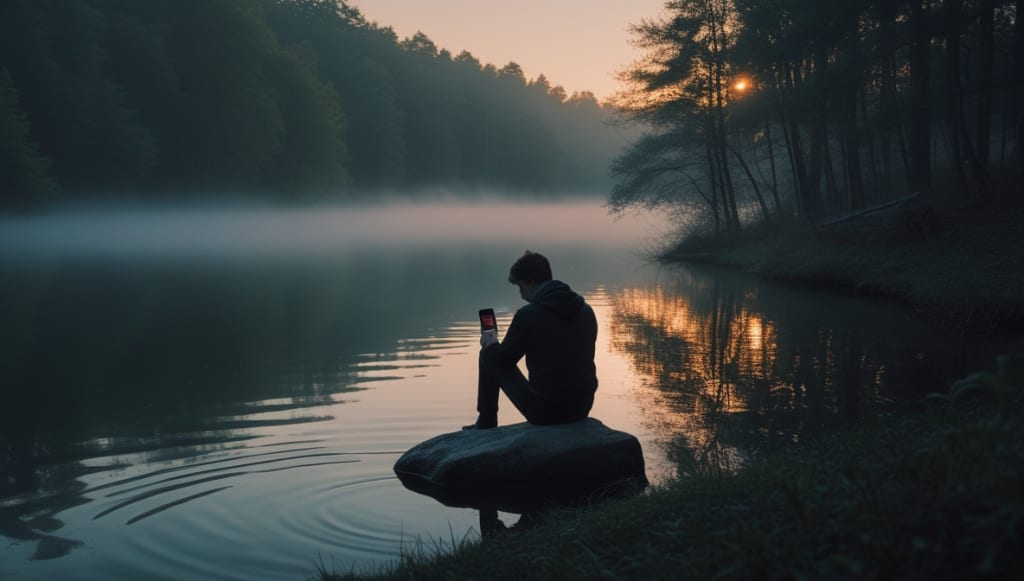
There was a time when quiet wasn't thought of as a luxury. Entering the woods, you could hear the wind rushing through the leaves, the faraway cry of a bird, or maybe the faint noise of water pouring over boulders. That sensation of calmness is uncommon these days, even in the most quiet places on Earth. Above, aeroplanes produce a noise. Mobile devices buzz in our pockets. Cars, drones, and electric barriers all generate perpetual background noise. Real quiet, the kind that allows you to actually interact with the world, has all but disappeared as we have enclosed ourselves with so many noises.
Noise used to be considered mostly an urban issue. It is everywhere now. From the dull hum of far-off powerlines to the faint static of our online contacts, technology penetrates every area of our surroundings. Our bodies and minds are nonetheless rather conscious even if most people are no longer conscious of it. Even though scientists call it noise pollution, it hardly characterizes all we lose. It's not only the absence of sound that is dwindling. It's the feeling of belonging, calm, and connection to anything outside of our own lives.
Vanishing Sound Environment
Stated acoustic ecologist Gordon Hempton once, silence is an endangered species. His argument is sound. Decades he has spent gathering natural sound landscapes ranging from rainforests to deserts; in the United States, he has discovered Less than ten places in the world now allow ten minutes of continuous natural calm.
Nature has not been quiet; our equipment is always producing noise. Vehicles generate a constant hum that might go across considerable distances. Cell towers' low mechanical noise is barely audible. Even in the furthest reaches of national parks, guests carry drones and Bluetooth speakers. This produces a global ongoing coating of artificial noise.
This too has consequences. Birds adjust their songs to make themselves heard over motors. Whales change their migratory patterns to stay off shipping lanes. Trees too respond to vibrations and exhibit signs of distress when often exposed to people. Turns out silence has ecological worth in addition to being a poetic notion.
The Noise Within
Still, our loss of serenity is not only physical. It is also inside. Every message, ping, or alarm draws some of our focus. Research shows that a typical person examines their phone 150 times daily. Many people are now trapped in a loop of little diversions, a continual mental noise that reflects the outside world's turbulence.
When was your last motionless sitting devoid of any audio equipment, podcasts, or musical accompaniment? These days, even relaxation looks insufficient without ambient sounds. We now feel uneasy at quiet since we have come to expect constant exhilaration. Once a center of regeneration, it now seems like a void we are rushing to fill.
Still, thinking happens in that space, in those times of quiet. That's when creativity bursts out. Emotions are very important. Without quiet, we lose our own voice as well as that of nature.
The Duality of Technological Progress
It is natural to point the finger at technology, yet it is not the foe. We created devices to improve our life, make it more convenient, secure, and quicker. Air conditioning is vital for survival in heat waves. While electric cars help to reduce pollution, smartphones let families stay in touch even across great distances. The real challenge is finding equilibrium, not the technology itself.
We have lost sight of the reality that life is not meant to run on continuous energy in our search for a society that never stops. Among the rhythms of nature are rise and fall, expansion and rest, night and day. The gap between life's motions as well as the absence of life define silence; it also does so.
Consider whether our technology was conceived with those patterns in mind. Automobiles that turn off entirely in parks. Apps that promote moments of peace instead of unrelenting participation and equipment that nightly automatically lowers and silences itself. Should we decide to heed that summons, the same ingenuity that populated our world with noise might also assist us in reclaiming calm.
The Return to Quiet
Some people are already acting. Many countries are creating silent parks, which safeguard the fauna and the noise as well. Visitors should switch off their devices and only listen. One travel to these locations is described as fantastic as it shows you that silence is not nothing. It is abundant, however, with the heartbeat of the earth, remote thunder, and rustling leaves.
But you don't need to go far to experience solitude. First of all, let your mobile phone at home as you go for a walk. While driving, switch off the entertainment. Positioning yourself next to an open window, count the noises created by nature instead of those generated by technology. The beginning might appear odd. A change happens progressively. The mind is pacified. The body unwinds. You start to recall the actual tone of calm.
Although the din of the equipment is unavoidable, silence has not disappeared; instead, it is ready just beneath the surface. We just have to stop and listen one more time.
About the Creator
Keep reading
More stories from Shahjahan Kabir Khan and writers in Longevity and other communities.
The Age of Biohacking: Are We Becoming Our Own Experiments?
Once mostly based on labs featuring microscopes, white coats, and significant financial support, scientific efforts now focus on natural settings. Nowadays, these events occur everywhere: in living areas, in workshops, and even in the bodies of individuals. People in the biohacking era merge the realms of self-improvement and self-testing by behaving both as the subjects of their own research and as the investigators.
By Shahjahan Kabir Khan3 months ago in Longevity
Day 4 of Quitting
If this is how sobriety feels, maybe it’s better to go through life a little buzzed… this, along with other hits like, I want to kill myself, I wish I was dead, and I’m going to throw myself off a bridge have been the only thoughts on rotation these past few days. I promise myself that if, in a month, I still feel like this (‘this’ meaning despondent, full of rage, and simultaneously numb) I can go back to smoking. Until mid-February though? Nicotine is off the table.
By sleepy drafts11 days ago in Longevity
So You Decided To Become a Nurse Practitioner:
So you decided to become an "Advanced Practice" nurse. Congratulations!... is what I would say if this was a good idea. Grad school? In this economy? What were you thinking? Likely it was something along the lines of either 1) “I've seen these other chucklefucks do it— Why can't I?” or even 2) “I've got a nice career, I should shake it up. I miss feeling like I have no clue what I'm doing.”
By Sandor Szaboa day ago in Fiction



Comments
There are no comments for this story
Be the first to respond and start the conversation.