
The Hidden Health Benefits of Having Your Home Professionally Cleaned
Having Your Home Professionally Cleaned

You know that feeling when you walk into a freshly cleaned space? There’s something about it that makes you take a deeper breath without even realizing it. But here’s the interesting part—cleanliness doesn’t just feel good. Research shows it actually affects your health in very real ways.
A clean home isn’t only about how things look. It quietly shapes how you breathe, sleep, think, and function every day.
The Air You’re Breathing Right Now
Take a moment to think about this: most of us spend around 90% of our time indoors, according to the Environmental Protection Agency. That makes the air inside your home incredibly important.
Dust isn’t just harmless debris on shelves and furniture. Research published in Environmental Science & Technology shows that household dust contains chemicals, allergens, and microscopic organisms. And those dust mites people talk about? They’re real—and common. The American College of Allergy, Asthma, and Immunology estimates that about 20 million Americans are allergic to them.
Regular vacuuming with a HEPA-filter vacuum has been shown to reduce airborne particles by up to 50%. The key is consistency and reaching areas that are often ignored, like air vents, ceiling fans, and baseboards.
Finally Getting Relief from Allergies
If you’ve ever woken up sneezing or congested for no clear reason, your home environment could be the cause. Pollen gets tracked inside on shoes and clothing. Pet dander lingers in the air. Moist areas can encourage mold growth.
A study in the Journal of Allergy and Clinical Immunology followed people who focused on thorough cleaning—using HEPA vacuums, washing bedding in hot water, and reducing clutter. After 12 weeks, participants reported noticeably fewer allergy symptoms. It wasn’t a cure—it was simply removing what was triggering their reactions.
The CDC also warns that mold exposure can cause respiratory problems and worsen asthma, particularly in children and older adults. Keeping moisture under control and addressing mold early is essential.

The Truth About Germs in Your Home
Here’s something most people don’t love hearing: studies by NSF International found that kitchen sponges, sinks, and cutting boards often contain more germs than toilet seats.
At the same time, not all bacteria are harmful. Many scientists believe modern homes can be over-sanitized, especially for children. The goal isn’t a sterile environment—it’s smart, balanced hygiene.
What Clutter Does to Your Brain
There’s a reason clutter feels stressful. A study published in Personality and Social Psychology Bulletin found that women who described their homes as cluttered had higher levels of cortisol, the body’s main stress hormone, throughout the day.
Some research even suggests that simple cleaning tasks—like washing dishes mindfully—can reduce nervousness and improve mental clarity. In many cases, cleaning itself becomes calming.
Why You Sleep Better in Clean Sheets
The National Sleep Foundation found that people who make their beds every morning are 19% more likely to report good sleep. Those who sleep in clean, fresh-smelling bedrooms also tend to rest better.
A study in the Indoor Air journal showed a connection between bedroom dust levels and sleep quality. Less dust was associated with better rest.
Dust and allergens in the bedroom can lead to congestion, coughing, and disrupted sleep—often without people realizing what’s causing it.
Keeping Everyone Safe from Falls
According to the CDC, one in four adults aged 65 and older falls each year, and many of these accidents happen at home.
Cluttered walkways, spills that aren’t cleaned up right away, and obstacles on floors increase the risk. Regular cleaning keeps floors clear and hazards easier to spot. This is just as important in homes with children, where cleaning helps prevent exposure to dangerous items.
Your Skin and the Surfaces Around You
Your skin comes into constant contact with your home—bedding, towels, furniture, and clothing. Dermatologists point out that dirty fabrics and surfaces can trap bacteria that contribute to acne, rashes, and irritation.
A study in JAMA Dermatology found that pillowcases collect oils, dead skin cells, and bacteria over time, which can worsen acne in people who are prone to breakouts. Washing linens regularly in hot water makes a noticeable difference.
The Bigger Picture: Stress and Heart Health
Chronic stress affects more than just mood. The American Heart Association notes that long-term stress contributes to high blood pressure, inflammation, and increased heart disease risk.
While a clean home won’t prevent heart disease on its own, reducing daily stress does support overall health. Cleaning also provides light physical activity. Research published in BMC Public Health found that people who regularly did housework showed better physical health markers than those who didn’t.
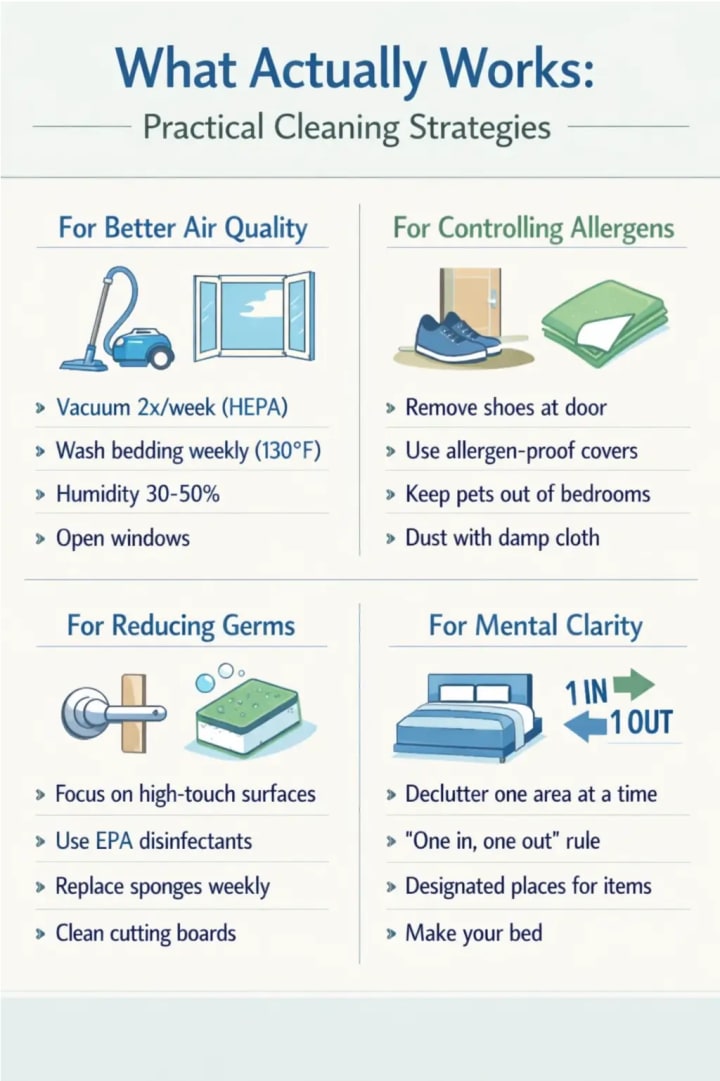
What Actually Works: Practical Cleaning Strategies
You don’t need expensive products or extreme routines. Research shows that a few simple habits go a long way.
For better air quality
Vacuum at least twice a week using a HEPA-filter vacuum. Wash bedding weekly in hot water—at least 130°F. Keep indoor humidity between 30% and 50% to prevent mold. Open windows regularly to let fresh air circulate.
For controlling allergens
Remove shoes at the door to avoid tracking in pollen. Use allergen-proof mattress and pillow covers. Keep pets out of bedrooms. Dust with a damp cloth instead of dry dusting, which spreads particles into the air.
For reducing germs
Focus on high-touch surfaces like doorknobs, light switches, faucets, and cabinet handles. Use EPA-approved disinfectants and follow label instructions carefully. Replace kitchen sponges weekly or disinfect them daily. Clean cutting boards thoroughly after handling raw meat.
For mental clarity
Declutter one area at a time. Use the “one in, one out” rule. Create designated places for everyday items. Make your bed each morning as a simple way to start the day with a sense of order.
When It Makes Sense to Get Help
Most homes do well with regular cleaning, but professional help can be useful after illness, renovations, or long periods of buildup. It’s also helpful for households dealing with serious allergies, mold concerns, or busy schedules where deep cleaning keeps getting delayed.
Professional cleaners use commercial-grade equipment and proper disinfection techniques that can make a real difference during periodic deep cleans.
Finding the Right Balance
A healthy home doesn’t need to be sterile. Research supports the “hygiene hypothesis,” which suggests that some microbial exposure—especially in childhood—may help support immune development.
Microbiologist Dr. Jack Gilbert, co-author of Dirt Is Good, explains that while basic hygiene prevents disease, over-sanitizing isn’t necessary. Focus on higher-risk areas like kitchens and bathrooms, and accept that a lived-in home will never be microbe-free—and doesn’t need to be.
About the Creator
Day 4 of Quitting
If this is how sobriety feels, maybe it’s better to go through life a little buzzed… this, along with other hits like, I want to kill myself, I wish I was dead, and I’m going to throw myself off a bridge have been the only thoughts on rotation these past few days. I promise myself that if, in a month, I still feel like this (‘this’ meaning despondent, full of rage, and simultaneously numb) I can go back to smoking. Until mid-February though? Nicotine is off the table.
By sleepy drafts15 days ago in Longevity
The great race for the Arctic: Why Russia, China and the US all have it in their sights
The Arctic is no longer just a frozen wasteland at the top of the world. Today, it has become a hotspot for global competition, attracting the attention of some of the world’s biggest powers: Russia, China, and the United States. As melting ice opens new shipping routes and exposes untapped natural resources, these nations are racing to secure influence in a region that could shape the future of geopolitics, trade, and energy. Why the Arctic Matters The Arctic is important for several reasons: Natural Resources – The region contains vast oil and gas reserves, as well as rare minerals crucial for modern technology. Experts estimate that the Arctic could hold 13% of the world’s undiscovered oil and 30% of its natural gas. Shipping Routes – As ice melts due to climate change, new passages like the Northern Sea Route and the Northwest Passage are becoming navigable. These routes could cut travel time between Asia and Europe by weeks, offering major economic advantages. Military and Strategic Positioning – The Arctic provides a unique vantage point for monitoring global military activity. Control over the region could give nations strategic leverage in both defense and trade. The combination of resources, strategic position, and new shipping routes has made the Arctic a prize worth competing for. Russia’s Arctic Ambitions Russia has been the most active player in the Arctic for decades: It has expanded its military presence, building airfields, radar stations, and icebreakers. Russia controls a vast portion of the Arctic coastline, giving it the advantage of established ports and infrastructure. Energy companies backed by the state are investing heavily in oil, gas, and mineral extraction in the region. Russia sees the Arctic as both an economic opportunity and a security priority. Its actions signal a clear intention to assert dominance over the region before other powers can catch up. China’s Arctic Strategy China is not an Arctic nation by geography, but it has made its ambitions clear: Beijing calls itself a “Near-Arctic State”, emphasizing its interest in shipping and resource access. China is investing in scientific research, Arctic ports, and partnerships with Arctic nations. The country sees the Northern Sea Route as a potential shortcut for trade between Asia and Europe, which could reduce shipping costs and fuel consumption. China’s approach is more economic and diplomatic, relying on partnerships and research projects rather than direct territorial claims. Still, its growing presence is reshaping the Arctic’s geopolitical landscape. The United States in the Arctic The US has long been an Arctic power, primarily through Alaska. Its strategy focuses on defense, environmental monitoring, and trade routes: The US Coast Guard maintains icebreakers and patrol ships to ensure security and maintain shipping lanes. Washington emphasizes freedom of navigation, aiming to prevent any single nation from dominating Arctic waters. Military exercises and collaborations with NATO allies aim to protect strategic interests and respond to potential conflicts. The US sees the Arctic as a region of both opportunity and responsibility, balancing security, environmental concerns, and international cooperation. The Race for Control The Arctic race is about more than natural resources. It is a complex competition of economics, diplomacy, and military positioning: Russia moves aggressively, building military infrastructure and exploiting resources. China invests in research, shipping, and partnerships, gaining influence without formal territorial claims. The US maintains a defensive posture, securing its territory and ensuring freedom of navigation. This “race” is unlike traditional conflicts. It is less about open warfare and more about strategic positioning, economic investment, and diplomatic influence. Environmental and Global Concerns The Arctic is fragile and sensitive to climate change. While melting ice opens opportunities, it also poses risks to wildlife, local communities, and global weather patterns: Rising temperatures accelerate ice melt, threatening polar bears, seals, and indigenous communities. Increased shipping and resource extraction could lead to oil spills, pollution, and habitat loss. Global climate patterns, including storms and ocean currents, could be disrupted by rapid Arctic changes. Nations are under pressure to balance ambition with environmental responsibility, though economic incentives often outweigh conservation efforts. What This Means for the Future The Arctic is likely to remain a geopolitical hotspot for decades. Key developments to watch include: Expansion of shipping routes that shorten travel times and reduce costs. Increased resource extraction, including oil, gas, and rare minerals. Rising military presence, as countries protect their interests and assert sovereignty. Scientific research collaborations, which could shape policy and environmental practices. The Arctic will not just be a frozen frontier — it will be a center of economic, strategic, and environmental importance. Key Takeaways The Arctic is valuable for its resources, trade routes, and strategic position. Russia, China, and the US are all investing heavily to secure influence. The race is a mix of military, economic, and diplomatic maneuvering. Climate change both enables and threatens these ambitions. How nations navigate this competition will impact global trade, security, and the environment. Conclusion The Arctic is no longer just an icy, remote region — it has become a frontline of global strategy. Russia, China, and the United States are all jockeying for influence, using a combination of military, economic, and scientific tools. As ice melts and new opportunities emerge, the Arctic will play a critical role in global geopolitics. How these powers manage competition, environmental responsibility, and cooperation could shape the region — and the world — for generations to come. The great race for the Arctic is not a story of war, but a story of ambition, strategy, and survival at the top of the world.
By Fiaz Ahmed about 23 hours ago in Longevity




Comments
There are no comments for this story
Be the first to respond and start the conversation.