
Radiation Dose Management Market Trends & Summary (2025–2033)
Rising Imaging Volumes, Stricter Safety Regulations, and Smart Technologies Accelerate Global Adoption of Radiation Dose Management Solutions

Introduction
The global healthcare ecosystem is undergoing a rapid transformation, driven by advanced diagnostic technologies, patient-centric care models, and stringent regulatory oversight. Among these developments, radiation dose management (RDM) has emerged as a critical component of modern radiology and medical imaging practices. With diagnostic imaging volumes increasing worldwide, concerns around patient and staff exposure to ionizing radiation have intensified. As a result, healthcare providers are increasingly turning to radiation dose management solutions to ensure safety, compliance, and quality care.
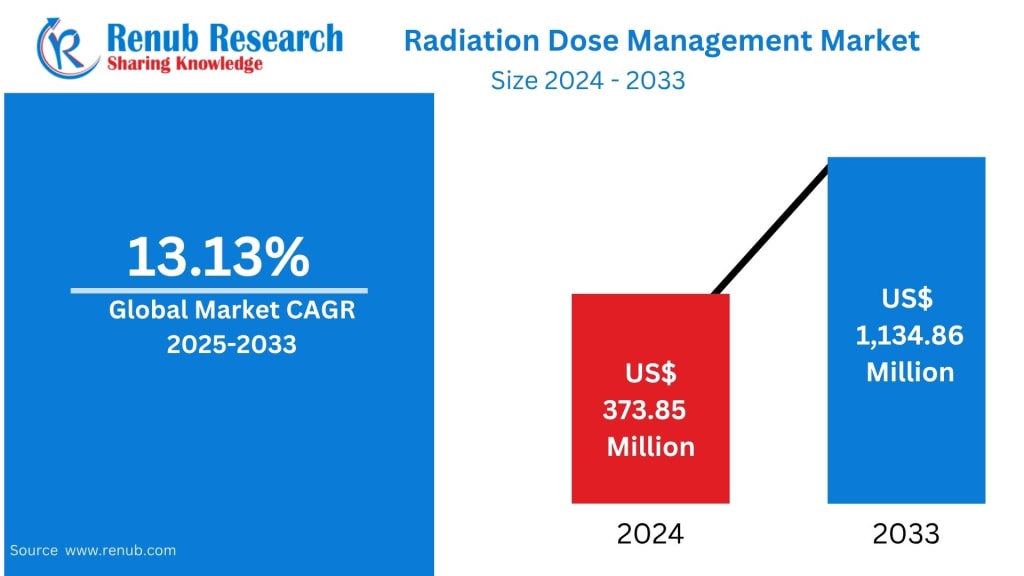
According to Renub Research, the Radiation Dose Management Market is expected to grow from US$ 373.85 million in 2024 to US$ 1,134.86 million by 2033, registering a robust CAGR of 13.13% from 2025 to 2033. This strong growth trajectory reflects rising awareness of radiation risks, expanding imaging procedures, and continuous innovation in dose optimization technologies.
Global Radiation Dose Management Industry Overview
Radiation dose management refers to medical systems and software solutions designed to monitor, control, optimize, and document radiation exposure during diagnostic and interventional imaging procedures. These systems collect and analyze radiation dose data from modalities such as computed tomography (CT), fluoroscopy, mammography, and nuclear medicine. They enable healthcare professionals—including radiographers, radiologists, physicians, and medical physics experts—to make informed decisions that balance diagnostic image quality with patient safety.
Radiation dose management platforms facilitate real-time dose monitoring, historical dose tracking, statistical benchmarking, automated reporting, and quality control. By streamlining data collection and analysis, these solutions reduce the manual workload associated with dose documentation while improving regulatory compliance. Consequently, RDM systems are now widely deployed across hospitals, imaging centers, and research institutions to minimize unnecessary radiation exposure.
Key Market Drivers
Growing Use of Diagnostic Imaging Modalities
One of the most significant drivers of the radiation dose management market is the rapid global adoption of diagnostic imaging technologies. CT scans, X-rays, PET scans, and fluoroscopy procedures generate massive volumes of radiation exposure data. Radiation dose management systems enable healthcare providers to collect, consolidate, and analyze this data efficiently, ensuring safer imaging practices.
In particular, the expanding use of CT scans has amplified the demand for dose monitoring solutions. In the United States alone, more than 80 million CT scans are performed annually, highlighting the scale at which radiation safety measures are required. As imaging utilization continues to grow, so does the need for robust dose management infrastructure.
Integration of Artificial Intelligence (AI) and IoT
Technological advancements have significantly enhanced the capabilities of radiation dose management systems. The integration of artificial intelligence (AI) and the Internet of Things (IoT) allows for real-time dose tracking, predictive analytics, and automated alerts for dose threshold violations. These innovations enable proactive risk mitigation and continuous improvement in imaging protocols.
AI-powered analytics help identify abnormal dose patterns, optimize imaging parameters, and support evidence-based decision-making. This technological convergence is transforming radiation dose management from a passive reporting tool into an intelligent, safety-driven clinical solution.
Regulatory Guidelines and Patient Safety Initiatives
Patient safety has become a central focus of global healthcare policies. Regulatory bodies such as the International Atomic Energy Agency (IAEA), the European Commission, and national healthcare authorities have introduced stringent guidelines governing the use of ionizing radiation. These regulations mandate dose monitoring, reporting, and optimization to reduce radiation-related risks.
In January 2023, the IAEA updated its safety standards based on findings from the United Nations Scientific Committee on the Effects of Atomic Radiation (UNSCEAR). Such evolving regulatory frameworks are compelling healthcare facilities to adopt radiation dose management systems, thereby accelerating market growth.
Emphasis on Quality Care and Vulnerable Populations
Healthcare providers are increasingly prioritizing high-quality, patient-centered care. Radiation dose management plays a vital role in protecting vulnerable populations, including children, pregnant women, and elderly patients, who are more susceptible to radiation-induced complications. By integrating dose management into routine clinical workflows, healthcare institutions can improve patient outcomes while maintaining diagnostic accuracy.
Technological Advancements in Imaging Techniques
Continuous innovation in medical imaging has led to the development of dose-reduction technologies without compromising image quality. Techniques such as iterative reconstruction algorithms and advanced image processing methods allow radiologists to obtain diagnostic-quality images at lower radiation doses.
Leading industry players are enhancing their software offerings to support these advancements. For instance, in August 2021, Affidea announced the release of GE Healthcare’s DoseWatch version 3.2, featuring enhanced dose monitoring and business intelligence capabilities. Such innovations are reinforcing the adoption of radiation dose management systems worldwide.
Challenges in the Radiation Dose Management Market
High Costs and Infrastructure Limitations
Despite its benefits, the adoption of radiation dose management systems faces economic and infrastructural challenges. The high cost of imaging modalities and dose management software can be prohibitive for smaller hospitals and healthcare facilities, particularly in developing regions.
According to the Iranian Journal of Radiology, the monthly cost of imaging services increased from USD 10,457.5 in 2019 to USD 26,482.2 in January 2023, highlighting rising operational expenses. Additionally, limited healthcare infrastructure in low- and middle-income countries restricts access to advanced imaging technologies.
The World Health Organization (WHO) reported in January 2023 that nearly 1.0 billion people in low- and middle-income nations rely on healthcare facilities with little or no electricity supply, further hindering the deployment of radiation dose management systems.
Limited Awareness and Training
Another major challenge is the lack of awareness and inadequate training among healthcare professionals. Without proper education, radiation dose management solutions may be underutilized or incorrectly implemented. Continuous training programs and educational initiatives are essential to ensure effective integration and maximize the benefits of these technologies.
Regional Market Insights
United States Radiation Dose Management Market
The U.S. market is experiencing steady growth due to high imaging volumes, an aging population, and a strong focus on patient safety. Strict regulations from agencies such as the FDA and IAEA encourage the adoption of dose management systems. While high implementation costs and system integration challenges persist, ongoing technological advancements and regulatory compliance continue to drive market expansion.
Germany Radiation Dose Management Market
Germany’s radiation dose management market is expanding rapidly, supported by advanced healthcare infrastructure and strict adherence to European Union safety standards. Government regulations and IAEA guidelines promote the use of dose optimization technologies. Despite challenges related to high costs and training requirements, the market outlook remains positive.
India Radiation Dose Management Market
India’s market is growing due to increasing demand for diagnostic imaging and rising awareness of radiation safety. Government initiatives and international safety standards are encouraging adoption. However, challenges such as limited infrastructure, high costs, and workforce training needs remain. Nevertheless, continued healthcare expansion is expected to support long-term growth.
United Arab Emirates Radiation Dose Management Market
The UAE market benefits from modern healthcare infrastructure and strong regulatory compliance with international safety standards. Increased medical imaging procedures and government support for patient safety initiatives are driving adoption. Although high costs and skilled workforce requirements pose challenges, the market is poised for sustained growth.
Radiation Dose Management Market Segmentation
By Product & Services:
Radiation Dose Management Solutions
Radiation Dose Management Services
By Modality:
Computed Tomography
Fluoroscopy & Interventional Imaging
Mammography
Nuclear Medicine
By End User:
Hospitals
Ambulatory Care Settings
Others
By Country (23 Markets):
United States, Canada, Germany, United Kingdom, France, Italy, Netherlands, Spain, China, South Korea, Japan, India, Indonesia, Malaysia, Argentina, Brazil, Mexico, Colombia, Saudi Arabia, South Africa, Israel, Australia, and UAE.
Competitive Landscape
The global radiation dose management market features prominent players focusing on innovation, strategic partnerships, and regulatory compliance. Key companies analyzed include:
Bayer AG
Koninklijke Philips N.V.
Thermo Fisher Scientific Inc.
McKesson Corporation
Cerner Corporation
Each company is evaluated across four perspectives: overview, key leadership, recent developments and strategies, and financial insights.
Final Thoughts
The radiation dose management market is positioned for remarkable growth over the next decade, driven by expanding diagnostic imaging volumes, stringent safety regulations, and rapid technological advancements. As healthcare systems worldwide strive to balance diagnostic accuracy with patient safety, radiation dose management solutions are becoming indispensable.
While challenges related to cost, infrastructure, and training persist—particularly in emerging economies—the long-term outlook remains highly positive. With continued innovation, regulatory support, and growing awareness, radiation dose management will play a pivotal role in shaping the future of safe, efficient, and patient-focused medical imaging.
About the Creator
Janine Root
Janine Root is a skilled content writer with a passion for creating engaging, informative, and SEO-optimized content. She excels in crafting compelling narratives that resonate with audiences and drive results.
Keep reading
More stories from Janine Root and writers in Longevity and other communities.
Global Cardiac Bio Implant Devices Market Trends & Summary (2025–2033)
Introduction The global healthcare industry is undergoing a profound transformation, driven by technological innovation, aging populations, and the growing burden of chronic diseases. Among the most dynamic segments within medical technology is the cardiac bio implant devices market, which plays a crucial role in diagnosing, managing, and treating life-threatening cardiovascular conditions. From pacemakers and implantable cardioverter defibrillators (ICDs) to cardiac resynchronization therapy (CRT) devices, cardiac bioimplants have become indispensable tools in modern cardiology.
By Janine Root 28 days ago in Longevity
Day 4 of Quitting
If this is how sobriety feels, maybe it’s better to go through life a little buzzed… this, along with other hits like, I want to kill myself, I wish I was dead, and I’m going to throw myself off a bridge have been the only thoughts on rotation these past few days. I promise myself that if, in a month, I still feel like this (‘this’ meaning despondent, full of rage, and simultaneously numb) I can go back to smoking. Until mid-February though? Nicotine is off the table.
By sleepy drafts5 days ago in Longevity
Neither Swimming Nor Pilates: The Best Activity for People With Knee Pain
Knee pain is one of the most common physical complaints worldwide, affecting people of all ages—from young athletes to older adults. Whether caused by arthritis, old injuries, excess weight, or simple wear and tear, knee pain often leaves people confused about one crucial question: Which exercise is actually safe and effective? While swimming and Pilates are frequently recommended, emerging evidence and expert opinion suggest there is another activity that may be even better for protecting and strengthening painful knees.
By Fiaz Ahmed 3 days ago in Longevity
Center Stage with Gina C.
*** I'm keen to republish the interviews I did for my series with Vocal creators. It's been a few years and I thought it might be nice to revisit these wonderful conversations. I'll be releasing them one at a time for a few weeks/months.
By Heather Hubler5 days ago in Interview


Comments
There are no comments for this story
Be the first to respond and start the conversation.