
Nanosatellite and Microsatellite Market Size and Forecast 2025–2033
Small Satellites, Big Impact: Powering the Next Wave of the Global Space Economy

Global Nanosatellite and Microsatellite Market Outlook
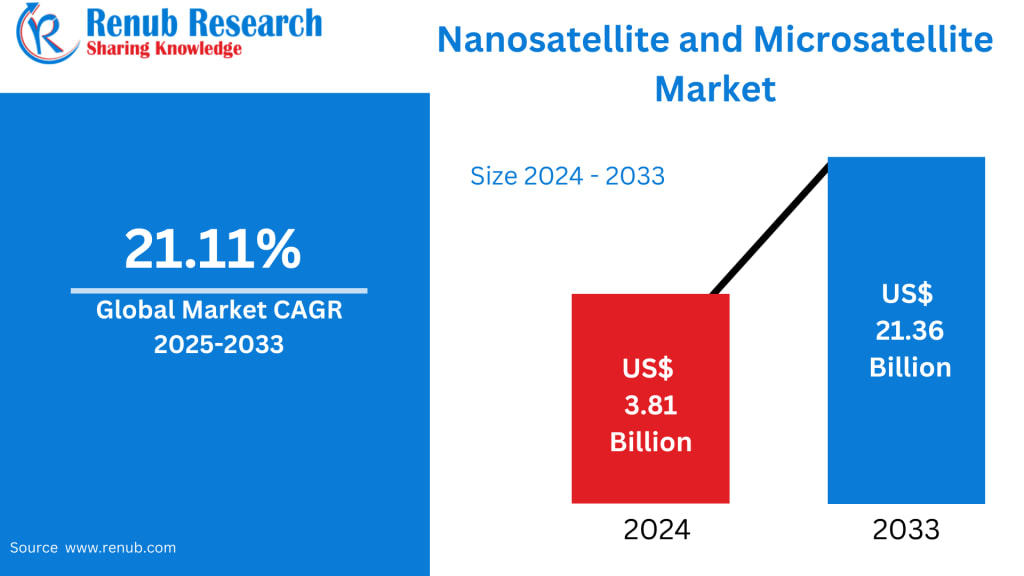
The Nanosatellite and Microsatellite Market is entering a phase of exceptional growth, driven by commercialization, technological miniaturization, and expanding use cases across civil, commercial, and defense domains. According to Renub Research, the market is expected to reach US$ 21.36 billion by 2033, up from US$ 3.81 billion in 2024, registering a robust CAGR of 21.11% from 2025 to 2033.
This remarkable expansion is fueled by the rising demand for cost-efficient satellite missions, the proliferation of Earth observation and remote sensing applications, rapid growth in IoT connectivity, and the increasing participation of private enterprises in the global space ecosystem. Unlike traditional large satellites, nanosatellites and microsatellites offer faster development cycles, lower launch costs, and flexible deployment through constellation-based architectures—making space more accessible than ever before.
Global Nanosatellite and Microsatellite Industry Overview
Nanosatellites—often referred to as CubeSats—typically weigh between 1 kg and 10 kg and are built around standardized modular designs, commonly measuring 10 cm per side. Despite their compact size, they integrate essential subsystems such as power units, onboard computers, sensors, and communication modules, enabling them to execute highly targeted space missions.
Microsatellites, ranging from 10 kg to 100 kg, offer greater payload capacity and operational flexibility. Their enhanced size allows them to carry advanced sensors and instruments for high-resolution Earth imaging, communication, and scientific experimentation. Together, nanosatellites and microsatellites have redefined mission economics by offering scalable, constellation-based solutions that rival the performance of traditional satellites at a fraction of the cost.
Their advantages—reduced manufacturing expense, shorter development timelines, and multi-satellite launch capability—have made small satellites the backbone of modern space missions. Governments, startups, academic institutions, and commercial operators are increasingly relying on these platforms to meet growing demands for real-time data, global connectivity, and rapid deployment.
Key Factors Driving Market Growth
Growing Need for Inexpensive Satellite Solutions
One of the most influential drivers of market growth is the increasing demand for low-cost and rapid-access satellite solutions. Conventional satellites often require years of development and massive capital investment. In contrast, nanosatellites and microsatellites can be designed, built, and launched within months, significantly lowering entry barriers.
This affordability has democratized space access, enabling universities, startups, research institutions, and emerging space nations to participate in satellite missions. The availability of rideshare and shared launch services has further reduced launch costs, accelerating innovation and commercial adoption across communication, weather forecasting, and scientific research sectors.
Expanding Applications in Earth Observation and Remote Sensing
Earth observation remains one of the strongest growth pillars of the nanosatellite and microsatellite market. These satellites deliver high-frequency, near-real-time data for monitoring climate change, natural disasters, urban expansion, agriculture, and environmental conditions.
Unlike large satellites that revisit the same location infrequently, small satellite constellations provide continuous coverage and rapid revisit rates. This capability is invaluable for applications such as disaster response, deforestation tracking, precision farming, and infrastructure planning. As governments and enterprises increasingly rely on data-driven decision-making, the demand for agile and affordable Earth observation platforms continues to surge.
Technological Advancements in Miniaturization
Rapid progress in microelectronics, sensors, propulsion systems, and onboard computing has significantly enhanced the capabilities of small satellites. Tasks once reserved for large satellites—such as autonomous navigation, high-speed data transmission, and precise positioning—are now achievable on nanosatellite and microsatellite platforms.
Standardized designs like CubeSats simplify integration and enable mass production, reducing costs and shortening development cycles. These innovations have encouraged both scientific institutions and private companies to invest heavily in small satellite programs, reinforcing their role as indispensable tools in modern space missions.
Challenges Facing the Market
Limited Payload Capacity and Functionality
Despite their advantages, nanosatellites and microsatellites face inherent limitations in payload capacity and power availability. These constraints often require trade-offs in sensor resolution, operational lifespan, and data transmission rates compared to larger satellites.
Such limitations can restrict their effectiveness in high-demand missions, including deep-space exploration or ultra-high-resolution imaging. Overcoming these challenges requires continued innovation in power-efficient components, miniaturized subsystems, and optimized mission design.
Space Debris and Orbital Congestion
The rapid deployment of small satellite constellations has intensified concerns about orbital congestion and space debris, particularly in Low Earth Orbit (LEO). Many small satellites lack advanced propulsion systems for collision avoidance and end-of-life deorbiting, increasing the risk of orbital debris.
As satellite launches multiply, regulatory bodies and industry stakeholders are under growing pressure to implement debris mitigation strategies, improved tracking systems, and sustainable space traffic management frameworks to ensure long-term orbital safety.
Regional Market Insights
United States Nanosatellite and Microsatellite Market
The United States leads the global market, supported by strong government funding, advanced space infrastructure, and a vibrant private sector. Agencies such as NASA and the Department of Defense actively fund small satellite missions for defense, research, and Earth observation.
A thriving startup ecosystem and the presence of major launch providers further accelerate innovation. The U.S. continues to shape global trends in small satellite commercialization and constellation deployment.
Germany Nanosatellite and Microsatellite Market
Germany’s market growth is driven by advanced engineering expertise, academic research, and government-backed programs. Institutions like the German Aerospace Center support nanosatellite missions for climate monitoring, communication, and Earth observation.
Germany’s active participation in European and ESA initiatives strengthens its role in enhancing Europe’s competitiveness in the global small satellite landscape.
India Nanosatellite and Microsatellite Market
India is emerging as a key global player, leveraging cost-efficient manufacturing and launch capabilities led by Indian Space Research Organisation. The country has successfully deployed numerous nanosatellites for Earth observation, research, and education.
A rapidly growing private space ecosystem and supportive government policies are positioning India as a preferred partner for international satellite missions.
United Arab Emirates Nanosatellite and Microsatellite Market
The UAE has made significant strides through strategic investments in space technology and innovation. Organizations such as the Mohammed Bin Rashid Space Centre are spearheading small satellite missions focused on scientific research and environmental monitoring.
These initiatives align with the UAE’s long-term vision to become a regional hub for space innovation and knowledge-based economic growth.
Recent Industry Developments
In November 2024, Surrey Satellite Technology Limited signed an agreement with the UK Ministry of Defence to develop the Juno satellite program, aimed at enhancing communication and Earth observation capabilities for defense applications.
In August 2024, Sierra Nevada Corporation partnered with Muon Space to expand its Vindlér RF satellite constellation, improving geolocation and radio frequency monitoring capabilities.
Market Segmentation Overview
By Satellite Mass
Nanosatellite (1 kg to 10 kg)
Microsatellite (10 kg to 100 kg)
By Component
Hardware
Software and Data Processing
Space Services
Launch Services
By Application
Communication
Earth Observation and Remote Sensing
Scientific Research
Biological Experiments
Technology Demonstration and Verification
Academic Training
Mapping and Navigation
Reconnaissance
Others
By End-Use Sector
Government
Civil
Commercial
Defense
Energy and Infrastructure
Others
Competitive Landscape
Key companies operating in the global nanosatellite and microsatellite market include AAC Clyde Space, Axelspace Corporation, Berlin Space Technologies, GomSpace, L3Harris Technologies Inc., Lockheed Martin Corporation, Planet Labs PBC, SpaceQuest Ltd., Spire Inc., and Surrey Satellite Technology.
Final Thoughts
The nanosatellite and microsatellite market is transforming the global space economy by making space missions more accessible, agile, and cost-effective. With strong growth projections through 2033, continuous technological innovation, and expanding commercial applications, small satellites are set to play a central role in communication, Earth observation, defense, and scientific exploration.
As governments and private enterprises increasingly embrace constellation-based strategies, the market is poised for sustained expansion—proving that in the modern space race, smaller satellites are delivering bigger impact than ever before.
About the Creator
Diya Dey
Market Analyst
Day 4 of Quitting
If this is how sobriety feels, maybe it’s better to go through life a little buzzed… this, along with other hits like, I want to kill myself, I wish I was dead, and I’m going to throw myself off a bridge have been the only thoughts on rotation these past few days. I promise myself that if, in a month, I still feel like this (‘this’ meaning despondent, full of rage, and simultaneously numb) I can go back to smoking. Until mid-February though? Nicotine is off the table.
By sleepy drafts4 days ago in Longevity
Greenland Claims: How Close Have NATO Members Come to Fighting Each Other?
Recent claims and rhetoric surrounding Greenland have reignited an uncomfortable question for the Western alliance: how close have NATO members come to open confrontation with one another? While NATO is built on collective defense and mutual trust, history shows that unity has at times been tested—sometimes severely.
By Aarif Lashari2 days ago in Longevity


Comments
There are no comments for this story
Be the first to respond and start the conversation.