


Imagine waking up and walking to a closet. Opening the doors to find a screen greeting you with a good morning.
"Good morning, Phoenix" you respond. "Let's get this day started."
The screen starts to scans your body when suddenly an alarm goes off. An alert that there is something wrong. Quickly you select the diagnose option in front of you and wait patiently for the scan to be completed. Seconds seem like hours while you stare at the screen. Lights flashing around the image of your anatomy, attempting to determine what is causing the problem.
The scan is complete.
Your eyes survey the image, assessing the damage. The screen illuminated like a night sky on the fourth of July. How could one body reflect so much hurt. You search the menu for a repair button. A menu comes up with what looks like a virtual build a bear for people. You begin scrolling through and selecting the replacements for the damaged parts.
*Download and install complete*
Wouldn't that be the ideal scenario? Your in pain because you broke your pinky, swap it out. Not sure why your leg hurts, quick computer diagnosis to pin point the issue. A click of a button to resolve your issues.
As someone who struggles on the daily with the unknowns in regards to my health, I would love to have a quick fix to all my issues. Sadly, that is not a reality. My reality has been getting tests done and receiving "ok" results but still having to deal with mysterious pains and symptoms.
It's difficult to live day in and day out with the confusion and frustration of not having real answers. Little by little things have been falling into place. Although there are still unanswered questions on what is causing what, it's a relief to put a name to a symptom. PCOS and Hashimoto's Thyroiditis for starters.
Now the road to recovery and treatment is long, difficult and tedious but here we are.
Below is some information on these diagnosis:
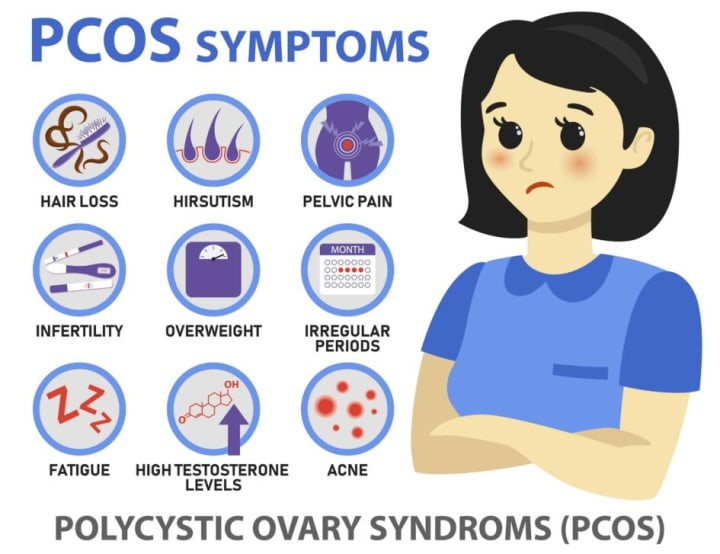
What is PCOS?
PCOS is a problem with hormones that affects women during their childbearing years (ages 15 to 44). Between 2.2 and 26.7 percent of women in this age group have PCOS.
PCOS affects a woman’s ovaries, the reproductive organs that produce estrogen and progesterone — hormones that regulate the menstrual cycle. The ovaries also produce a small amount of male hormones called androgens. The ovaries release eggs to be fertilized by a man’s sperm. The release of an egg each month is called ovulation. Follicle-stimulating hormone (FSH) and luteinizing hormone (LH) control ovulation. FSH stimulates the ovary to produce a follicle — a sac that contains an egg — and then LH triggers the ovary to release a mature egg.
PCOS is a “syndrome,” or group of symptoms that affects the ovaries and ovulation. Its three main features are:
- cysts in the ovaries
- high levels of male hormones
- irregular or skipped periods
In PCOS, many small, fluid-filled sacs grow inside the ovaries. The word “polycystic” means “many cysts.” These sacs are actually follicles, each one containing an immature egg. The eggs never mature enough to trigger ovulation. The lack of ovulation alters levels of estrogen, progesterone, FSH, and LH. Estrogen and progesterone levels are lower than usual, while androgen levels are higher than usual. Extra male hormones disrupt the menstrual cycle, so women with PCOS get fewer periods than usual.
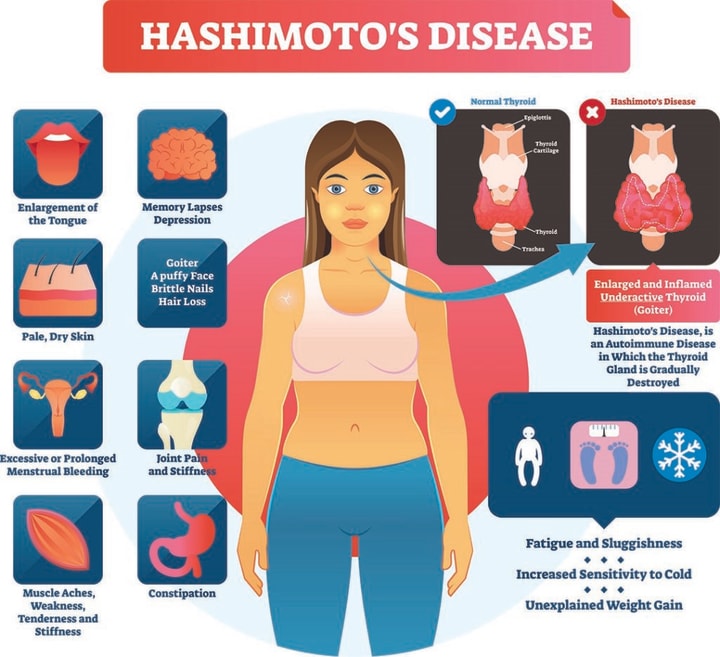
What is Hashimoto's Thyroiditis?
The term “Thyroiditis” refers to “inflammation of the thyroid gland”. There are many possible causes of thyroiditis (see Thyroiditis brochure). Hashimoto’s thyroiditis, also known as chronic lymphocytic thyroiditis, is the most common cause of hypothyroidism in the United States. It is an autoimmune disorder involving chronic inflammation of the thyroid. This condition tends to run in families. Over time, the ability of the thyroid gland to produce thyroid hormones often becomes impaired and leads to a gradual decline in function and eventually an underactive thyroid (Hypothyroidism). Hashimoto’s thyroiditis occurs most commonly in middle aged women, but can be seen at any age, and can also affect men and children.
There are no signs or symptoms that are unique to Hashimoto’s thyroiditis. Because the condition usually progresses very slowly over many years, people with Hashimoto’s thyroiditis may not have any symptoms early on, even when the characteristic thyroid peroxidase (TPO) antibodies are detected in blood tests. TPO is an enzyme that plays a role in the production of thyroid hormones. If Hashimoto’s thyroiditis causes cell damage leading to low thyroid hormone levels, patients will eventually develop symptoms of hypothyroidism (see Hypothyroidism brochure). Hypothyroid symptoms may include fatigue, weight gain, constipation, increased sensitivity to cold, dry skin, depression, muscle aches and reduced exercise tolerance, and irregular or heavy menses. In some cases, the inflammation causes the thyroid to become enlarged (goiter), which rarely may cause neck discomfort or difficulty swallowing.
About the Creator
How China Is Challenging the U.S. to Become the Next Great Space Power
As Beijing’s space ambitions expand, Washington faces an intensifying geopolitical and technological rivalry in orbit and beyond. In the early decades of the 21st century, the United States long stood unchallenged as the dominant space power — a position built on decades of NASA leadership, unmatched launch capability, and a vibrant commercial space economy. But today, a determined China is mounting one of the most consequential strategic challenges in space since the Cold War, pushing to rival — and ultimately surpass — the U.S. in space influence, technology, and strategic advantage. National Strategy and Long‑Term Vision China’s leaders have openly signaled their ambition to become a global space powerhouse. Official space policy documents and state planning envision a broad array of capabilities — from heavy‑lift rockets to lunar exploration — aimed at reshaping the space order that has been U.S.‑dominated for decades. According to analyses of government planning, Beijing intends to establish a full suite of launch vehicles, satellites, and space infrastructure that could surpass current international norms by mid‑century. Underpinning this vision is a belief among Chinese space officials that self‑reliance and indigenous innovation are key to international competitiveness. Recent reports in state media emphasize that China’s aerospace industry is pushing far beyond imitation toward original technological breakthroughs in areas like rocket manufacturing, intelligent space systems, and advanced materials — all with the strategic goal of securing leadership in space. Commercial Space: From Government Giants to Private Innovators China’s rapid ascent isn’t limited to state space agencies. A growing ecosystem of private space companies — much like the commercial boom seen in the U.S. — has taken root, focusing on reusable rockets, satellite networks, and novel space services. A recent South China Morning Post report highlights Beijing’s push to encourage private innovation within its space sector, supporting technologies such as reusable launch vehicles, space debris monitoring, extraterrestrial resource utilization, and even in‑space biomanufacturing — fields long dominated by U.S. firms such as SpaceX or Blue Origin. This commercial expansion broadens China’s capabilities and compresses the technological gap with the U.S., challenging American assumptions that commercial innovation is exclusively an American forte. It also signals a shift in global space economics, where China may soon contend for commercial markets once dominated by Western companies. Military and Strategic Dimensions Alongside civil and commercial ambitions, China’s space strategy has clear military implications. U.S. strategic assessments note Beijing’s efforts to build counterspace capabilities — systems designed to deter, deny, or degrade another nation’s satellite operations — a key advantage in future conflicts. China has already deployed anti‑satellite weapons, jamming technologies, and sophisticated ground‑to‑space radar systems that could threaten U.S. space assets in a crisis. For the United States, which relies heavily on space systems for communication, navigation, and battlefield awareness, these capabilities represent a serious strategic challenge. Beijing’s ability to field space and counterspace technologies could blunt some of Washington’s military advantages in the Asia‑Pacific region and beyond. Lunar and Deep Space Objectives China’s Chang’e lunar exploration program is another marker of its space ambitions. With a series of increasingly complex robotic missions and plans for an International Lunar Research Station by the 2030s, Beijing aims to be a leading voice in lunar science and development — directly challenging the U.S. Artemis program and international partnerships spearheaded by NASA. � Wikipedia Missions like the strategically significant Queqiao‑2 communications relay satellite, which supports lunar missions over long distances, further demonstrate China’s growing sophistication in deep space operations and infrastructure deployment. U.S. Response: Maintaining Leadership Recognizing the challenge, U.S. policymakers are pushing legislative and strategic initiatives designed to preserve American competitiveness in space. A newly passed NASA authorization package includes provisions aimed at reinforcing U.S. lunar presence, strengthening Earth orbit assets, and countering Chinese influence in space science and technology — signaling a bipartisan consensus on the gravity of the space rivalry. A New Era of Cosmic Competition The emerging science and technological competition between China and the United States in space is unlike anything seen since the original Moon race. Today’s contest spans not only national prestige but military advantage, commercial opportunity, and scientific discovery. As each side pursues its vision of space dominance, the outcome will shape global power structures for decades to come — affecting diplomacy, security, and economic leadership both on Earth and beyond. If you’d like alternative versions, transcripts, or a set of headline + subtitle options for this topic, just let me know!
By Fiaz Ahmed 6 days ago in Longevity


Comments
There are no comments for this story
Be the first to respond and start the conversation.